Layered Crater on Mars
July 18, 2007 Layers Exposed in Crater Near Mawrth Vallis

Image Credit: NASA/JPL/Univ. of Arizona

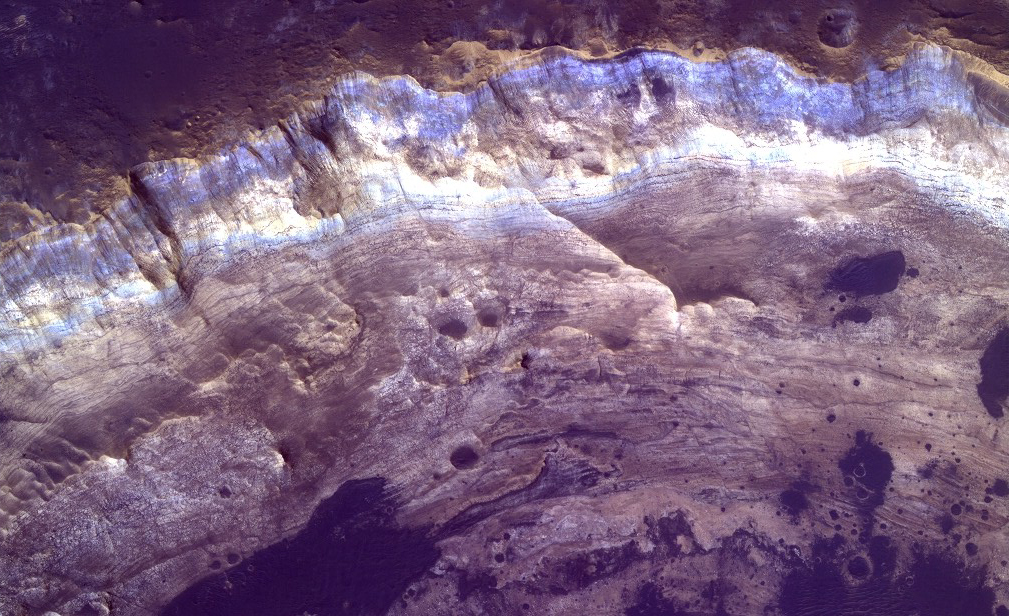
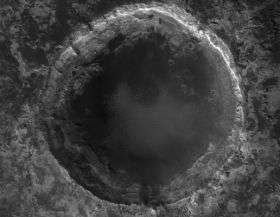
This image covers an impact crater roughly 4 kilometers (2.5 miles) in diameter. The subimage shows just a small segment of the crater rim (1336 x 889; 3 MB).

The surface outside the crater (top) is relatively dark, while the interior wall of the crater has a lighter tone. A few dark patches on the crater wall have small dunes or ripples on their surfaces, and are likely pits filled with dark sand.

The light-toned material making up the crater wall is finely layered and fractured in places. The layers may be part of a sedimentary or volcanic ash deposit that became indurated (cemented and solidified) prior to the impact that formed the crater. The impact has revealed layers that were previously buried beneath the Martian surface, similar to the craters explored by the Opportunity rover in Meridiani Planum. These craters are windows into the Martian subsurface.

Just 30 kilometers (20 miles) to the east of this crater lies Mawrth Vallis, an ancient outflow channel that may have been carved by catastrophic floods. The orbiting spectrometers OMEGA (on Mars Express) and CRISM (on MRO) have detected clay minerals in layered deposits in and around Mawrth Vallis. These minerals, which require water to form, are likely present in the layered bedrock exposed in this crater wall. The crater may thus provide a glimpse into an intriguing period of Martian history, when liquid water may have been more abundant at or near the Martian surface than it is today.

Source: NASA


print this article email this article download pdf blog this article bookmark this article     Stumble it Digg this share on Facebook retweet share on Reddit add to delicious
Rate this story - 4.4 /5 (10 votes)


July 18, 2007 all stories

Comments: 0

4.4 /5 (10 votes)
  • Stumble this up

  • Digg this

  • share this

  • hide
  • Related Stories


  • hide
  • Relevant PhysicsForums posts

  • Question about 2-body gravity
    created 1hour ago
  • life on Mars
    created 3 hours ago
  • Semi-major axis from cartesian co-ordinates
    created 16 hours ago
  • Primary Mirror grinding
    created 18 hours ago
  • More from Physics Forums - General Astronomy

Other News

From Greenhouse to Icehouse

From Greenhouse to Icehouse

Space & Earth / Earth Sciences

created 2 hours ago | popularity 4 / 5 (2) | comments 5

A new study that reconstructed ocean temperatures from millions of years ago could provide new insight into how the Earth responds to climate change.


'Cosmic fruit machine' matches collisions

'Cosmic fruit machine' matches collisions

Space & Earth / Astronomy

created 5 hours ago | popularity 5 / 5 (1) | comments 1

(PhysOrg.com) -- A new website will give everyone the chance to contribute to science by playing a 'cosmic fruit machine' and compare images of colliding galaxies with millions of simulated images of galactic ...


Humanity would need five Earths to create the resources needed if everyone lived as like Americans, a report has stated

Mankind using Earth's resources at alarming rate

Space & Earth / Environment

created 2 hours ago | popularity 3 / 5 (4) | comments 6

Humanity would need five Earths to produce the resources needed if everyone lived as profligately as Americans, according to a report issued Tuesday.


Supervolcano eruption -- in Sumatra -- deforested India 73,000 years ago

Supervolcano eruption -- in Sumatra -- deforested India 73,000 years ago

Space & Earth / Earth Sciences

created 20 hours ago | popularity 4.4 / 5 (12) | comments 2

A new study provides "incontrovertible evidence" that the volcanic super-eruption of Toba on the island of Sumatra about 73,000 years ago deforested much of central India, some 3,000 miles from the epicenter, ...


New computer-developed map shows more extensive valley network on Mars

New computer-developed map shows more extensive valley network on Mars

Space & Earth / Space Exploration

created 18 hours ago | popularity 4.5 / 5 (8) | comments 0

New research adds to the growing body of evidence suggesting the Red Planet once had an ocean.