New tool to measure speeding nuclei is a fast-beam first
An international collaboration at the Michigan State University National Superconducting Cyclotron Laboratory has demonstrated a new technique for studying particles traveling at one-third the speed of light. The result, which will be published in Physical Review Letters, opens up new doors to investigating rare isotopes.
In the study, NSCL users from the Institute for Nuclear Physics of the University of Cologne in Germany and Central Michigan University teamed with Krzysztof Starosta, NSCL assistant professor, and other MSU researchers to make a lifetime measurement of an excited state of germanium-64, Ge-64. Measuring the amount of time it takes for an isotope to decay into lower energy state helps nuclear scientists characterize shape and structure exotic nuclei.
All nuclei are made up of protons and neutrons, and the stable form of Ge-73, relatively abundant on Earth and commonly used as a semiconductor in the computing industry, has 32 protons and 41 neutrons. Ge-64, in contrast, has an equivalent number of protons and neutrons — 32 of each — an exceedingly rare combination for this element. The NSCL Coupled Cyclotron Facility is a world-leader in producing exotic, unstable isotopes.
“The fact that at NSCL sufficient beam time could be allocated for a step-by-step development of the new technique was crucial for the success of this experiment”, says Alfred Dewald, a University of Cologne physicist and a coauthor of the paper. “No other facility is so focused on spectroscopy of exotic nuclei using gamma-ray spectroscopy.”
Physicists are interested in isotopes like Ge-64 with mirror-image sets of protons and neutrons that fall within a specific mass region — heavier than nickel and lighter than tin. It is a nuclear neighborhood marked by strange phenomena, including nuclei that rapidly change from being round to cigar- or pancake-shaped. The broad theoretical outlines of shape-shifting behavior are well understood, yet until now, precise experimental observation has been difficult to achieve.
The method applied by the researchers hinges on the Doppler effect — the same principle that makes an approaching ambulance sound higher pitched than one traveling away, or which causes waves to be more closely spaced together in front of a person walking through water than the waves that trail behind.
Gamma rays, a form of light waves, have a set frequency, a measure of how closely the waves are spaced. When a moving nucleus emits a gamma ray, the ray’s wave will appear compressed in forward directions and stretched out in backward directions. By measuring these Doppler shifts, scientists can calculate the speed of the nucleus when it released the gamma ray.
In the study, scientists directed a beam of Ge-64 into a thin metal foil that slowed the beam down without stopping it. The Ge-64 nuclei began in a high-energy state and dropped to a lower state, a de-excitation that could happen before or after passing through the sheet.
Gamma rays emitted before the nucleus reaches the foil will have different Doppler shifts compared to those emitted from nuclei which downshift their state after passing through the foil. This is because the nuclei have slowed down.
By comparing how many gamma rays came from nuclei before or after passing through the foil, scientists can determine the average distance where the excited states in Ge-64 decayed. Knowing this distance, simple calculations relating speed, distance, and time yielded the average amount of time it took for the Ge-64 to change states, information important to understanding shape, structure and other important properties of the nucleus.
NSCL studies isotopes by fragmenting beams of nuclei traveling at more than 62,000 miles per second. This fast-beam method holds certain advantages over alternative means of producing rare isotopes, allowing physicists to study nuclei at the extreme edge of existence. For example, in fast-beam facilities it’s well-understood how nuclei that first strike a target and then impact downstream detectors slow down and stop, a fact that make exacting measurements possible.
But studying such speeding nuclei is rife with challenges, too, such as filtering and purifying the beam and having the right equipment to detect the few sought-after isotopes from the many billions of billions of other particles in the beam. Until now, such challenges had hindered the success of lifetime measurement experiments at fast-beam facilities.
“To make this experiment happen, you need to bring together all the top elements you have available in the lab and from our users,” said Starosta, the paper’s lead author. “You need everything to be optimized, and it happened for this particular experiment.”
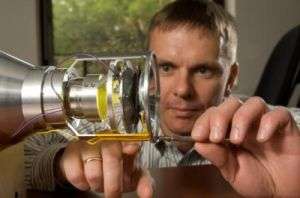
Key to the team’s success was a device designed by Dewald that is capable of making highly precise in-flight distance measurements on the sub-micron scale. A micron is one-millionth of a meter.
“At one-third of the velocity of light it takes about 10-14 seconds to travel a micron,” Dewald said. “This precision is an important factor to reach the final precision of about 10-13 seconds with which one measures the lifetimes of nuclear excitations.”
“It is very important to have a new method available to measure lifetimes of exotic nuclei, as from these lifetimes we learn the most about the quantal structure of atomic nuclei” said Jan Jolie, director Institute for Nuclear Physics of the University of Cologne, “Moreover, the new method allows to determine lifetimes for higher excitations than can be reached by the conventional methods.”
The study’s success is significant for another reason — it is only the second time a precise lifetime measurement has been made in the mysterious portion of the nuclear landscape where unusual proton-neutron ratios may cause strange behavior.
“It’s opening up a whole range of possible studies,” said Roderick Clark, a physicist and co-leader of the nuclear structure group at Lawrence Berkeley National Laboratory, who was not involved in the experiment. “That’s as far as you can go, the frontiers of this research. This is one of the areas that NSCL is leading the world in.”
Source: Michigan State University


