Scientists invent novel hydrogels for repairing, regenerating human tissue
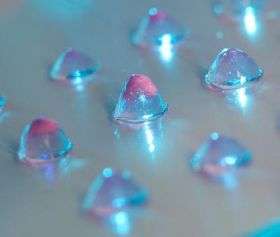
University of Delaware scientists have invented a novel biomaterial with surprising antibacterial properties that can be injected as a low-viscosity gel into a wound where it rigidifies nearly on contact--opening the door to the possibility of delivering a targeted payload of cells and antibiotics to repair the damaged tissue.
Regenerating healthy tissue in a cancer-ridden liver, healing a biopsy site and providing wounded soldiers in battle with pain-killing, infection-fighting medical treatment are among the myriad uses the scientists foresee for the new technology.
The patented invention by Joel Schneider, UD associate professor of chemistry and biochemistry, and Darrin Pochan, associate professor of materials science, and their research groups marks a major step forward in the development of hydrogels for medical applications.
Formulating hydrogels as delivery vehicles for cells extends the uses of these biopolymers far beyond soft-contact lenses into an intriguing realm once viewed as the domain of science fiction, including growing bones and organs to replace those that are diseased or injured.
“This is an area that will be exploding over the next decade,” Pochan said.
Hydrogels are formed from networks of super-absorbent, chain-like polymers. Although they are not soluble in water, they soak up large amounts of it, and their porous structure allows nutrients and cell wastes to pass right through them.
Schneider and Pochan and their research teams have been focusing on developing peptide-based hydrogels that, once implanted in the human body, will become scaffolds for cells to hold onto and grow--cells such as fibroblasts, which form connective tissue, and osteoblasts, which form bone.
“They're like rebar when you're building something with concrete,” Schneider said. “They give the cement something to hang onto.”
The basis of UD's hydrogels is “MAX1,” a self-assembling peptide that the scientists designed six years ago and named after Pochan's son, Max.
Peptides are short chains of amino acids, the building blocks of proteins. Different amino acids are bonded together to form chains, which then fold up into more compact shapes with specific functions.
The peptide that Schneider and Pochan and their research teams designed undergoes triggered “self-assembly,” meaning that the peptide will fold automatically into a specific shape in response to a particular trigger, or environmental stimulus, such as exposure to light. After folding, it self-assembles, affording the hydrogel.
Using “MAX8,” the eighth iteration of their original peptide, Lisa Haines-Butterick, a doctoral student in Schneider's group, figured out how to encapsulate living cells in the hydrogel and then inject the gel into secondary sites without harming the cells.
“Although we have currently only demonstrated this capacity of our gels using simple models, we envision that when injected into the body, the cells encapsulated in the gel can go about their business in restructuring the tissue,” Schneider explained.
UD's peptide-based hydrogels display several novel features. Not only are they cytocompatible, meaning that they are not toxic to the living cells they are enlisted to deliver, but some of the gels are inherently antimicrobial, killing certain gram-negative and gram-positive bacteria, a characteristic the research team currently is exploring.
The UD hydrogels also can be freeze-dried into a powder and reconstituted into a solution for use. They can be injected from a syringe, offering a minimally invasive approach to medical treatment, as well as a targeted, “leak-proof' way of potentially delivering cells and drugs to a wound or diseased organ.
Collaborations with physicians at Christiana Care Health System in Newark, Del., may lead to future developments for the hydrogels. Schneider recently began working with Dr. Joseph Bennett, a surgeon at the Helen F. Graham Cancer Center who resects liver tumors.
Both Schneider and Pochan attribute this new collaboration to the Center for Translational Cancer Research, a collaboration of Christiana Care Health System, A. I. duPont Hospital for Children and UD, including the University's Delaware Biotechnology Institute. The center is under the direction of Mary C. Farach-Carson a professor of both biological sciences and material sciences at UD.
“You know, the liver is an amazing organ,” Schneider said. “It has the ability to regenerate itself quite easily. If almost 70 percent of it is lost to disease and removed, that remaining 30 percent can grow back, affording a functional liver. We want to use the hydrogels to deliver hepatocytes to the liver,” he noted. “These could be used to beef up the liver's function prior to surgery if, for example, someone had hepatitis, or drank a lot, factors that would normally limit the amount of cancerous liver that can be removed.”
While Schneider and Pochan aren't Felix and Oscar in The Odd Couple, they do work in very different scientific disciplines, and they have an easy banter.
Both scientists joined the UD faculty in 1999. They met during new faculty orientation at the president's house, seated at the same table.
“Serendipity can really be your friend,” Pochan said.
Besides learning about each other's research, Pochan and Schneider also found out they lived in the same neighborhood in Philadelphia, although at different times (Schneider during postgraduate research at the University of Pennsylvania, and Pochan during his first years at UD), and even had some of the same mutual friends there.
“What are the odds?” Schneider said.
Both scientists have since gone on to win the National Science Foundation's prestigious Faculty Early Career Development Award in 2004 and the DuPont Young Professor Award (Pochan in 2002 and Schneider in 2005). Schneider also received the Francis Alison Society's Young Scholars Award in 2003, and Pochan is this year's recipient of the American Physical Society's John H. Dillon Medal.
“The thing is, he used to throw these things away,” Pochan said, referring to the hydrogels and pointing his thumb at Schneider.
“For the research I was working on when I was a graduate student a long time ago, the last thing I wanted to make was hydrogels,” Schneider explained, “so when that's what I ended up with, I'd throw them out. Then Darrin said to me, 'You know, these things are really pretty interesting....'
“It's been a very successful collaboration,” Schneider added. “A whole host of terrific students and other people on- and off-campus have helped this come to fruition,” he noted. “Without these students and collaborators, this work would be impossible.”
Source: University of Delaware


