ESA's Earth Explorer gravity satellite on show
July 19, 2007
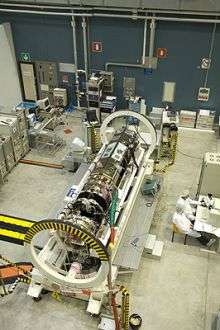
GOCE in preparation at Thales Alenia Space facility in Turin, Italy. ESA's gravity mission is dedicated to measuring the Earth's gravity field and modelling the geoid with unprecedented accuracy and spatial resolution. GOCE will advance our understanding of ocean circulation – which plays a major role in climate regulation, sea-level change and Earth interior processes such as volcanism and earthquakes. Credits: ESA - S. Corvaja
GOCE, ESA’s first satellite dedicated to measuring the Earth’s gravity field, has been presented to the press today in Turin, Italy, before being shipped to ESTEC – the space agency’s research and technology centre in the Netherlands – for final testing.
The Gravity field and steady-state Ocean Circulation Explorer(GOCE), the first core Earth Explorer mission to be developed as part of ESA's Living Planet Programme, will significantly advance our knowledge of how the Earth works and provide insight into ocean circulation, sea-level change, climate change, volcanism and earthquakes.
The spacecraft has been in Italy at Thales Alenia Space, the prime contractor for the development, integration and testing, for roughly nine months where the last subsystems and the payload were integrated on its platform.
Speaking at today’s media event, Carlo Alberto Penazzi, President and Chief Executive Officer of Thales Alenia Space in Italy, said: "We are especially proud to have played a major role in this ESA project, which represents a crucial step forward in increasing our knowledge of the structure of our planet and its well-being."
ESA GOCE Project Manager, Danilo Muzi highlighting the role of industry in this very challenging satellite’s development, said: "Forty-five companies distributed over 13 European countries have been working with ESA on the design of the satellite since 2001. The development of the GOCE satellite represents genuine European industrial cooperation."
"ESA's gravity satellite will measure Earth's gravity from place to place around the globe to provide a uniform global picture. It will do this with a level of detail and accuracy never before achieved," ESA GOCE Project Scientist, Mark Drinkwater, said. "This fundamental reference dataset will give access to new scientific insights into ocean circulation and its impact on climate, as well as into the structure of the interior of the Earth in critical locations such as earthquake and volcanic zones."
Because the gravitational signal is stronger closer to the Earth, GOCE has been designed to fly in a particularly low orbit - at an altitude of just 250 km. However, the remaining atmosphere at low altitudes creates a demanding environment for the satellite and presented a challenge for its design.
Unlike other missions where various independent instruments are carried aboard the spacecraft, GOCE is unique in that the instrumentation actually forms part of the structure of the satellite. A completely stable, rigid and unchanging local environment is required to acquire extremely high fidelity ‘true’ gravity readings, so the spacecraft intentionally has no mechanical moving parts.
The newly developed primary instrument - the gravity gradiometer - measures the terrestrial gravitational field thanks to a set of six ultra-sensitive capacitive sensors. In order to attain the required sensitivity, the gradiometer is combined with a precise GPS-based Satellite-to-Satellite Tracking Instrument to provide accurate three-dimensional positioning of the satellite along its orbit.
Once delivered to ESTEC in Noordwijk, the Netherlands, the spacecraft and gradiometer will undergo the final integration and environmental testing programme to make sure everything is in order to withstand the rigours of launch and the hostile conditions it will experience in space.
In spring 2008, GOCE will be launched on a Rockot launcher from the Plesetsk Cosmodrome in north-western Russia, under the responsibility of the German-Russian launch operator Eurockot.
Source: European Space Agency
-
NASA to launch weather-climate satellite Oct 27
Oct 12, 2011 |
5 / 5 (1) |
3
-
The seasonal potato: Recalculation of the Potsdam geoid shows time-dependent variation of gravity
Jun 30, 2011 |
5 / 5 (2) |
0
-
Earth's gravity revealed in unprecedented detail (w/ video)
Apr 01, 2011 |
4.5 / 5 (13) |
14
-
Satellite measures gravity's effect on climate change
Mar 09, 2011 |
3.3 / 5 (3) |
0
-
ESA's ice mission goes live
Nov 23, 2010 |
5 / 5 (1) |
0
-
Engineers build first sub-10-nm carbon nanotube transistor
Feb 01, 2012 |
4.9 / 5 (33) |
30
-
Something old, something new: Evolution and the structural divergence of duplicate genes
Jan 31, 2012 |
4.6 / 5 (7) |
1
-
The hidden nanoworld of ice crystals: Revealing the dynamic behavior of quasi-liquid layers
Jan 30, 2012 |
5 / 5 (4) |
1
-
Stock market network reveals investor clustering
Jan 27, 2012 |
3.9 / 5 (23) |
8
-
Of microchemistry and molecules: Electronic microfluidic device synthesizes biocompatible probes
Jan 26, 2012 |
5 / 5 (2) |
0
-
Never ending outer space.....
19 hours ago
-
Neutron Star fragments?
21 hours ago
-
stationary or not?
Feb 11, 2012
-
Scale of the Universe
Feb 10, 2012
-
Titan's lack of impact craters
Feb 09, 2012
-
Real pictures of black hole eating a star?
Feb 08, 2012
- More from Physics Forums - General Astronomy
More news stories
Salvage workers begin pumping fuel from Italian shipwreck
Salvage workers Sunday began pumping fuel from the shipwrecked Italian cruise liner Costa Concordia, a day ahead of schedule, officials said.
5 hours ago |
not rated yet |
0
Latin America mining boom clashes with conservation
Latin America is experiencing a mining boom as prices rise fuelled by a hike in global demand, but the region is also being hit by a wave of violent protests, strikes and rallies by environmentalists.
13 hours ago |
5 / 5 (1) |
1
Political leaders play key role in how worried Americans are by climate change: study
More than extreme weather events and the work of scientists, it is national political leaders who influence how much Americans worry about the threat of climate change, new research finds.
Feb 06, 2012 |
5 / 5 (6) |
73
NASA budget will axe Mars deal with Europe: scientists
US President Barack Obama's budget proposal to be submitted next week for 2013 will cut NASA's budget by 20 percent and eliminate a major partnership with Europe on Mars exploration, scientists said Thursday.
Space & Earth / Space Exploration
Feb 10, 2012 |
5 / 5 (3) |
58
Humans may have helped the decline of African rainforests 3000 years ago
(PhysOrg.com) -- Large areas of rainforests in Central Africa mysteriously disappeared over three thousand years ago, to be replaced by savannas. The prevailing theory has been that the cause was a change ...
Scientists discover molecular secrets of 2,000-year-old Chinese herbal remedy
For roughly two thousand years, Chinese herbalists have treated Malaria using a root extract, commonly known as Chang Shan, from a type of hydrangea that grows in Tibet and Nepal. More recent studies suggest that halofuginone, ...
Overeating may double risk of memory loss
New research suggests that consuming between 2,100 and 6,000 calories per day may double the risk of memory loss, or mild cognitive impairment (MCI), among people age 70 and older. The study was released today and will be ...
New method to examine batteries -- MRI from the inside
There is an ever-increasing need for advanced batteries for portable electronics, such as phones, cameras, and music players, but also to power electric vehicles and to facilitate the distribution and storage of energy derived ...
A mitosis mystery solved: How chromosomes align perfectly in a dividing cell
Although the process of mitotic cell division has been studied intensely for more than 50 years, Whitehead Institute researchers have only now solved the mystery of how cells correctly align their chromosomes during symmetric ...
Lab study raises questions over nano-particle impact
Tests involving chickens have raised questions about the impact on health from engineered nano-particles, the ultra-fine grains commonly used in drugs and processed foods, scientists said on Sunday.
Starve a virus, feed a cure? Findings show how some cells protect themselves against HIV
A protein that protects some of our immune cells from the most common and virulent form of HIV works by starving the virus of the molecular building blocks that it needs to replicate, according to research published online ...