'Blue Needle' Presents New Challenge for Theorists
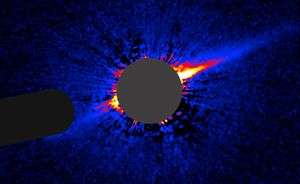
Astronomers using the W. M. Keck Observatory and NASA’s Hubble Space Telescope to study disks of debris around stars have found one that is extremely lopsided.
While scientists are accustomed to finding asymmetrical accumulations of dust and larger bodies around stars, the debris disk around a star known as HD 15115 has a needle-like shape.
Astronomers believe the shape of debris disks can be affected by extrasolar planets or nearby stars on very elliptical orbits. Researchers are studying whether the gravity of a star known as HIP 12545, located about 10 light years from HD 15115, is the reason for the needle formation which appears blue when viewed in optical light with Hubble and near-infrared light with Keck.
While protoplanetary disks around young stars are thought to be the basis for the birth of planets, debris disks such as the one around HD 15115 are believed to be made up of the remnants of planet production. They are also similar to the Kuiper Belt, the region of our solar system extending from and beyond the orbit of Neptune that contains numerous objects made up of rock and ice. About 800 of those objects have been identified in recent years including a number of dwarf planets which the International Astronomical Union last year ruled also includes Pluto.
Astronomers believe debris disks, which are replenished by dust from collisions among its member objects, also can be affected by planets nearer to the star, much as Neptune ’s gravity can have an effect on Kuiper Belt objects. Paul Kalas, lead author of a study on HD 15115, cited one theory about planet-disk interaction closer to home as an example of how the needle formed. Some astronomers have developed a theory that Neptune originally formed between Saturn and Uranus, but was eventually kicked out to its present location beyond Uranus by a gravitational dance between Saturn and Jupiter before their orbits stabilized. “Therefore, we speculate that if such a planetary upheaval were occurring around HD 15115 at the present time, it could explain the highly asymmetric disk,” Kalas said.
The disk around HD 15115, which is the result of its highly elliptical orbit, is believed to begin at about the same distance from its star as the Kuiper Belt does from our Sun, but extends outward by at least ten times farther. The outer extend of the Blue Needle is detected to at least 550 AU making it the second-most extended debris disk seen to date.
Dusty disks are known to exist around at least 100 stars, but because of the difficulty in observing material close to the brightness of a star, less than a dozen have been studied closely. But the installation of the Advanced Camera for Surveys aboard the Hubble –before it malfunctioned early this year – led to increased discoveries of debris disks over the past three years. Kalas said while the Hubble has been used to survey debris disks in optical light, Keck has been invaluable for more detailed analysis in infrared wavelengths and to image the regions close to the star, where planet formation may have occurred.
From the evidence so far, Kalas considers both HD 15115 and HIP 12545 to be among nearly 30 stars that belong to the Beta Pictoris Moving Group. Moving groups are expanded clusters of stars believed to have a common birthplace and age, in this case about 12 million years, which are moving together loosely through space. HD 15115 has many similarities to another star know as AU Microscopii, a closely studied member of the Beta Pictoris Moving Group Located 32 light years form earth.
However, the debris disk around HD 15115 is not only far more asymmetrical than those observed around three other stars in the group, it also has significantly less dust than two of them of similar mass. Kalas said that the missing material might be related to the process that created the needle formation. “The missing mass is quite interesting,” he said. “Perhaps the mechanism which perturbed the disk into its current asymmetric morphology also shaved away a significant fraction of the mass.”
The dusty disk around HD 15115 was first indirectly detected in 2000 and first imaged using the Hubble Space Telescope in July 2006. The disk’s needle-like shape was extremely unusual, prompting the astronomers to request observations at W.M. Keck Observatory to confirm the disk’s existence and to image it closer to the star than was possible with Hubble. When the Keck near-infrared images were compared to the Hubble optical images, the disk was found to have an extremely blue color, which is also relatively rare among such disks. It was investigated further using Keck adaptive optics last year.
It is not yet known whether HIP 12545, the suspected gravitational perturber, has its own dusty disk. Kalas hopes to take advantage of Keck’s adaptive optics – which removes the distortions caused by the Earth’s atmosphere – to investigate that further this fall.
HD 15115 is classified as an “F” star, slightly larger than the Sun. HIP 12545 is an M star which has roughly half as much mass as the Sun.
As the discovery of Beta Pictoris a decade ago resulted in more than 300 scientific papers, Kalas believes that the research of HD 15115 will prompt a wealth of follow-up observations. Questions remaining to be answered include whether the needle formation is a temporary phenomenon. “The blue needle presents a host of new challenges for theorists,” Kalas said.
Funding for the project was provided by NASA. The research on HD 15115, has been accepted for publication in Astrophysical Journal Letters. The study was co-authored by James Graham, like Kalas an astronomer at the University of California at Berkeley and the Center for Adaptive Optics at the University of California at Santa Cruz , with graduate student Michael P. Fitzgerald.
Source: W. M. Keck Observatory


