Ice Age survivors in Iceland
July 19, 2007
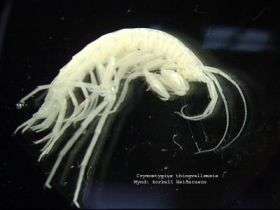
Crymostygius thingvallensis, the only species in a recently described family of groundwater amphipods Crymostygidae. Photograph by Thorkell Heidarsson
Many scientists believe that the ice ages exterminated all life on land and in freshwater in large parts of the Northern Hemisphere, especially on ocean islands such as Iceland.
Scientists at Holar University College and the University of Iceland have challenged that belief, at least when looking at groundwater animals. They have discovered two species of groundwater amphipods in Iceland that are the only animals species found solely in Iceland.
“These finding can only be explained by these animals surviving glaciations in some kind of refugium under the glaciers,” says Bjarni K. Kristjánsson, the scientist who found the species.
In an article in the August issue of The American Naturalist, they put forward strong support for their theory. “Groundwater amphipods are poor at dispersal, and can not be transported with birds or humans,” says Jörundur Svavarsson. One of these new species falls within a new family of amphipods, which indicates that the species has been a long time in Iceland.
“The time since the end of the last glaciation is not enough for a family to evolve,” says Svavarsson. Kristjansson and Svavarsson find it likely that the amphipod came to Iceland as early as 30-40 million years ago, when the volcanic island was being formed.
“If our theory is right, we have discovered the oldest inhabitants of Iceland, and that can help us further understand how Iceland was formed,” says Kristjansson.
Citation: Bjarni K. Kristjánsson and Jörundur Svavarsson, "Subglacial refugia in Iceland enabled groundwater amphipods to survive glaciations" The American Naturalist (2007) volume 170:292–296 DOI: 10.1086/518951
Source: University of Chicago
-
Fast photon control brings quantum photonic technologies closer
1 hour ago |
5 / 5 (2) |
0
-
Engineers build first sub-10-nm carbon nanotube transistor
Feb 01, 2012 |
4.9 / 5 (33) |
30
-
Something old, something new: Evolution and the structural divergence of duplicate genes
Jan 31, 2012 |
4.6 / 5 (7) |
1
-
The hidden nanoworld of ice crystals: Revealing the dynamic behavior of quasi-liquid layers
Jan 30, 2012 |
5 / 5 (5) |
1
-
Stock market network reveals investor clustering
Jan 27, 2012 |
3.9 / 5 (23) |
8
More news stories
Big Society could threaten biodiversity conservation
A study of the Moray Firth Seal Management Plan (MFSMP), in north-east Scotland, identified four key conditions for long-term success, three of which pointed to the importance of direct government involvement.
1 hour ago |
not rated yet |
0
New molecule has potential to help treat genetic diseases and HIV
(PhysOrg.com) -- Chemists at The University of Texas at Austin have created a molecule that's so good at tangling itself inside the double helix of a DNA sequence that it can stay there for up to 16 days before ...
3 hours ago |
5 / 5 (2) |
0
|
Biobased approaches examined in fight against zebra chip
Thanks to investigations by scientists-turned-detectives with the U.S. Department of Agriculture (USDA) and other agencies, potato growers in the western United States and abroad now know the identities of ...
1 hour ago |
not rated yet |
0
Integrated pest management recommendations for the southern pine beetle
The southern pine beetle, Dendroctonus frontalis Zimmermann, is a chronic insect pest within pine forests in the southeastern United States. Under favorable environmental and host conditions, it is an agg ...
6 hours ago |
not rated yet |
0
A mitosis mystery solved: How chromosomes align perfectly in a dividing cell
Although the process of mitotic cell division has been studied intensely for more than 50 years, Whitehead Institute researchers have only now solved the mystery of how cells correctly align their chromosomes during symmetric ...
21 hours ago |
4.5 / 5 (24) |
0
|
Fast photon control brings quantum photonic technologies closer
(PhysOrg.com) -- Using photons instead of electrons to transmit information could lead to faster and more secure ways to communicate, among other advantages. Now a team of physicists has taken another step toward realizing ...
Planck mission steps closer to the cosmic blueprint
(PhysOrg.com) -- ESA's Planck mission has revealed that our Galaxy contains previously undiscovered islands of cold gas and a mysterious haze of microwaves. These results give scientists new treasure to mine ...
New ability to regrow blood vessels holds promise for treatment of heart disease
(Medical Xpress) -- University of Texas at Austin researchers have demonstrated a new and more effective method for regrowing blood vessels in the heart and limbs a research advancement that could have ...
Slowing ocean current caused Earth to spin faster
(PhysOrg.com) -- Most people probably didn’t notice it, but back in 2009, the Earth spun around on its axis a tiny bit faster than usual, making for some slightly shorter days. It only happened for a ...
Myths and shame keep many from seeking bankruptcy protection
(PhysOrg.com) -- Two interesting facts that may counter modern ideas about bankruptcy: The overwhelming majority of U.S. filings belong to individuals rather than corporations or entities, and most of these ...
Motivation to exercise affects behavior
(Medical Xpress) -- For many people, the motivation to exercise fluctuates from week to week, and these fluctuations predict whether they will be physically active, according to researchers at Penn State. In an effort to ...