Excavated Teeth Study: Europeans may have imported slaves in the 1500s
In the early European histories of the New World, there are numerous accounts of African slaves accompanying explorers and colonists. Now, digging in a colonial era graveyard in one of the oldest European cities in Mexico, archaeologists have found what they believe are the oldest remains of slaves brought from Africa to the New World. The remains date between the late-16th century and the mid-17th century, not long after Columbus first set foot in the Americas.
The discovery is to be reported in an upcoming edition of the American Journal of Physical Anthropology by a team of researchers from UW-Madison and the Autonomous University of the Yucatan.
The African origin of the slaves was determined through the reading of telltale signatures locked at birth into the tooth enamel of individuals by strontium isotopes, a chemical which enters the body through the food chain as nutrients pass from bedrock through soil and water to plants and animals. The isotopes found in the teeth are an indelible signature of birthplace, as they can be directly linked to the bedrock of specific locales, giving archaeologists a powerful tool to trace the migration of individuals on the landscape.
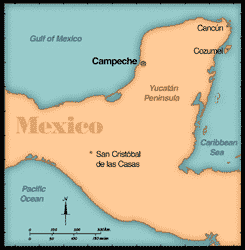
The new study, which was supported by the National Science Foundation, draws on isotope ratios found in the teeth of four individuals from among 180 burials found in a multiethnic burial ground associated with the ruins of a colonial church in Campeche, Mexico, a port city on the Yucatan Peninsula.
The new isotopic studies are important, according to the new report's authors, James Burton and T. Douglas Price of UW-Madison and Vera Tiesler of the Autonomous University of the Yucatan, because they provide the earliest definitive physical link between the African Diaspora and the New World. Over a span of nearly 400 years, as many as 12 million people were placed in bondage and brought across the Atlantic under horrific conditions to work, primarily, in the mines and plantations of the New World.
"This is the earliest documentation of the African Diaspora in the New World," says Price, a UW-Madison professor of anthropology. "It does mean that slaves were brought here almost as soon as Europeans arrived."
In early colonial Mexico, Campeche was an important Spanish gateway to the New World. It served as a base for exploration and conquest and was a key defensive outpost in a region infested with pirates. Presumably, slaves from the infamous West African port of Elmina were shipped to Campeche where they may have been used as domestic servants.
The discovery of the remains of slaves born in Africa from such an early date shows that slavery became an integral aspect of the New World economy not long after the Conquistadors completed the subjugation of Mexico, says Price.
Archaeological and historical evidence, including a map of colonial Campeche, suggest the graveyard was in use from about 1550 to the late 1600s. It was uncovered, along with the foundations of a colonial era church, in 2000 by construction workers digging around Campeche's central park. The site was excavated under the direction of Tiesler.
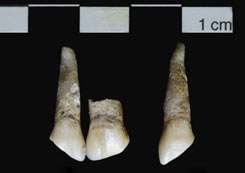
The archaeologists were drawn to some of the individuals buried in the colonial cemetery because of distinctive dental mutilations, a decorative practice characteristic of Africa.
Burton and Price, in collaboration with Tiesler, are conducting a much broader study of human mobility in ancient Mesoamerica using isotopic analysis. They conducted a blind study of the isotopic content of teeth from 10 individuals from the Campeche churchyard. Four of the samples, says Burton, "were like something we'd never seen."
The ratios, he explains, were well off the charts for anyone born in Mesoamerica. Instead, they reflected the geology of West Africa, which is underlain by a massive shield of ancient rock, much older than the geology of Mexico and Central America.
The chemical analysis, combined with the distinctive dental mutilation, provides strong evidence that "these folks were born in Africa and brought to the New World," says Price. " The thing that impresses me is that it was happening so early. "
African slaves were brought to the New World as the Spanish needed labor to harvest timber and work in the mines that enriched Spain. Early in their rule, the Spanish enslaved Indians to perform heavy labor, but they turned to the African slave trade as diseases introduced by Europeans decimated native peoples.
Source: University of Wisconsin


