Genetic diversity in honeybee colonies boosts productivity
July 20, 2007 Genetic diversity in honeybee colonies boosts productivity

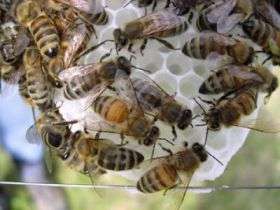
Worker honeybees construct a new comb, an important part of colony founding. Colonies of promiscuous queens tend to be far more successful in such chores and in surviving their first winter than colonies produced by monogamous queens, report Cornell researchers Tom Seeley and Heather Mattila in Science magazine. Credit: Heather R. Mattila/Cornell University

Why do queen honeybees mate with dozens of males? Does their extreme promiscuity, perhaps, serve a purpose?

An answer to this age-old mystery is proposed in the July 20 issue of Science magazine by Cornell scientists: Promiscuous queens, they suggest, produce genetically diverse colonies that are far more productive and hardy than genetically uniform colonies produced by monogamous queens.

"An intriguing trait of honeybee species worldwide is that each honeybee queen mates with an extraordinarily high number of males," said Heather R. Mattila, a Cornell postdoctoral fellow in neurobiology and behavior and co-author of the article with Thomas D. Seeley, Cornell professor of neurobiology and behavior.

In every honeybee species, say the researchers, queens mate with multiple males. The European honeybee -- the common species in North America -- mates with from six to 20 mates on average, for example, while the giant honeybee in Asia has a reported record of 102 mates.

To study the reasons for honeybees' promiscuity, the Cornell biologists inseminated 12 queens with sperm from 15 drones (a different set for each) and nine additional queens with sperm from a single drone (but a different one in each case). They then prompted the hives to swarm in early June to form new colonies.

"After only two weeks of building new nests, the genetically diverse colonies constructed 30 percent more comb, stored 39 percent more food and maintained foraging levels that were 27 to 78 percent higher than genetically uniform colonies," said Mattila.

By the end of the summer, the genetically diverse colonies had five times more bees, eight times more reproductive males and heavier average body weights, mostly because of larger amounts of stored food.

By winter's end, 25 percent of the genetically diverse colonies survived to their one-year anniversary (only about 20 percent of new honeybee colonies make it that long in upstate New York). But all of the genetically uniform hives starved to death.

"These differences are noteworthy considering colonies had similarly sized worker populations when they were first formed," said Mattila. "Undoubtedly, our results reveal enormous benefits of genetic diversity for the productivity of honeybee colonies."

For example, the researchers found that bees in the genetically diverse colonies used sophisticated mechanisms for communication, including waggle dancing, more often than bees in genetically uniform colonies to discover food sources and direct nest mates to food. Because there was more information available among nest mates about food discoveries, the diverse colonies gained far more weight than did genetically uniform colonies.

Source: Cornell University


print this article email this article download pdf blog this article bookmark this article     Stumble it Digg this share on Facebook retweet share on Reddit add to delicious
Rate this story - 4.5 /5 (13 votes)


July 20, 2007 all stories

Comments: 0

4.5 /5 (13 votes)
  • Stumble this up

  • Digg this

  • share this

  • hide
  • Related Stories

  • Sex life may hold key to honeybee survival
    created Sep 14, 2009 | popularity not rated yet | comments 0
  • Colonies in collapse: What's causing massive honeybee die-offs?
    created Nov 12, 2008 | popularity not rated yet | comments 0
  • The social life of honeybees coordinated by a single gene
    created Mar 06, 2007 | popularity not rated yet | comments 0
  • Queen bee promiscuity boosts hive health
    created Dec 11, 2006 | popularity not rated yet | comments 0
  • Termite creates sustainable monoculture fungus-farming
    created Nov 20, 2009 | popularity not rated yet | comments 0


Other News

First-ever blueprint of a minimal cell is more complex than expected

First-ever blueprint of a minimal cell is more complex than expected

Biology / Cell & Microbiology

created 6 hours ago | popularity 5 / 5 (9) | comments 0

What are the bare essentials of life, the indispensable ingredients required to produce a cell that can survive on its own? Can we describe the molecular anatomy of a cell, and understand how an entire organism ...


Ecological speciation by sexual selection on good genes: Is speciation adaptive?

Biology / Ecology

created 6 hours ago | popularity not rated yet | comments 0

Darwin suggested that the action of natural selection can produce new species, but 150 years after the publication of his famous book, 'On the Origin of Species', debate still continues on the mechanisms of speciation. New ...


The six elephants in Sierra Leone were shot and "crudely butchered"

S.Leone elephants 'wiped out' by poachers: official

Biology / Ecology

created 8 hours ago | popularity 5 / 5 (4) | comments 4

Poachers "wiped out" the entire elephant herd in Sierra Leone's only wildlife park, wildlife managers said Thursday after police said they had arrested a gang of 10 poachers.


Knockouts in human cells point to pathogenic targets

Knockouts in human cells point to pathogenic targets

Biology / Cell & Microbiology

created 10 hours ago | popularity not rated yet | comments 0

(PhysOrg.com) -- Whitehead researchers have developed a new approach for genetics in human cells and used this technique to identify specific genes and proteins required for pathogens.


Whiteflies sabotage alarm system of plant in distress

Whiteflies sabotage alarm system of plant in distress

Biology / Plants & Animals

created 11 hours ago | popularity 5 / 5 (1) | comments 0

(PhysOrg.com) -- When spider mites attack a bean plant, the plant responds by producing odours which attract predatory mites. These predatory mites then exterminate the spider mite population, thus acting ...