NASA Robots Practice Moon Survey in the Arctic Circle
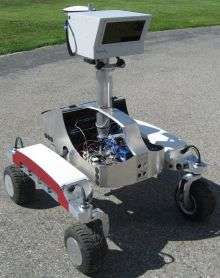
Two NASA robots are surveying a rocky, isolated polar desert within a crater in the Arctic Circle. The study will help scientists learn how robots could evaluate potential outposts on the moon or Mars.
The robots, K10 Black and K10 Red, carry 3-D laser scanners and ground-penetrating radar. The team arrived at Haughton Crater at Devon Island, Canada, on July 12 and will operate the machines until July 31. Scientists chose the polar region because of the extreme environmental conditions, lack of infrastructure and resources, and geologic features. Additionally, Haughton Crater is geographically similar to Shackleton Crater at the South Pole of the moon. Both are impact craters that measure roughly 12.4 miles in diameter.
"We are learning about the awesome potential of human and robot teams," said S. Pete Worden, director of NASA's Ames Research Center in Moffett Field, Calif., where the group conducting the survey is based. "Studying how humans and robots can maximize scientific returns in sites such as Devon Island will prepare us to walk on the moon and Mars."
NASA is planning to send astronauts back to the moon by 2020. Prior to establishing a lunar outpost, the agency must conduct detailed surveys at a variety of locations to produce maps, look for minerals and water, and learn other details. NASA plans to accomplish its surveys with an automated orbiting spacecraft, not a robotic lander, but the agency still has a keen interest in advancing the laser scanning technology.
Most of the lunar sites are on harsh terrain and in permanently shadowed areas. It is not unusual for site surveys to require thousands of measurements and hundreds of hours to complete. A robot can reduce mission cost and improve mission effectiveness by allowing ground control to conduct surveying tasks.
"A typical scenario involves multiple rovers autonomously surveying a region while humans supervise and assess data from a remote location," said Terry Fong, director of the Intelligent Robots Group at Ames.
The robots are using different techniques than the goal-directed traverses and isolated sampling tasks that Mars scientific rovers have used to explore the Red Planet. K10 Black and K10 Red are using a mix of information previously obtained by aerial and satellite imaging and data that the robot survey team is gathering.
The 3-D laser scanner can map topographic features as far as 3,280 feet away. The ground-penetrating radar, which NASA's Jet Propulsion Laboratory in Pasadena, Calif., developed, can map below ground as deep as 16.4 feet.
"The robots are covering the area in lawnmower-like paths at human walking speeds to systematically map above and below ground," said Fong.
The practice survey in Haughton Crater is taking place at an area called Drill Hill. The robots are covering approximately 120 acres of terrain. Researchers are commanding the robots remotely from the Haughton-Mars base camp more than two miles away from Drill Hill.
The robots navigate using the Global Positioning System, stereo cameras, laser scanners and sun trackers. Each of the four-wheel-drive machines weighs 165 pounds and can carry a payload up to 110 pounds.
A key objective of the Drill Hill survey is to test the instruments and software on the robots as well as the equipment and software that humans will use at lunar outposts and ground control to supervise the robots. Engineers at NASA's Johnson Space Center in Houston will assess advanced robot driving techniques using a multi-screen cockpit. Ames will test software that makes high-resolution maps for interactive display in 3-D.
Source: NASA


