Keeping GLAST on Track
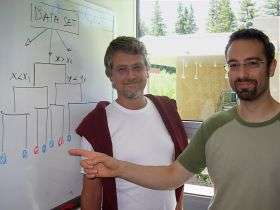
Thanks to the work of a team of physicists at SLAC, a technique used for years in physics experiments such as BaBar will soon help researchers monitor the performance of the Gamma Ray Large Area Space Telescope (GLAST) in space.
"As far as I know, we're the first to try using this technique for monitoring," said David Paneque, a physicist with GLAST.
Known as the "random forest" method, this monitoring technique is one of many that will be used to keep an eye on the performance of the Large Area Telescope (LAT) instrument, on board the GLAST satellite. Although major malfunctions causing large chunks of data to be lost should be easy to spot, more minor malfunctions causing inaccurate readings could be much harder to detect, showing up only after the numbers have been crunched. The random forest method will be used to compare the incoming data stream to a known set of data, providing contrast when new data starts falling outside of an expected range.
"This is one of many tools to monitor GLAST," said Anders Borgland, a SLAC employee with the GLAST Instrument Science Operations Center. "Our goal is to spot any problem within an hour."
The technique has already proven successful with data obtained while the instrument is still on the ground, but ground readings differ significantly from those taken in space due to the constantly changing environment. The next step will be to establish a new template once GLAST is in orbit. Establishing these new numbers—and a reliable procedure to apply the technique—will be a tremendous challenge, but the GLAST team is confident in its ability to do so.
"We're going to be surprised when GLAST is launched and we see how things are in space," said Paneque. "We will need to be flexible and react quickly."
Source: by Ken Kingery, SLAC Today


