New Honda Accord drives itself
February 1, 2006
Honda Accord

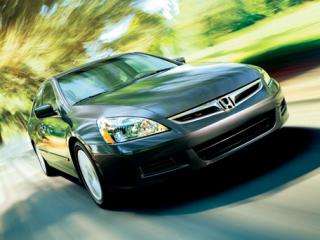
Japanese car manufacturer Honda has launched a new self-driven car. Dubbed Honda Accord ADAS, the vehicle can change gear and steer itself around bends. While the auto-pilot function will currently only operate on motorways and dual carriageways, officials at Honda believe that future ADAS models will tackle all roads.

Graham Avent, a spokeman for Honda, points out that ADAS is not a substitute for alert human drivers but does allow people to take a rest behind the steering wheel during long journeys. ADAS drivers cannot leave their seats, but need only touch the steering wheel every ten seconds to indicate that they are still alert.

ADAS may also help prevent road accidents as the system can help to correct the effect of some driver errors.

The car’s auto-pilot capability is based on two main components: Adaptive Cruise Control (ACC) and Lane Keep Assist System (LKAS). ACC is a radar sensor placed behind the Honda badge at the front of the car. It scans ahead to look out for other vehicles, responding to the result by reducing or increasing the car’s speed accordingly. LKAS, a camera placed next to the rear-view mirror, monitors the white lines along motorways and dual carriageways, using the received data to control the car’s steering.

Honda UK says the car will cost UKP 25,880 (US$46,500) and will be in showrooms in March. All Honda cars will be equipped with ADAS by 2016.

Although ADAS can facilitate an easier drive, Honda insists that the driver’s role remains paramount. Even when activated, the auto-pilot function will be overridden by the driver’s input, leaving the driver in full control of the car.

Copyright 2006 PhysOrg.com

3.7 /5 (56 votes)  

Rank 3.7 /5 (56 votes)
Tags

Related Stories
Relevant PhysicsForums posts

More news stories

Review: Soulo converts iPad into karaoke machine

Karaoke lovers typically fall into two categories: Those who enjoy it, and those whose arms have to be twisted to get up and sing in public.

Electronics / Consumer & Gadgets

created 16 hours ago | popularity not rated yet | comments 0

Google rumored to have built Heads-Up-Display glasses prototype

(PhysOrg.com) -- 9to5Google is reporting that they have received a tip from someone they believe to be a reliable source saying that Google is working on a Heads-Up-Display (HUD) pair of eye-glasses. The per ...

Electronics / Consumer & Gadgets

created Feb 08, 2012 | popularity 4.3 / 5 (8) | comments 2 | with audio podcast weblog

Intel packs performance and reliability into its latest SSD 520 series

Intel Corporation announced today its fastest, most robust client/consumer solid-state drive (SSD) to date, the Intel Solid-State Drive 520 Series (Intel SSD 520), a 6 gigabit-per-second (gbps) SATA III SSD ...

Electronics / Hardware

created Feb 07, 2012 | popularity 5 / 5 (1) | comments 3

Airborne robot swarms are making complex moves (w/ video)

(PhysOrg.com) -- The GRASP Lab at the University of Pennsylvania this week released a video that shows their new look in GRASP Lab robotic flying devices. They are now showing flying devices with more complex ...

Electronics / Robotics

created Feb 02, 2012 | popularity 4.9 / 5 (30) | comments 10 | with audio podcast report

Hitachi ships the industry's first 25-nanometer SLC NAND flash enterprise-class SSDs

Demonstrating its commitment to delivering leading-edge technologies and solutions for enterprise-class servers and storage systems, Hitachi Global Storage Technologies (Hitachi GST) today announced that its ...

Electronics / Hardware

created Feb 08, 2012 | popularity not rated yet | comments 0


New Zealand team finds early plant arrivers dominated landscape

(PhysOrg.com) -- It seems intuitive that not all plant species could have taken a foothold on land at the same time all those millions of years ago as conditions on Earth evolved to the point where they could survive; some ...

Black holes and star formation

(PhysOrg.com) -- It has long been recognized that galaxy mergers or even close interactions can play a vital role in shaping the morphology of galaxies. One way they can do so, it is thought, is by triggering ...

Deciding to go left or right: Researchers use device to determine that lower animals can navigate too

For decades, scientists have associated binary decision making — opting to go left or right — with higher-ranking animals, including humans. A team of Harvard researchers, however, is rewriting that ...

Chemists harvest light to create 'green' tool for pharmaceuticals

(PhysOrg.com) -- A team of University of Arkansas researchers, including an Honors College undergraduate student, has created a new, "green" method for developing medicines. The researchers used energy from ...

Tidal forces could squeeze out planetary water

Alien planets might experience tidal forces powerful enough to remove all their water, leaving behind hot, dry worlds like Venus, researchers said.

Researchers develop gene therapy to boost brain repair for demyelinating diseases

(Medical Xpress) -- Our bodies are full of tiny superheroes—antibodies that fight foreign invaders, cells that regenerate, and structures that ensure our systems run smoothly. One such structure is myelin—a ...