Tightly packed molecules lend unexpected strength to nanothin sheet of material
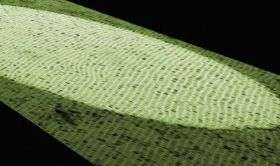
Scientists at the University of Chicago and Argonne National Laboratory have discovered the surprising strength of a sheet of nanoparticles that measures just 50 atoms in thickness.
“It’s an amazing little marvel,” said Heinrich Jaeger, Professor in Physics at the University of Chicago. “This is not a very fragile layer, but rather a robust, resilient membrane.”
Even when suspended over a tiny hole and poked with an ultrafine tip, the membrane boasts the equivalent strength of an ultrathin sheet of plexiglass that maintains its structural integrity at relatively high temperatures.
“When we first realized that they can be suspended freely in air, it truly surprised all of us,” said Xiao-Min Lin, a physicist at Argonne’s Center for Nanoscale Materials.
The characteristics of the nanoparticles are described in the July 22 issue of the journal Nature Materials in a paper written by Jaeger and Lin, along with Klara Mueggenburg, a graduate student in physics at the University of Chicago, and Rodney Goldsmith, an undergraduate student at Xavier University in New Orleans who participated as part of the National Science Foundation’s Research Experience for Undergraduates program. The work was funded by the NSF-supported Materials Science and Engineering Center at the University of Chicago. Additional support came from the U.S. Department of Energy.
The material’s characteristics make it a promising candidate for use as a highly sensitive pressure sensor in precision technological applications. “If we use different types of nanoparticles to make the same kind of suspended membrane, we can even imagine using these devices as chemical filters to promote catalytic reactions on a very small length scale,” Lin said.
As artificial atoms, the nanoparticles might also serve as building blocks in assembling specially designed nano-objects. “This is the ultimate limit of such a solid. It’s just one layer,” Jaeger said. “What is interesting is that already one layer is so resilient and has these interesting properties.”
But the payoff is scientific as well as technological. Scientists had already discovered that the electronic properties of semiconductor material can change dramatically when its tiniest metallic components are tightly packed between organic molecules, a phenomenon called nano-confinement. “But now we find that mechanical properties can also change dramatically. On a basic science level, that’s why this is exciting,” Jaeger said.
The experimental material consisted of gold particles separated by organic “bumpers” to keep them from coming into direct contact. The research team suspended this array of nanoparticles in a solution, then spread the solution across a small chip of silicon, a popular semiconductor material. When the solution dried, it left behind a blanket of nanoparticles that drape themselves over holes in the chip, each hole measuring hundreds of nanoparticles in diameter. Then the researchers probed the strength of the freely suspended nanoparticle layer by poking it with the tip of an atomic force microscope.
Plexiglass draws its strength from the nature of its polymers, long chains of molecules that become entangled with one another. But the short-chain polymers the research group used to link the nanoparticles were scarcely long enough to qualify as polymers at all.
“They probably do not have the chance to entangle like a ‘card-carrying’ polymer would do,” Jaeger said. “The molecules are anchored to the gold particles, but only on one end. The strength comes from compressing them between the gold particles.”
The research team also found that the material held together when heated until reaching temperatures of 210 degrees and beyond.
While the Chicago-Argonne experiments focused on two-dimensional sheets, they generally agree with computer simulations on similar three-dimensional assemblies of smaller nanoparticles conducted by Uzi Landman’s team at Georgia Institute of Technology.
“The behavior of these systems is sensitive to dimensionality, and this is a subject that should be explored in the future,” said Landman, the Fuller Callaway Chair in Computational Materials Science at the Georgia Institute of Technology. “This actually brings another control parameter into question. Change the dimensionality, you change the properties.”
Source: University of Chicago


