Astronomers Discover Supergiant Star Spews Molecules Needed for Life
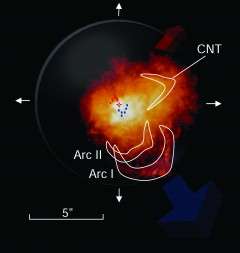
University of Arizona astronomers who are probing the oxygen-rich environment around a supergiant star with one of the world's most sensitive radio telescopes have discovered a score of molecules that include compounds needed for life.
"I don't think anyone would have predicted that VY Canis Majoris is a molecular factory. It was really unexpected," said Arizona Radio Observatory (ARO) Director Lucy Ziurys, UA professor of astronomy and of chemistry. "Everyone thought that the interesting chemistry in gas clouds around old stars was happening in envelopes around nearer, carbon-rich stars," Ziurys said. "But when we started looking closely for the first time at an oxygen-rich object, we began finding all these interesting things that weren't supposed to be there."
VY Canis Majoris, one of the most luminous infrared objects in the sky, is an old star about 5,000 light years away. It's a half million times more luminous than the sun, but glows mostly in the infrared because it's a cool star. It truly is "supergiant" -- 25 times as massive as the sun and so huge that it would fill the orbit of Jupiter. But the star is losing mass so fast that in a million years -- an astronomical eyeblink -- it will be gone. The star already has blown away a large part of its atmosphere, creating its surrounding envelope that contains about twice as much oxygen as carbon.
Ziurys and her colleagues are not yet halfway through their survey of VY Canis Majoris, but they've already published in the journal, Nature (June 28 issue), about their observations of a score of chemical compounds. These include some molecules that astronomers have never detected around stars and are needed for life.
Among the molecules Ziurys and her team reported in Nature are table salt (NaCl); a compound called phosphorus nitride (PN), which contains two of the five most necessary ingredients for life; molecules of HNC, which is a variant form of the organic molecule, hydrogen cyanide; and an ion molecule form of carbon monoxide that comes with a proton attached (HCO+). Astronomers have found very little phosphorus or ion molecule chemistry in outflows from cool stars until now.
"We think these molecules eventually flow from the star into the interstellar medium, which is the diffuse gas between stars. The diffuse gas eventually collapses into denser molecular clouds, and from these solar systems eventually form," Ziurys said.
Comets and meteorites dump about 40,000 tons of interstellar dust on Earth each year. We wouldn't be carbon-based life forms otherwise, Ziurys noted, because early Earth lost all of its original carbon in the form of a methane atmosphere.
"The origin of organic material on Earth -- the chemical compounds that make up you and me -- probably came from interstellar space. So one can say that life's origins really begin in chemistry around objects like VY Canis Majoris."
Astronomers previously studied VY Canis Majoris with optical and infrared telescopes. "But that's kind of like diving in with a butcher knife to look at what's there, when what you need is an oyster fork," Ziurys said.
The Arizona Radio Observatory's 10-meter Submillimeter Telescope (SMT) on Mount Graham, Ariz., excels as a sensitive stellar "oyster fork." Chemical molecules each possess their own unique radio frequencies. The astronomers identify the unique radio signatures of chemical compounds in laboratory work, enabling them to identify the molecules in space.
The ARO team recently began testing a new receiver in collaboration with the National Radio Astronomy Observatory. The receiver was developed as a prototype for the Atacama Large Millimeter Array, a telescope under construction in Chile. The state-of-the-art receiver has given the SMT 10 times more sensitivity at millimeter wavelengths than any other radio telescope. The SMT can now detect emission weaker than a typical light bulb from distant space at very precise frequencies.
The UA team has discovered that the molecules aren't just flowing out as a gas sphere around VY Canis Majoris, but also are blasting out as jets through the spherical envelope.
"The signals we receive show not only which molecules are seen, but how the molecules are moving toward and away from us," said Stefanie Milam, a recent doctoral graduate on the ARO team.
The molecules flowing out from VY Canis Majoris trace complex winds in three outflows: the general, spherical outflow from the star, a jet of material blasting out towards Earth, and another jet shooting out a 45 degree angle away from Earth.
Astronomers have seen bipolar outflows from stars before, but not two, unconnected, asymmetric and apparently random outflows, Ziurys said.
Ziurys said she believes the two random jets are evidence for what astronomers earlier proposed are "supergranules" that form in very massive stars, and has been seen in Betelgeuse. Supergranules are huge cells of gas that form inside the star, then float to the surface and are ejected out of the star, where they cool in space and form molecules, creating jet outflows with certain molecular compositions.
Back in the 1960s, no one believed molecules could survive the harsh environment of space. Ultraviolet radiation supposedly reduced matter to atoms and atomic ions. Now scientists conclude that at least half of the gas in space between the stars within the 33-light-year inner galaxy is molecular, Ziurys said. "Our results are more evidence that we live in a really molecular universe, as opposed to an atomic one," Ziurys said.
Source: University of Arizona


