Researchers work toward spark-free, fuel-efficient engines
In an advance that could help curb global demand for oil, MIT researchers have demonstrated how ordinary spark-ignition automobile engines can, under certain driving conditions, move into a spark-free operating mode that is more fuel-efficient and just as clean.
The mode-switching capability could appear in production models within a few years, improving fuel economy by several miles per gallon in millions of new cars each year. Over time, that change could cut oil demand in the United States alone by a million barrels a day. Currently, the U.S. consumes more than 20 million barrels of oil a day.
The MIT team presented their latest results on July 23 at the Japan Society of Automotive Engineers (JSAE)/Society of Automotive Engineers (SAE) 2007 International Fuel and Lubricants Meeting.
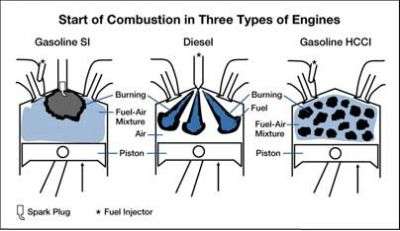
Many researchers are studying a new way of operating an internal combustion engine known as “homogeneous charge compression ignition” (HCCI). Switching a spark-ignition (SI) engine to HCCI mode pushes up its fuel efficiency.
In an HCCI engine, fuel and air are mixed together and injected into the cylinder. The piston compresses the mixture until spontaneous combustion occurs. The engine thus combines fuel-and-air premixing (as in an SI engine) with spontaneous ignition (as in a diesel engine). The result is the HCCI's distinctive feature: combustion occurs simultaneously at many locations throughout the combustion chamber.
That behavior has advantages. In both SI and diesel engines, the fuel must burn hot to ensure that the flame spreads rapidly through the combustion chamber before a new “charge” enters. In an HCCI engine, there is no need for a quickly spreading flame because combustion occurs throughout the combustion chamber. As a result, combustion temperatures can be lower, so emissions of nitrogen pollutants are negligible. The fuel is spread in low concentrations throughout the cylinder, so the soot emissions from fuel-rich regions in diesels are not present.
Perhaps most important, the HCCI engine is not locked into having just enough air to burn the available fuel, as is the SI engine. When the fuel coming into an SI engine is reduced to cut power, the incoming air must also be constrained-a major source of wasted energy.
However, it is difficult to control exactly when ignition occurs in an HCCI engine. And if it does not begin when the piston is positioned for the power stroke, the engine will not run right.
“It's like when you push a kid on a swing,” said Professor William H. Green, Jr., of the Department of Chemical Engineering. “You have to push when the swing is all the way back and about to go. If you push at the wrong time, the kid will twist around and not go anywhere. The same thing happens to your engine.”
According to Green, ignition timing in an HCCI engine depends on two factors: the temperature of the mixture and the detailed chemistry of the fuel. Both are hard to predict and control. So while the HCCI engine performs well under controlled conditions in the laboratory, it is difficult to predict at this time what will happen in the real world.
Green, along with Professor Wai K. Cheng of the Department of Mechanical Engineering, and colleagues in MIT's Sloan Automotive Laboratory and MIT's Laboratory for Energy and the Environment have been working to find the answer.
A large part of their research has utilized an engine modified to run in either HCCI or SI operating mode. For the past two years, Morgan Andreae (MIT PhD 2006) and graduate student John Angelos of chemical engineering have been studying the engine's behavior as the inlet temperature and type of fuel are changed.
Not surprisingly, the range of conditions suitable for HCCI operation is far smaller than the range for SI mode. Variations in temperature had a noticeable but not overwhelming effect on when the HCCI mode worked. Fuel composition had a greater impact, but it was not as much of a showstopper as the researchers expected.
Using the results of their engine tests as a guide, the researchers developed an inexpensive technique that should enable a single engine to run in SI mode but switch to HCCI mode whenever possible. A simple temperature sensor determines whether the upcoming cycle should be in SI or HCCI mode (assuming a constant fuel).
To estimate potential fuel savings from the mode-switching scheme, Andreae determined when an SI engine would switch into HCCI mode under simulated urban driving conditions. Over the course of the simulated trip, HCCI mode operates about 40 percent of the time.
The researchers estimate that the increase in fuel efficiency would be a few miles per gallon. “That may not seem like an impressive improvement,” said Green. “But if all the cars in the US today improved that much, it might be worth a million barrels of oil per day-and that's a lot.”
This research was supported by Ford Motor Company and the Ford-MIT Alliance, with additional support from BP.
Source: MIT


