Did pterosaurs feed by skimming?
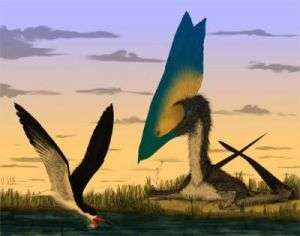
Scientists at the University of Sheffield, collaborating with colleagues at the Universities of Portsmouth and Reading, have taken a step back in time and provided a new insight into the lifestyle of a prehistoric flying reptile.
Using new physical and mathematical modelling, Dr Stuart Humphries from the University of Sheffield, along with scientists from the Universities of Portsmouth and Reading, has shown that suggestions that extinct pterosaurs gathered their food by ‘skimming’ the surface of the ocean with their beaks are inaccurate.
Previous studies have suggested that some pterosaurs may have fed like modern-day ‘skimmers’, a rare group of shorebirds, belonging to the Rynchops group. These sea-birds fly along the surface of lakes and estuaries scooping up small fish and crustaceans with their submerged lower jaw. Inferred structural similarities between pterosaur and Rynchops jaws had previously been used to suggest that some pterosaur were anatomically suited for skimming.
However, new evidence provided by the researchers suggests that the fossilised jaws of suggested pterosaur skimmers mean that these creatures may have found it impossible to feed in this way.
According to the research, the thicker jaws of pterosaurs would make it difficult for them to deflect water the way the extraordinarily slim bills of Rynchops do. By combining experiments using life-size models of pterosaur and skimmer jaws with hydrodynamic and aerodynamic modelling, the researchers demonstrated that skimming requires more energy than the giant reptilian fliers were likely able to supply.
The researchers established that pterosaurs weighing more than one kilogram would not have been able to skim at all. They also found that anatomical comparisons between the highly-specialised skull of Rynchops and those of postulated skimming pterosaurs suggest that even smaller forms were poorly adapted for skim-feeding. They believe that the pterosaurs they studied would have in fact fed using more conventional methods.
The size and body plan of these long-extinct animals can be reliably reconstructed from fossils, as can their time of existence on Earth. As a result of this evidence, scientists know that pterosaurs had membrane-covered wings like bats. Their extremely light, hollow skeletons were presumably filled with air, allowing even pterosaurs with wingspans in excess of 10 m to take to the skies, which they began to do as far back as 230 million years ago.
Discovering the ecological traits of these reptiles though is far more complicated. One way scientists currently gain an insight into ecological traits of extinct animals is by comparing fossilized morphological (shape and form) features to those of living animals.
However, as this new research shows, these records do not provide direct evidence of behaviour and ecology. Dr Humphries, from the Department of Animal and Plant Sciences, said: “Our results illustrate the pitfalls involved in using morphological data to study the ecology of extinct animals, including dinosaurs and pterodactyles.”
“While we acknowledge that these comparisons do offer clues to the ecological traits of extinct creatures, we hope that our research shows that biomechanical analysis is also needed to supplement such efforts in order to paint a more realistic portrait of the prehistoric landscape."
Citation: Humphries S, Bonser RHC, Witton MP, Martill DM (2007) Did pterosaurs feed by skimming" Physical modelling and anatomical evaluation of an unusual feeding method. PLoS Biol 5(8): e204. doi:10.1371/journal.pbio.0050204.
Source: University of Sheffield


