July 24, 2007 feature
Hacking the Wii remote for physics class
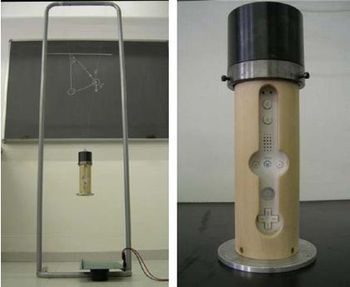
You might be surprised to know that your Nintendo Wii remote control has a small accelerometer that, until recently, research physicists paid good money to purchase. But the increasing widespread use of accelerometers in everything from video games to Segways to the iPhone is pushing the cost down and enabling some cheap experimental fun—and education.
Recently, Maurizio Vannoni from the Instituto Nazionale di Ottica Applicata and Samuele Straulino from the Università di Firenze demonstrated how to rig up the Wii remote to teach students about mechanics. Vannoni works in optical testing, interferometry and holography, while Straulino has worked on cosmic-ray physics and satellites, and is currently working on the OpenLab Project (see below). Usually, accelerometers are expensive items for classrooms, and not readily available to most teachers.
“Similar projects have been already proposed using a simple mouse,” Straulino told PhysOrg.com. “We therefore realized that a more sophisticated controller (like the Wii Remote) could be also more useful in developing simple experiments to be done with secondary school students.”
In general, accelerometers are used for measuring acceleration, including gravitational acceleration. The Wii remote has a three-axis accelerometer, allowing it to measure a player’s movements along three axes (such as in a tennis game). A monochrome camera on the front of the device can locate and track up to four infrared (IR) LED sources, further enabling the device to evaluate its own relative position.
To teach students concepts in dynamics and kinematics such as force, velocity and acceleration, Vannoni and Straulino used the intact Wii remote to measure acceleration of a swinging pendulum. They connected the remote to a PC via Bluetooth, and used software to interpret data from the accelerometers to numerically and graphically calculate the pendulum’s position, velocity, and acceleration.
The Wii remote was attached to the bottom of a weight tied to a nylon wire, with the IR camera pointing to the floor. An IR LED was positioned on the floor just below the pendulum rest position so that the camera could only see the LED when close to the resting position. As the pendulum swung, displacement data was submitted to the PC in real time for later analysis by students.
The physicists also used the Wii to demonstrate the forces involved in free-fall. While dropping the Wii remote from about 4 m into a box filled with foam, the accelerometers transmitted the free-fall data to a portable computer, again showing good results. The researchers suggest that the Wii could be used in many other physics experiments with minor adaptations.
“As an example of a real-word application, crash-test dummies contain several accelerometers: recorded values are examined and compared with human body tolerance limits,” Vannoni explained. “The used accelerometers are similar to those contained inside the Wii Remote. The free-fall of the Wii Remote into the box filled with foam is a sort of ‘crash-test’ (be careful about this setup, to avoid the real crash of the device).”
An Italian Web site called The OpenLab Project (www.openlab.unifi.it/) at Florence University is the reference point in the researchers’ area to help teachers build educational experiments, and they suggest the Wii device could be useful in this project.
Citation: Vannoni, Maurizio and Straulino, Samuele. “Low-cost accelerometers for physics experiments.” Eur. J. Phys. 28 (2007) 781-787.
Copyright 2007 PhysOrg.com.
All rights reserved. This material may not be published, broadcast, rewritten or redistributed in whole or part without the express written permission of PhysOrg.com.


