New 'planet' is larger than Pluto
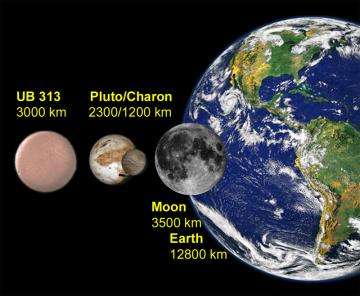
Claims that the Solar System has a tenth planet are bolstered by the finding by a group lead by Bonn astrophysicists that this alleged planet, announced last summer and tentatively named 2003 UB313, is bigger than Pluto. By measuring its thermal emission, the scientists were able to determine a diameter of about 3000 km, which makes it 700 km larger than Pluto and thereby marks it as the largest solar system object found since the discovery of Neptune in 1846 (Nature, 2 February 2006).
Like Pluto, 2003 UB313 is one of the icy bodies in the so-called Kuiper belt that exists beyond Neptune. It is the most distant object ever seen in the Solar System. Its very elongated orbit takes it up to 97 times farther from the Sun than is the Earth - almost twice as far as the most distant point of Pluto's orbit - so that it takes twice as long as Pluto to orbit the Sun. When it was first seen, UB313 appeared to be at least as big as Pluto. But an accurate estimate of its size was not possible without knowing how reflective it is. A team lead by Prof. Frank Bertoldi from the University of Bonn and the Max Planck Institute for Radio Astronomy (MPIfR) and the MPIfR's Dr. Wilhelm Altenhoff has now resolved this problem by using measurements of the amount of heat UB313 radiates to determine its size, which when combined with the optical observations also allowed them to determine its reflectivity. "Since UB313 is decidedly larger than Pluto," Frank Bertoldi remarks, "it is now increasingly hard to justify calling Pluto a planet if UB313 is not also given this status."
UB313 was discovered in January 2005 by Prof. Mike Brown and his colleagues from the Californian Institute of Technology in a sky survey using a wide field digital camera that searches for distant minor planets at visible wavelengths. They discovered a slowly moving, spatially unresolved source, the apparent speed of which allowed them to determine its distance and orbital shape. However, they were not able to determine the size of the object, although from its optical brightness it was believed to be larger than Pluto.
Astronomers have found small planetary objects beyond the orbits of Neptune and Pluto since 1992, confirming a then 40-year old prediction by astronomers Kenneth Edgeworth (1880-1972) and Gerard P. Kuiper (1905-1973) that a belt of smaller planetary objects beyond Neptune exists. The so-called Kuiper Belt contains objects left from the formation of our planetary system some 4.5 billion years ago. In their distant orbits they were able to survive the gravitational clean-up of similar objects by the large planets in the inner solar system. Some Kuiper Belt objects are still occasionally deflected to then enter the inner solar system and may appear as short period comets.
In optically visible light, the solar system objects are visible through the light they reflect from the Sun. Thus, the apparent brightness depends on their size as well as on the surface reflectivity. Latter is known to vary between 4% for most comets to over 50% for Pluto, which makes any accurate size determination from the optical light alone impossible.
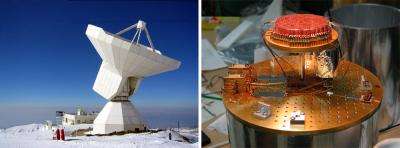
The Bonn group therefore used the IRAM 30-meter telescope in Spain, equipped with the sensitive Max-Planck Millimeter Bolometer (MAMBO) detector developed and built at the MPIfR, to measure the heat radiation of UB313 at a wavelength of 1.2 mm, where reflected sunlight is negligible and the object brightness only depends on the surface temperature and the object size. The temperature can be well estimated from the distance to the sun, and thus the observed 1.2 mm brightness allows a good size measurement. One can further conclude that the UB313 surface is such that it reflects about 60% of the incident solar light, which is very similar to the reflectivity of Pluto.
"The discovery of a solar system object larger than Pluto is very exciting," Dr. Altenhoff exclaims, who has researched minor planets and comets for decades. "It tells us that Pluto, which should properly also be counted to the Kuiper Belt, is not such an unusual object. Maybe we can find even other small planets out there, which could teach us more about how the solar system formed and evolved. The Kuiper Belt objects are the debris from its formation, an archeological site containing pristine remnants of the solar nebula from which the sun and the planets formed." Dr. Altenhoff made the pioneering discovery of heat radiation from Pluto in 1988 with a predecessor of the current detector at the IRAM 30-meter telescope.
The size measurement of 2003 UB313 is published in the 2 February 2006 issue of Nature. The research team includes Prof. Dr. Frank Bertoldi (Bonn University and MPIfR), Dr. Wilhelm Altenhoff (MPIfR), Dr. Axel Weiss (MPIfR), Prof. Dr. Karl M. Menten (MPIfR), and Dr. Clemens Thum (IRAM).
The Kuiper Belt
UB313 is a members of a ring of some 100,000 objects on the outskirts of the solar system, beyond Neptune at distances over 4 billion km from the sun, over 30 times the distance between Earth and Sun. The objects in this "Kuiper belt" circle the sun in stable orbits with periods of about 300 years. In the middle of the last century, the existence of a ring of small planetary objects was first suggested by the astronomers Kenneth Edgeworth (1880-1972) and Gerard P. Kuiper (1905-1973), but the first discovery of a "Kuiper belt object" was not until 1992. By now, over 700 such objects are known. UB313 is somewhat different from the normal Kuiper belt in that its orbit is highly excentric and 45 degrees inclined to the ecliptic plane of the planets and Kuiper Belt. It is likely that is originated in the Kuiper Belt and was deflected to its inclined orbit by Neptune.
Source: Max-Planck-Gesellschaft


