Spitzer Finds Evidence for Planets with Four Parents
July 24, 2007
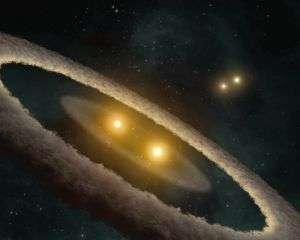
This artist's concept illustrates a quadruple-star system. Image credit: NASA/JPL-Caltech/UCLA
How many stars does it take to "raise" a planet? In our own solar system, it took only one – our sun. However, new research from NASA's Spitzer Space Telescope shows that planets might sometimes form in systems with as many as four stars.
Astronomers used Spitzer's infrared vision to study a dusty disk that swirls around a pair of stars in the quadruple-star system HD 98800. Such disks are thought to give rise to planets. Instead of a smooth, continuous disk, the telescope detected gaps that could be caused by a unique gravitational relationship between the system's four stars. Alternatively, the gaps could indicate planets have already begun to form, carving out lanes in the dust.
"Planets are like cosmic vacuums. They clear up all the dirt that is in their path around the central stars," said Elise Furlan, of the NASA Astrobiology Institute at the University of California at Los Angeles. Furlan is the lead author of a paper that has been accepted for publication in The Astrophysical Journal.
HD 988000 is approximately 10-million years old, and is located 150 light-years away in the constellation TW Hydrae.
Before Spitzer set its gaze on HD 98800, astronomers had a rough idea of the system's structure from observations with ground-based telescopes. They knew the system contains four stars, and that the stars are paired off into doublets, or binaries. The stars in the binary pairs orbit around each other, and the two pairs also circle each other like choreographed ballerinas. One of the stellar pairs, called HD 98800B, has a disk of dust around it, while the other pair has none.
Although the four stars are gravitationally bound, the distance separating the two binary pairs is about 50 astronomical units (AU) -- slightly more than the average distance between our sun and Pluto. Until now, technological limitations have hindered astronomers' efforts to look at the dusty disk around HD 98800B more closely.
With Spitzer, scientists finally have a detailed view. Using the telescope's infrared spectrometer, Furlan's team sensed the presence of two belts in the disk made of large dust grains. One belt sits at approximately 5.9 AU away from the central binary, HD 98800B, or about the distance from the sun to Jupiter. This belt is likely made up of asteroids or comets. The other belt sits at 1.5 to 2 AU, comparable to the area where Mars and the asteroid belt sit, and probably consists of fine grains.
"Typically, when astronomers see gaps like this in a debris disk, they suspect that a planet has cleared the path. However, given the presence of the diskless pair of stars sitting 50 AU away, the inward-migrating dust particles are likely subject to complex, time-varying forces, so at this point the existence of a planet is just speculation," said Furlan.
Astronomers believe that planets form like snowballs over millions of years, as small dust grains clump together to form larger bodies. Some of these cosmic rocks then smash together to form rocky planets, like Earth, or the cores of gas-giant planets like Jupiter. Large rocks that don't form planets often become asteroids and comets. As these rocky structures violently collide, bits of dust are released into space. Scientists can see these dust grains with Spitzer's supersensitive infrared eyes.
According to Furlan, the dust generated from the collision of rocky objects in the outer belt should eventually migrate toward the inner disk. However, in the case of HD 98800B, the dust particles do not evenly fill out the inner disk as expected, due to either planets or the diskless binary pair sitting 50 AU away and gravitationally influencing the movement of dust particles.
"Since many young stars form in multiple systems, we have to realize that the evolution of disks around them and the possible formation of planetary systems can be way more complicated and perturbed than in a simple case like our solar system," Furlan added.
Multiple-star planets would also have interesting sunsets.
Source: NASA, by Linda Vu/Spitzer Science Center
-
Searching for planets in clouds of dust
19 hours ago |
5 / 5 (2) |
1
-
Mighty Martian meteorite lands at UK's Natural History Museum
Feb 08, 2012 |
not rated yet |
0
-
IBEX spacecraft measures 'alien' particles from outside solar system
Jan 31, 2012 |
5 / 5 (8) |
0
-
New research suggests Fomalhaut B may not be a planet after all
Jan 27, 2012 |
4.7 / 5 (6) |
3
-
The Rings of Pluto?
Jan 25, 2012 |
4.3 / 5 (3) |
0
-
Engineers build first sub-10-nm carbon nanotube transistor
Feb 01, 2012 |
4.9 / 5 (33) |
30
-
Something old, something new: Evolution and the structural divergence of duplicate genes
Jan 31, 2012 |
4.6 / 5 (7) |
1
-
The hidden nanoworld of ice crystals: Revealing the dynamic behavior of quasi-liquid layers
Jan 30, 2012 |
5 / 5 (4) |
1
-
Stock market network reveals investor clustering
Jan 27, 2012 |
3.9 / 5 (23) |
8
-
Of microchemistry and molecules: Electronic microfluidic device synthesizes biocompatible probes
Jan 26, 2012 |
5 / 5 (2) |
0
-
Never ending outer space.....
18 hours ago
-
Neutron Star fragments?
20 hours ago
-
stationary or not?
Feb 11, 2012
-
Scale of the Universe
Feb 10, 2012
-
Titan's lack of impact craters
Feb 09, 2012
-
Real pictures of black hole eating a star?
Feb 08, 2012
- More from Physics Forums - General Astronomy
More news stories
Latin America mining boom clashes with conservation
Latin America is experiencing a mining boom as prices rise fuelled by a hike in global demand, but the region is also being hit by a wave of violent protests, strikes and rallies by environmentalists.
11 hours ago |
5 / 5 (1) |
1
Salvage workers begin pumping fuel from Italian shipwreck
Salvage workers Sunday began pumping fuel from the shipwrecked Italian cruise liner Costa Concordia, a day ahead of schedule, officials said.
3 hours ago |
not rated yet |
0
Political leaders play key role in how worried Americans are by climate change: study
More than extreme weather events and the work of scientists, it is national political leaders who influence how much Americans worry about the threat of climate change, new research finds.
Feb 06, 2012 |
5 / 5 (6) |
73
NASA budget will axe Mars deal with Europe: scientists
US President Barack Obama's budget proposal to be submitted next week for 2013 will cut NASA's budget by 20 percent and eliminate a major partnership with Europe on Mars exploration, scientists said Thursday.
Space & Earth / Space Exploration
Feb 10, 2012 |
5 / 5 (3) |
58
Humans may have helped the decline of African rainforests 3000 years ago
(PhysOrg.com) -- Large areas of rainforests in Central Africa mysteriously disappeared over three thousand years ago, to be replaced by savannas. The prevailing theory has been that the cause was a change ...
Overeating may double risk of memory loss
New research suggests that consuming between 2,100 and 6,000 calories per day may double the risk of memory loss, or mild cognitive impairment (MCI), among people age 70 and older. The study was released today and will be ...
Google might launch Drive for cloud storage soon
(PhysOrg.com) -- Google's next big move, according to the Wall Street Journal, is a cloud storage service called Drive. Hardly first to the plate, Google is simply catching up to introducing its cloud reposi ...
Scientists discover molecular secrets of 2,000-year-old Chinese herbal remedy
For roughly two thousand years, Chinese herbalists have treated Malaria using a root extract, commonly known as Chang Shan, from a type of hydrangea that grows in Tibet and Nepal. More recent studies suggest that halofuginone, ...
New method to examine batteries -- MRI from the inside
There is an ever-increasing need for advanced batteries for portable electronics, such as phones, cameras, and music players, but also to power electric vehicles and to facilitate the distribution and storage of energy derived ...
Lab study raises questions over nano-particle impact
Tests involving chickens have raised questions about the impact on health from engineered nano-particles, the ultra-fine grains commonly used in drugs and processed foods, scientists said on Sunday.
Injured boomers beware: Know when to see doctor
(AP) -- It happened to nurse Jane Byron years after an in-line skating fall, business owner Haralee Weintraub while doing "men's" push-ups, and avid cyclist Gene Wilberg while lifting a heavy box.