Nanotech clay armour creates fire resistant hard wearing latex emulsion paints
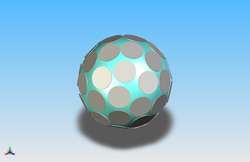
July 26, 2007 Diagram of clay armour

Diagram of clay armour

Researchers at the University of Warwick's Department of Chemistry have found a way of replacing the soap used to stabilize latex emulsion paints with nanotech sized clay armour that can create a much more hard wearing and fire resistant paint.

To date latex emulsion paints have relied on the addition of soaps or similar materials to overcome the polymer parts of the paint's aversion to water, stabilize the paint, and make it work.

The University of Warwick chemistry researchers led by Dr Stefan Bon have found a simple way to individually coat the polymer particles used in such paints with a series of nanosized Laponite clay discs. The discs effectively create an armoured layer on the individual polymer latex particles in the paint. The clay discs are 1 nanometre thick by 25 nanometres in diameter.

The Lapointe clay discs can be applied using current industrial paint manufacture equipment. They not only provides an alternative to soap but can also be used to make the paint much more hard wearing and fire resistant.

The process devised by the Warwick team can be used to create highly sensitive materials for sensors. The researchers can take closely packed sample of the armoured polymers and heat it to burn away the polymer cores of the armoured particles leaving just a network of nanotech sized connected hollow spheres. This gives a very large useful surface area in a very small space which is an ideal material to use to create compact but highly sensitive sensors.

Their research is in a paper enitled "Pickering Miniemulsion Polymerization Using Laponite Clay as a Stabilizer" by Stefan A. F. Bon and Patrick J. Colver and is published as the cover article in Langmuir. The ACS Journal of Surfaces and Colloids Vol. 23, Issue 16 July 31.

Source: University of Warwick


print this article email this article download pdf blog this article bookmark this article     Stumble it Digg this share on Facebook retweet share on Reddit add to delicious
Rate this story - 4.7 /5 (11 votes)


July 26, 2007 all stories

Comments: 0

4.7 /5 (11 votes)
  • Stumble this up

  • Digg this

  • share this

  • hide
  • Related Stories

  • New insights into the life of the Maya
    created Nov 16, 2009 | popularity not rated yet | comments 0
  • Engineers hit pay dirt with clay mixture
    created Apr 14, 2009 | popularity not rated yet | comments 0
  • Pore-free Ceramics Shine New Light on Lasers, Electronics and Biomedical Implants
    created Feb 16, 2009 | popularity not rated yet | comments 0
  • Centuries-old Maya Blue mystery finally solved
    created Feb 26, 2008 | popularity not rated yet | comments 0
  • Probing Question: How can you spot a forgery?
    created Feb 01, 2007 | popularity not rated yet | comments 0


  • hide
  • Relevant PhysicsForums posts

Other News

Nanotech in Space: Experiment To Weather the Trials of Orbit

Nanotech in Space: Experiment To Weather the Trials of Orbit

Nanotechnology / Nanomaterials

created 7 hours ago | popularity 4 / 5 (2) | comments 0

Novel nanomaterials developed at Rensselaer were sent into orbit on Nov. 16 aboard Space Shuttle Atlantis.


Nanoparticles used in common household items caused genetic damage in mice

Nanotechnology / Bio & Medicine

created Nov 16, 2009 | popularity 4.8 / 5 (24) | comments 11

Titanium dioxide (TiO2) nanoparticles, found in everything from cosmetics to sunscreen to paint to vitamins, caused systemic genetic damage in mice, according to a comprehensive study conducted by researchers at UCLA's Jonsson ...


Water droplets direct self-assembly process in thin-film materials

Nanotechnology / Nanomaterials

created Nov 23, 2009 | popularity 5 / 5 (4) | comments 2

You can think of it as origami - very high-tech origami. Researchers at the University of Illinois have developed a technique for fabricating three-dimensional, single-crystalline silicon structures from thin films by coupling ...


Peptides control crystal growth with 'switches, throttles and brakes'

Peptides control crystal growth with 'switches, throttles and brakes'

Nanotechnology / Bio & Medicine

created Nov 23, 2009 | popularity 5 / 5 (3) | comments 0

(PhysOrg.com) -- By producing some of the highest resolution images of peptides attaching to mineral surfaces, scientists have a deeper understanding how biomolecules manipulate the growth crystals. This research ...


Nanotube defects equal better energy and storage systems

Nanotube defects equal better energy and storage systems

Nanotechnology / Nanomaterials

created Nov 19, 2009 | popularity 4.4 / 5 (10) | comments 2

(PhysOrg.com) -- Most people would like to be able to charge their cell phones and other personal electronics quickly and not too often. A recent discovery made by UC San Diego engineers could lead to carbon ...