Simple Method Yields Complex Micro- and Nanoparticle Shapes
July 26, 2007 By Laura Mgrdichian feature
Simple Method Yields Complex Micro- and Nanoparticle Shapes

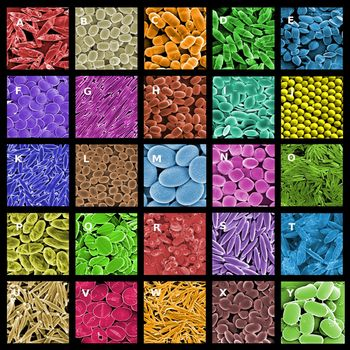
A collection of scanning electron microscope images (color added) of the particle shapes, including capsules (C), “tacos” (E), and lenses (R). Photo courtesy of Samir Mitragotri.

In applications from drug delivery to electronics, polymer particles several billionths to millionths of a meter in size could play key roles. But before many of these uses can be realized, scientists must thoroughly understand how these particles behave – behaviors that are strongly linked to the particles' precise shapes, which so far have been difficult to produce on demand and in variation. Recently, however, scientists from the University of California at Santa Barbara (UCSB) found a way to widen this bottleneck.

“There is a shortage of methods to produce non-spherically shaped polymer particles. We have developed a method that addresses this challenge,” said UCSB engineer Samir Mitragotri, the study's corresponding scientist, to PhysOrg.com.

The method is fairly simple, low cost, and can produce substantial quantities of particles (from billions to trillions) of more than 20 widely varying shapes. These include rods, various disks, bullets, barrels, and lenses.

The particles are made of polystyrene, a polymer most commonly used to make foam packaging materials. The pre-shaped particles are spherical and have diameters between 60 nanometers (billionths of a meter) and 10 micrometers (millionths of a meter).

The particles are first suspended in a polymer solution, cast into films of varying thicknesses, and mixed with the compound glycerol to plasticize the films. The films were then dried. From there, the researchers used two approaches, dubbed A and B, and then a combination of the two, to engineer the full array of shapes.

In approach A, the particles were melted using either a solvent or heat and then the entire film was stretched on an apparatus custom built for the task. By stretching the film in one, two, or both directions, the particles were pulled into various shapes. Different shapes resulted from the use of solvent versus heat, and the thickness of the film also produced new geometries. Among the shapes yielded by approach A were circular disks, rectangular disks, “flying saucers,” rods, and worms.

In approach B, the films were stretched before melting, which produced a different set of shapes than A, most more complex, including pulley wheels, barrels, bullets, and capsules.

Combining approaches A and B resulted in yet another set of shapes, many rather unusual. These included ribbon-like particles with curled ends, elongated hexagonal disks, and even “ravioli” and “tacos.”

Most of the shapes produced were a few micrometers in size, but the scientists were able to produce nanoparticles, which greatly increases the particles' potential applications. The group says that particles made of polymers other than polystyrene could be produced using their method, and that the method is scalable to produce even greater numbers of them.

Added Mitragotri, “There is already evidence supporting the importance of particle shape in various applications, such as the design of new carriers for drug delivery. We believe that the availability of a simple method to make these particles will lead to many new discoveries and technologies.”

Citation: Julie A. Champion, Yogesh K. Katare, and Samir Mitragotri (2007) Proc Natl Acad Sci USA 104:11901-11904

Copyright 2007 PhysOrg.com.
All rights reserved. This material may not be published, broadcast, rewritten or redistributed in whole or part without the express written permission of PhysOrg.com.

4.3 /5 (30 votes)  

Rank 4.3 /5 (30 votes)
Tags

Relevant PhysicsForums posts
  • polymer nanocomposites
    createdFeb 10, 2012
  • Corrosion Tests on Magnesium
    createdFeb 09, 2012
  • polyethylene copper nanocomposite
    createdFeb 09, 2012
  • Output of xrd analysis
    createdFeb 08, 2012
  • Transport phenomena problem based on problems 18.B11 and 19B.6 from Bird, stewart, lw
    createdFeb 06, 2012
  • Help with material selection - Car Piston
    createdFeb 05, 2012
  • More from Physics Forums - Materials & Chemical Engineering

More news stories

Lab study raises questions over nano-particle impact

Tests involving chickens have raised questions about the impact on health from engineered nano-particles, the ultra-fine grains commonly used in drugs and processed foods, scientists said on Sunday.

Nanotechnology / Bio & Medicine

created 5 hours ago | popularity 5 / 5 (5) | comments 0

New kind of solar cell could capture significantly more energy than current cells

New solar cells could increase the maximum efficiency of solar panels by over 25%, according to scientists from the University of Cambridge.

Nanotechnology / Nanophysics

created Feb 08, 2012 | popularity 4.5 / 5 (13) | comments 14 | with audio podcast

Nanoshell whispering galleries improve thin solar panels

Visitors to Statuary Hall in the U.S. Capitol Building may have experienced a curious acoustic feature that allows a person to whisper softly at one side of the cavernous, half-domed room and for another on ...

Nanotechnology / Nanomaterials

created Feb 07, 2012 | popularity 4.4 / 5 (7) | comments 6 | with audio podcast

'Dark plasmons' transmit energy

Microscopic channels of gold nanoparticles have the ability to transmit electromagnetic energy that starts as light and propagates via "dark plasmons," according to researchers at Rice University.

Nanotechnology / Nanophysics

created Feb 09, 2012 | popularity 4.8 / 5 (10) | comments 1 | with audio podcast

Revealing how a battery material works

Since its discovery 15 years ago, lithium iron phosphate (LiFePO4) has become one of the most promising materials for rechargeable batteries because of its stability, durability, safety and ability to deliver ...

Nanotechnology / Nanomaterials

created Feb 08, 2012 | popularity 5 / 5 (6) | comments 0 | with audio podcast


Declining health-care productivity in England: Who says so?

Reports that the National Health Service in England has been declining in productivity in the last decade appear to have been accepted as fact. However, a Viewpoint published Online First by The Lancet disputes this. The Vi ...

Scientists discover molecular secrets of 2,000-year-old Chinese herbal remedy

For roughly two thousand years, Chinese herbalists have treated Malaria using a root extract, commonly known as Chang Shan, from a type of hydrangea that grows in Tibet and Nepal. More recent studies suggest that halofuginone, ...

New method to examine batteries -- MRI from the inside

There is an ever-increasing need for advanced batteries for portable electronics, such as phones, cameras, and music players, but also to power electric vehicles and to facilitate the distribution and storage of energy derived ...

Overeating may double risk of memory loss

New research suggests that consuming between 2,100 and 6,000 calories per day may double the risk of memory loss, or mild cognitive impairment (MCI), among people age 70 and older. The study was released today and will be ...

A mitosis mystery solved: How chromosomes align perfectly in a dividing cell

Although the process of mitotic cell division has been studied intensely for more than 50 years, Whitehead Institute researchers have only now solved the mystery of how cells correctly align their chromosomes during symmetric ...

Starve a virus, feed a cure? Findings show how some cells protect themselves against HIV

A protein that protects some of our immune cells from the most common and virulent form of HIV works by starving the virus of the molecular building blocks that it needs to replicate, according to research published online ...