MIT duo see people-powered 'Crowd Farm'
July 26, 2007
MIT duo see people-powered 'Crowd Farm'

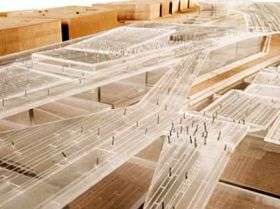
The students' test of the Crowd Farm in a train station and public space in Torino, Italy. Graphic / MIT School of Architecture and Planning

Two graduate students at MIT's School of Architecture and Planning want to harvest the energy of human movement in urban settings, like commuters in a train station or fans at a concert.

The so-called "Crowd Farm," as envisioned by James Graham and Thaddeus Jusczyk, both M.Arch candidates, would turn the mechanical energy of people walking or jumping into a source of electricity. Their proposal took first place in the Japan-based Holcim Foundation's Sustainable Construction competition this year.

A Crowd Farm in Boston's South Station railway terminal would work like this: A responsive sub-flooring system made up of blocks that depress slightly under the force of human steps would be installed beneath the station's main lobby. The slippage of the blocks against one another as people walked would generate power through the principle of the dynamo, a device that converts the energy of motion into that of an electric current.

The electric current generated by the Crowd Farm could then be used for educational purposes, such as lighting up a sign about energy. "We want people to understand the direct relationship between their movement and the energy produced," says Juscyzk.

The Crowd Farm is not intended for home use. According to Graham and Jusczy, a single human step can only power two 60W light bulbs for one flickering second. But get a crowd in motion, multiply that single step by 28,527 steps, for example, and the result is enough energy to power a moving train for one second.

And while the farm is an urban vision, the dynamo-floor principle can also be applied to capturing energy at places like rock concerts, too. "Greater movement of people could make the music louder," suggests Jurcyzk.

The students' test case, displayed at the Venice Biennale and in a train station in Torino, Italy, was a prototype stool that exploits the passive act of sitting to generate power. The weight of the body on the seat causes a flywheel to spin, which powers a dynamo that, in turn, lights four LEDs.

"People tended to be delighted by sitting on the stool and would get up and down repeatedly," recalls Graham.

Other people have developed piezo-electric (mechanical-to-electrical) surfaces in the past, but the Crowd Farm has the potential to redefine urban space by adding a sense of fluidity and encouraging people to activate spaces with their movement.

"Our intention was to think of it not as a high-tech mat that would be laid down somewhere, but to really integrate it into a new sort of building system," Graham says.

The Crowd Farm floor is composed of standard parts that are easily replicated but it is expensive to produce at this stage, they said. "Only through experimentation - which can be expensive - do technologies become practical," Graham says.

Graham and Juscyzk rely on bicycles, rather than trains or buses, for their commute to MIT. But, both students were impressed enough by recent experiences in large crowds - for Graham, the 2003 New York City blackout; for Juscyzk, Boston's World Cup celebration in City Hall Plaza - to start work on the Farm. The students were inspired as well by an "ingenious little device by Thomas Edison. When visitors came to his house, they passed through a turnstile that pumped water into his holding tank," says Graham. In addition, they were guided by their advisor, Associate Professor J. Meejin Yoon, who helped them take their proposal from the power-stool to the Crowd Farm.

Source: MIT

4.7 /5 (9 votes)  

Rank 4.7 /5 (9 votes)
Tags

Relevant PhysicsForums posts
  • feed hold button on CNC lathe
    created10 hours ago
  • Mechanics of Solids ( Final exam question) plz help!
    created12 hours ago
  • RFAC in Fortran
    created15 hours ago
  • dynamics 2/32
    created21 hours ago
  • dynamics
    created21 hours ago
  • Vibration Absorbtion Problem
    createdFeb 08, 2012
  • More from Physics Forums - General Engineering

More news stories

Soraa LED light may dim 50-watt halogen rivals

(PhysOrg.com) -- Soraa, a Fremont, California company founded in 2008, this week launched its first product, a light that uses LEDS (light emitting diodes). The "Soraa LED MR16 lamp" is the "perfect" replacement ...

Technology / Semiconductors

created 11 hours ago | popularity 4.6 / 5 (13) | comments 8 | with audio podcast report

Model analyzes shape-memory alloys for use in earthquake-resistant structures

Recent earthquake damage has exposed the vulnerability of existing structures to strong ground movement. At the Georgia Institute of Technology, researchers are analyzing shape-memory alloys for their potential ...

Technology / Engineering

created 5 hours ago | popularity not rated yet | comments 0 | with audio podcast

Google launches Chrome browser for Android smartphones

With more and more people connecting to the Internet through a phone or a tablet instead of a PC, Google Inc. is bringing its fast-growing browser, Chrome, to the newest Android-powered mobile devices.

Technology / Software

created 7 hours ago | popularity 5 / 5 (4) | comments 0

Samsung can continue selling Galaxy tabs in Germany: court

South Korea's Samsung Electronics can continue to sell its Galaxy Tab 10.1N tablet computer in Germany, a German court ruled Thursday, rejecting a bid by arch-rival Apple to have them banned.

Technology / Business

created 9 hours ago | popularity 5 / 5 (2) | comments 2

Digital photos could put kids at risk

A study published in the International Journal of Electronic Security and Digital Forensics this month suggests that parents and carers could be putting children at risk if they upload digital photos that are automatically "geota ...

Technology / Internet

created 5 hours ago | popularity not rated yet | comments 2


Decoding the molecular machine behind E. coli and cholera

Scientists from Queen Mary, University of London have discovered the workings behind some of the bacteria that kill hundreds of thousands every year, possibly paving the way for new antibiotics that could treat infections ...

Deadly bird parasite evolves at exceptionally fast rate

A new study of a devastating bird disease that spread from poultry to house finches in the mid-1990s reveals that the bacteria responsible for the disease evolves at an exceptionally fast rate. What's more, ...

Flexible paper robots

(PhysOrg.com) -- These inexpensive robots can stretch, bend and twist under control, and lift objects up to 120 times their own weight. Being soft, they can apply gentle and even pressure, and adapt to varied ...

Tell me how you are -- and I know how long you will live

The way people rate their health determines their probability of survival in the following decades. Researchers from the Institute of Social and Preventive Medicine at the University of Zurich demonstrate that for ratings ...

New research reveals why fishermen keep fishing despite dwindling catches

Half of fishermen would not give up their livelihood in the face of drastically declining catches according to research led by the University of East Anglia (UEA).

Ultrasound study provides first direct evidence of effect of malaria on fetal growth

A study of almost 3,800 pregnancies has provided the most accurate and direct evidence to date that malaria infection reduces early foetal growth. Low birth weight is the most important risk factor for neonatal mortality ...