Fossils older than dinosaurs reveal pattern of early animal evolution on Earth
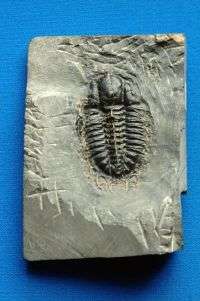
The abundant diversity of characteristics within species likely helped fuel the proliferation and evolution of an odd-looking creature that emerged from an unprecedented explosion of life on Earth more than 500 million years ago. University of Chicago paleontologist Mark Webster reports this finding in the July 27 issue of the journal Science.
“From an evolutionary perspective, the more variable a species is, the more raw material natural selection has to operate on,” said Webster, an Assistant Professor in Geophysical Sciences at Chicago.
Paleontologists for decades have suspected that highly variable species evolved more rapidly than others, said Nigel Hughes, Professor of Earth Sciences at the University of California, Riverside. “Various studies have approached questions pertaining to it—but this is the first to convincingly document it in any group,” Hughes said.
Most studies have focused on variability between species rather than within them, but in his Science paper, Webster analyzed 982 species of trilobites, ancient relatives of spiders and horseshoe crabs. “They’re segmented little creatures, very beautiful to look at,” Webster said. “They catch the eye of a lot of amateur collectors, and professionals like myself tend to get hooked on them very easily.”
Extinct for 250 million years, trilobites once were the most common creatures in the world’s oceans. Trilobites ranged in size from nearly microscopic to more than a foot long, though most of the 17,000 known species measured from one to four inches. “They were very diverse. That, in combination with their abundance as fossils, means they’re ripe for studying evolutionary patterns in very old rocks,” Webster said.
Trilobites were among the creatures that emerged 500 million years ago, during what paleontologists call “the Cambrian explosion,” or “the Cambrian radiation.” Before this time, life on Earth was limited mostly to bacteria, algae, single-celled organisms and only the simplest animal groups. But during the Cambrian Period, more complex creatures with skeletons, eyes and limbs emerged with amazing suddenness.
“The paper is relevant to the big question of what fueled the Cambrian radiation, and why that event was so singular,” said UC-Riverside’s Hughes of Webster’s study. It appears that organisms displayed “rampant” within-species variation “in the ‘warm afterglow’ of the Cambrian explosion,” Hughes said, but not later. “No one has shown this convincingly before, and that’s why this is so important.”
Webster has hunted trilobites from the northwest highlands of Scotland to the deserts of the American Southwest. He specializes in the olenellids, the oldest, most primitive trilobite group ever to evolve. The olenellids also show a great deal of variation within species.
“That led me into thinking there’s something weird about these very primitive Cambrian trilobites that you don’t see in other ones,” he said.
The only way to verify his hunch was to conduct an analysis that combined the data compiled in previously published reports. “It’s too much for one person to look at a thousand trilobite species,” Webster said.
So for his Science study, Webster combed through 68 previously published studies of trilobites, searching for descriptions of evolving characteristics that could be incorporated into his analysis. After eliminating studies that were inappropriate for inclusion, 49 still remained.
He focused on actively evolving characteristics. The trilobite head alone, for example, displays many such characteristics. These include differences in ornamentation, number and placement of spines, and the shape of head segments. His findings: Overall, approximately 35 percent of the 982 trilobite species exhibited some variation in some aspect of their appearance that was evolving. But more than 70 percent of early and middle Cambrian species exhibited variation, while only 13 percent of later trilobite species did so.
“There’s hardly any variation in the post-Cambrian,” he said. “Even the presence or absence or the kind of ornamentation on the head shield varies within these Cambrian trilobites and doesn’t vary in the post-Cambrian trilobites.”
Paleontologists have proposed two ideas to account for why variation within species declined through time. One is ecological. In the very early Cambrian seas, fewer organisms existed than today, which meant that they faced less competition for food. “You didn’t really have to be tightly specialized to make a living in the Cambrian,” Webster said.
But as evolution gave rise to more varieties of organisms, ecological communities became more diverse. “You had to be very fine-tuned to your particular niche to make a living and to beat out competitors for a limited resource.”
The genomic hypothesis offers a second explanation for the decline of within-species variation over time. According to this idea, internal processes in the organism were the key factors. Various developmental processes interact with one another to control the growth and formation of body parts as any organism progresses from egg to adult.
“It’s been suggested that early on in evolutionary history, in the Cambrian Period, the degree to which these different developmental processes interacted with each other within the organism was a lot less,” Webster said. “As a result, the constraints on what the final organism looked like were relatively low.”
Both hypotheses are equally viable in light of Webster’s latest findings. “We need to tease apart what’s controlling this pattern of high within-species variation. There’s a lot more work to do,” he said.
Source: University of Chicago


