Smithsonian's National Zoo researchers use electronic eggs to help save threatened species
July 27, 2007
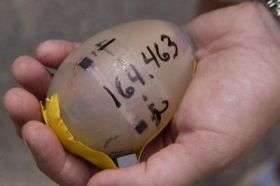
Telemetric Egg

Staff at Smithsonian's National Zoo use telemetric eggs, such as this one, to record important information about kori bustard incubation. The electronic egg is put under the adult bird and records incubation temperature and the rate the parent birds turn the egg. The data are sent from the egg to a receiver and recorded 24 hours a day. This information is vital to better understand the complete biology of the species. Credit: Jessie Cohen, Smithsonian's National Zoo

This is an important summer for kori bustards at the Smithsonian’s National Zoo. Four chicks of this threatened African bird have hatched in June and July. Along with the bumper crop of baby birds is a bumper crop of new information for scientists working to preserve the species, thanks to an electronic egg that transmits real-time incubation data from the nest.

The telemetric egg, placed in the nest after the mother has laid her eggs, contains sensors that record temperatures on four quadrants of the egg’s surface as well as in the egg’s interior. Motion detectors record how frequently the mother turns the egg during incubation. The data are recorded 24 hours a day and downloaded to a computer every 48 hours. National Zoo staff use the information to mimic natural incubation in a controlled setting in the lab.

“It’s really a breakthrough. This is data we couldn’t get any other way,” said National Zoo biologist Sara Hallager. “The information we gather helps us both understand more about the biology of these birds and how to better incubate them artificially.”

Understanding the normal activities of breeding is essential for improving husbandry practices for a species. But much of this basic biological information remains unknown for many threatened and endangered species. Temperatures and turning frequencies for artificially incubating eggs can sometimes rely as much on guesswork as on hard data. Improving the success rate of breeding not only increases the numbers of birds in captive populations, but also helps maintain their genetic diversity, which is essential for a healthy population.

Since it began its kori bustard breeding program in 1997, the National Zoo has bred and raised to adulthood nearly 40 individual birds, which have been shared with other zoos. The four eggs hatched this summer have some desired genetic diversity. The two eggs hatched in June are from a well-established genetic line; one of the eggs hatched in July is from a female not previously bred.

“For captive populations like these, the more genetic diversity the better,” Hallager said. “It’s really exciting.”

Hallager heads the Kori Bustard Species Survival Plan administered by the Association of Zoos and Aquariums. Species Survival Plans, or SSPs, are population management and conservation programs for selected species in North American zoos and aquariums. The SSPs are designed to maintain healthy and self-sustaining populations that are genetically diverse and demographically stable.

Telemetric eggs like the ones used for the National Zoo’s kori bustards have been used for whooping cranes at the Calgary Zoo in Alberta, Canada, and for waterfowl at the Saint Louis Zoo, but the technique is not yet widely applied. In addition to the kori bustards, the National Zoo also has two telemetric eggs in flamingo nests. Telemetric eggs are not yet available in sizes smaller than duck-sized eggs; but, according to Hallager, eggs for smaller species should be technologically feasible in the future.

Kori bustards, native to eastern and southern Africa, are the heaviest birds capable of flight, with males reaching up to 40 pounds; still, they are primarily ground-dwelling birds, inhabiting grasslands and feeding on an omnivorous diet. Wild populations are threatened by habitat loss and poaching for their meat and feathers.

Only the National Zoo and eight other institutions in the world have successfully bred kori bustards in captivity. There are four adult kori bustards on display at the National Zoo, which may be seen by visitors at the outdoor Bird House exhibit.

Source: Smithsonian

3.5 /5 (4 votes)  

Rank 3.5 /5 (4 votes)
Tags

Relevant PhysicsForums posts

More news stories

Entire genome of extinct human decoded from fossil

(PhysOrg.com) -- In 2010, Svante Pääbo and his colleagues presented a draft version of the genome from a small fragment of a human finger bone discovered in Denisova Cave in southern Siberia. The ...

Biology / Biotechnology

created Feb 07, 2012 | popularity 4.7 / 5 (58) | comments 45 | with audio podcast

Why are there so few fish in the Earth's oceans?

(PhysOrg.com) -- A Stony Brook University researcher has found that, contrary to popular belief, there are not plenty of fish in the sea.

Biology / Plants & Animals

created Feb 08, 2012 | popularity 4.3 / 5 (17) | comments 26 | with audio podcast

Miami battling invasion of giant African snails

No one knows how they got there. But an invasion of African giant snails has southern Florida in a panic over potential crop damage, disease and general yuckiness surrounding the slimy gastropods.

Biology / Ecology

created Feb 10, 2012 | popularity 4.5 / 5 (2) | comments 5

Deciding to go left or right: Researchers use device to determine that lower animals can navigate too

For decades, scientists have associated binary decision making — opting to go left or right — with higher-ranking animals, including humans. A team of Harvard researchers, however, is rewriting that ...

Biology / Plants & Animals

created Feb 09, 2012 | popularity 4 / 5 (1) | comments 4 | with audio podcast

Study shows chimps able to understand needs of others

(PhysOrg.com) -- By setting up a unique experiment, a small team of researchers has found that chimpanzees are able to understand need in other chimps, despite their general disinclination to offer aid when ...

Biology / Plants & Animals

created Feb 07, 2012 | popularity 5 / 5 (2) | comments 4 | with audio podcast report


Google might launch Drive for cloud storage soon

(PhysOrg.com) -- Google's next big move, according to the Wall Street Journal, is a cloud storage service called Drive. Hardly first to the plate, Google is simply catching up to introducing its cloud reposi ...

Latin America mining boom clashes with conservation

Latin America is experiencing a mining boom as prices rise fuelled by a hike in global demand, but the region is also being hit by a wave of violent protests, strikes and rallies by environmentalists.

Walney offshore wind farm is world's biggest (for now)

(PhysOrg.com) -- The Walney wind farm on the Irish Sea--characterized by high tides, waves and windy weather--officially opened this week. The farm is treated in the press as a very big deal as the Walney ...

Love a click away in Indonesia's Twitter Republic

He was a geeky kid from Yogyakarta, she a glamorous city girl in Jakarta. In a country with one of the world's most vibrant social networking scenes they fell in love on Twitter.

GPS court ruling leaves US phone tracking unclear

A US Supreme Court decision requiring a warrant to place a GPS device on the car of a criminal suspect leaves unresolved the bigger issue of police tracking using mobile phones, legal experts say.

Europeans protest controversial Internet pact

Tens of thousands of people marched in protests in more than a dozen European cities Saturday against a controversial anti-online piracy pact that critics say could curtail Internet freedom.