Martian dust storm threatens rovers' survival
July 27th, 2007 Martian dust storm threatens rovers' survival

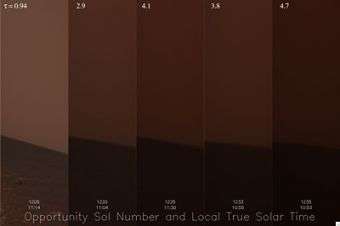
This photo, taken by the rover Opportunity, shows the Martian sky darkening over the first 30 Martian days of the storm. The number at the top of each frame is the opacity measurement (higher numbers mean dustier skies), and the numbers at the bottom are the mission sol (Martian day) number and local time on Mars. Credit: NASA/JPL/Cornell

In the three-and-a-half years that they've been on Mars, the NASA rovers Spirit and Opportunity have never seen anything like this: a large-scale dust storm that has darkened the skies and put the rovers in the gravest danger they have yet faced.

Severe winds started brewing across Mars almost a month ago, kicking up dust that prevents light from reaching the rovers' solar panels. While the dust in the atmosphere coats the planet with about the same thickness as a human hair, it has blocked 99 percent of direct sunlight to Opportunity. The rover now relies mostly on light scattered from the dust in the atmosphere to power it, and it's getting less than 25 percent of the power from its solar panels than before the storm.

Spirit, which is on the other side of the planet, has fared slightly better. For the past week, though, both rovers have had to stop driving and limit their science observations to conserve power. If the skies continue to darken over an extended period, they may not be able to generate enough power to stay warm and operate at all.

"It's fair to say this is the most dangerous situation we've faced with either rover since the beginning of the mission," said Jim Bell, Cornell associate professor of astronomy and Pancam lead scientist. "No one really knows how long the vehicles can survive with such little power," he said.

There is no storm activity directly over the rover sites right now, but Martian weather is variable and unpredictable, and Mars could remain shrouded in dust for a long time.

"Dust activity is now taking place over much of the planet, and chances are good that it will do so for weeks to come ... maybe even as long as a few months," said Steve Squyres, Cornell's Goldwin Smith Professor of Astronomy and principal investigator of the Mars Exploration Rover mission. "So there's a chance that we are looking at a significant period of low activity for both vehicles. The good news is that both rovers are very clean and in good health, and poised to do good science when there's enough power to do so."

The storm hit at an extremely inopportune time -- right when both rovers were positioned to study some of the most intriguing targets they have seen to date. Opportunity has been perched at the rim of Victoria Crater, waiting to descend its steep slopes and study the rocks exposed in the crater walls. To get to Victoria, the rover spent years driving the five miles from its landing site. Spirit has been in the vicinity of the Home Plate feature, planning to study its layered outcrops, which may reveal evidence of past volcanic activity.

When the storm clears, engineers at NASA's Jet Propulsion Laboratory will assess how much of the planned science each rover can perform.

In the meantime, Sprit and Opportunity have to, well, wait for the dust to settle.

Source: Cornell University


print this article email this article download pdf blog this article bookmark this article     Digg this Stumble it share on Facebook share on Reddit add to delicious save to Yahoo! bookmarks
4.9/5 after 21 votes


July 27th, 2007 all stories
Space & Earth / Space Exploration

Comments: 0
Rank: 4.9/5 after 21 votes

  • Stumble this up

  • Digg this

  • Share it:
  • share on Facebook
  • share on MySpace
  • share on Slashdot
  • rss-newsfeed
  • share on Google
  • share on Reddit
  • add to delicious
  • save to Yahoo! bookmarks
  • share on Windows Live
  • Add to Mixx!
Rating: 4.9/5 after 21 votes

  • Related Stories

  • Not space junk yet: Mars rovers carry on despite age, ailments
    created Jun 28, 2009 | popularity not rated yet | comments 0
  • Mars Rover Yielding New Clues While Lodged in Martian Soil
    created Jun 25, 2009 | popularity not rated yet | comments 0
  • Mars and Earth Activities Aim to Get Spirit Rolling Again
    created May 19, 2009 | popularity not rated yet | comments 0
  • Spirit rover's wheels stuck in soft Martian dirt
    created May 12, 2009 | popularity not rated yet | comments 0
  • Spirit Resumes Driving While Analysis of Problem Behaviors Continues
    created Apr 24, 2009 | popularity not rated yet | comments 0

Tags


  • Physicists Demonstrate Quantum Memory with Matter Qubits
    Physicists Demonstrate Quantum Memory with Matter Qubits
    Physics / General Physics
    created Jul 03, 2009 | popularity 4.4 / 5 (17) | comments 1
  • 'Holey' Nanosheets for Wastewater Dye Removal
    Nanotechnology / Nanomaterials
    created Jul 01, 2009 | popularity 5 / 5 (5) | comments 1
  • Jellyfish Robot Swims Like its Biological Counterpart
    Jellyfish Robot Swims Like its Biological Counterpart
    Electronics / Robotics
    created Jun 26, 2009 | popularity 4.4 / 5 (8) | comments 1
  • Could Maxwell's Demon Exist in Nanoscale Systems?
    Could Maxwell's Demon Exist in Nanoscale Systems?
    Physics / General Physics
    created Jun 24, 2009 | popularity 4.4 / 5 (18) | comments 29
  • Living Safely with Robots, Beyond Asimov's Laws
    Living Safely with Robots, Beyond Asimov's Laws
    Electronics / Robotics
    created Jun 22, 2009 | popularity 4.6 / 5 (52) | comments 40
  • Other News

    Steam billows from the cooling towers at a nuclear power generating station in Byron

    Tropical zone expanding due to climate change: study

    Space & Earth / Earth Sciences

    created 1hour ago | popularity 5 / 5 (2) | comments 0

    Climate change is rapidly expanding the size of the world's tropical zone, threatening to bring disease and drought to heavily populated areas, an Australian study has found.


    US ambitions to send astronauts back to the moon as a prelude to missions to Mars have been put in doubt

    Forty years ago man first walked on the moon

    Space & Earth / Space Exploration

    created 22 hours ago | popularity 4.3 / 5 (4) | comments 2

    Forty years ago on July 20, 1969, American astronaut Neil Armstrong realized the oldest dream of human civilizations when he became the first man to walk on the moon.


    The least sea ice in 800 years

    The least sea ice in 800 years

    Space & Earth / Earth Sciences

    created Jul 01, 2009 | popularity 4.1 / 5 (65) | comments 60

    New research, which reconstructs the extent of ice in the sea between Greenland and Svalbard from the 13th century to the present indicates that there has never been so little sea ice as there is now. The ...


    Gas around young galaxy

    Intense heat killed the Universe's would-be galaxies, researchers say

    Space & Earth / Astronomy

    created Jul 01, 2009 | popularity 3.4 / 5 (21) | comments 27

    (PhysOrg.com) -- Our Milky Way galaxy only survived because it was already immersed in a large clump of dark matter which trapped gases inside it, scientists led by Durham University's Institute for Computational ...


    Scientists' Drill Hits Magma: Only Third Time on Record

    Scientists' Drill Hits Magma: Only Third Time on Record

    Space & Earth / Earth Sciences

    created Jun 29, 2009 | popularity 4.7 / 5 (22) | comments 21

    (PhysOrg.com) -- Scientists drilling a borehole deep into Iceland’s rocky crust to explore new methods of using geothermal energy hit a major roadblock on Thursday: Their drill ran into molten rock at a depth ...