Neutron Star Swaps Lead to Short Gamma-Ray Bursts
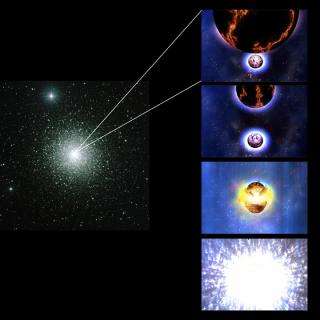
Gamma-ray bursts are the most powerful explosions in the universe, emitting huge amounts of high-energy radiation. For decades their origin was a mystery. Scientists now believe they understand the processes that produce gamma-ray bursts.
However, a new study by Jonathan Grindlay of the Harvard-Smithsonian Center for Astrophysics (CfA) and his colleagues, Simon Portegies Zwart (Astronomical Institute, The Netherlands) and Stephen McMillan (Drexel University), suggests a previously overlooked source for some gamma-ray bursts: stellar encounters within globular clusters.
"As many as one-third of all short gamma-ray bursts that we observe may come from merging neutron stars in globular clusters," said Grindlay.
Gamma-ray bursts (GRBs) come in two distinct "flavors." Some last up to a minute, or even longer. Astronomers believe those long GRBs are generated when a massive star explodes in a hypernova. Other bursts last for only a fraction of a second. Astronomers theorize that short GRBs originate from the collision of two neutrons stars, or a neutron star and a black hole.
Most double neutron star systems result from the evolution of two massive stars already orbiting each other. The natural aging process will cause both to become neutron stars (if they start with a given mass), which then spiral together over millions or billions of years until they merge and release a gamma-ray burst.
Grindlay's research points to another potential source of short GRBs - globular clusters. Globular clusters contain some of the oldest stars in the universe crammed into a tight space only a few light-years across. Such tight quarters provoke many close stellar encounters, some of which lead to star swaps. If a neutron star with a stellar companion (such as a white dwarf or main-sequence star) exchanges its partner with another neutron star, the resulting pair of neutron stars will eventually spiral together and collide explosively, creating a gamma-ray burst.
"We see these precursor systems, containing one neutron star in the form of a millisecond pulsar, all over the place in globular clusters," stated Grindlay. "Plus, globular clusters are so closely packed that you have a lot of interactions. It's a natural way to make double neutron-star systems."
The astronomers performed about 3 million computer simulations to calculate the frequency with which double neutron-star systems can form in globular clusters. Knowing how many have formed over the galaxy's history, and approximately how long it takes for a system to merge, they then determined the frequency of short gamma-ray bursts expected from globular cluster binaries. They estimate that between 10 and 30 percent of all short gamma-ray bursts that we observe may result from such systems.
This estimate takes into account a curious trend uncovered by recent GRB observations. Mergers and thus bursts from so-called "disk" neutron-star binaries - systems created from two massive stars that formed together and died together - are estimated to occur 100 times more frequently than bursts from globular cluster binaries. Yet the handful of short GRBs that have been precisely located tend to come from galactic halos and very old stars, as expected for globular clusters.
"There's a big bookkeeping problem here," said Grindlay.
To explain the discrepancy, Grindlay suggests that bursts from disk binaries are likely to be harder to spot because they tend to emit radiation in narrower blasts visible from fewer directions. Narrower "beaming" might result from colliding stars whose spins are aligned with their orbit, as expected for binaries that have been together from the moment of their birth. Newly joined stars, with their random orientations, might emit wider bursts when they merge.
"More short GRBs probably come from disk systems - we just don't see them all," explained Grindlay.
Only about a half dozen short GRBs have been precisely located by gamma-ray satellites recently, making thorough studies difficult. As more examples are gathered, the sources of short GRBs should become much better understood.
The paper announcing this finding was published in the January 29 online issue of Nature Physics. It is available online at www.nature.com/nphys/index.html and in preprint form at arxiv.org/abs/astro-ph/0512654
Source: Harvard-Smithsonian Center for Astrophysics


