New material brings hydrogen fuel, cheaper petrochemicals closer to reality
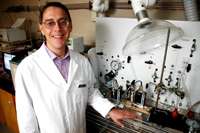
A rubbery material that can purify hydrogen efficiently in its most usable form for fuel cells and oil refining has been developed by a chemical engineering group at The University of Texas at Austin.
In the Feb. 3 edition of Science, Dr. Benny Freeman details how his laboratory designed the membrane material and tested its ability, with colleagues at Research Triangle Institute (RTI) in Research Triangle Park, N.C., to successfully separate hydrogen from carbon dioxide and other contaminant gases.
This member of a new family of membrane materials with superior gas-separating ability could lower the costs of purifying hydrogen for hydrogen-fueled vehicles. Hydrogen fuel cells are considered a leading alternative energy for running cars and other devices in the future. The membrane material could also replace an expensive step in current petrochemical processing, or reduce how much energy the step requires. The membrane was tested under conditions that mimic those routinely used by the petrochemical industry to refine petroleum components (crude oil and natural gas) for use.
"A significant amount of the hydrogen in use today goes into the refining industry to refine crude oil to produce gasoline or other products, so this membrane could lower refining costs," said Freeman, the Kenneth A. Kobe Professor in Chemical Engineering.
The membrane differs structurally and functionally from previous options, with a key advantage being its ability to permit hydrogen to remain compressed at high pressure. A compressed form of the light-weight gas is needed to process fossil fuels and for it to serve as a readily replaceable fuel for fuel cells.
Freeman and graduate student Haiqing Lin designed the membrane material in Freeman's laboratory at the university's Center for Energy and Environmental Resources.
The engineers and RTI collaborators Lora Toy and Raghubir Gupta tested flat, disk-shaped versions of the material for its ability to separate different mixtures of hydrogen and carbon dioxide gases at different temperatures. The researchers used the three common temperatures for industrial hydrogen purification: 95 degrees, 50 degrees and minus 4 degrees Fahrenheit.
The new membrane not only separated these two gases better than previous membranes, but did so when additional components such as hydrogen sulfide and water vapor were present as occurs in industrial settings. The membrane worked so well that it was 40 times more permeable to (better at separating out) carbon dioxide than hydrogen.
In contrast, current commercial membranes favor the transport of hydrogen, a small molecule, over larger carbon dioxide molecules. This process results in hydrogen being transferred to a low-pressure environment that requires expensive recompression of the gas before use.
The new membrane avoids this recompression step by favoring the transport of larger, polar gas molecules as a result of the polar nature of the polymer materials making up the membrane. The polar, reverse-selective materials based on ethylene oxide interact better with polar gases such as carbon dioxide than with smaller, nonpolar hydrogen gas, which is left behind in a high-pressure state.
"The membrane likes carbon dioxide more than hydrogen, and we optimized that affinity," Freeman said. Plasticization, a process that softens materials and dilates them, was also found to improve the movement of the larger carbon dioxide through the new membrane for separation purposes. Several companies have already shown interest in collaborating to develop the material for industrial-scale applications.
Source: University of Texas at Austin


