'Deep Impact' team reports first evidence of cometary ice
February 2, 2006
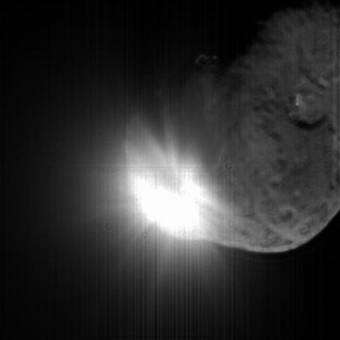
Ejecta plume from Tempel 1, 13 seconds after impact

Comet Tempel 1, which created a flamboyant Fourth of July fireworks display in space last year, is covered with a small amount of water ice. These results, reported by members of NASA's Deep Impact team in an advanced online edition of Science, offer the first definitive evidence of surface ice on any comet.

"We have known for a long time that water ice exists in comets, but this is the first evidence of water ice on comets," said Jessica Sunshine, Deep Impact co-investigator and lead author of the Science article.

A chief scientist with Science Applications International Corporation who holds three Brown University degrees, Sunshine said the discovery offers important insight into the composition of comets – small, Sun-orbiting space travelers that are believed to be leftovers from the formation of the solar system.

"Understanding a comet's water cycle and supply is critical to understanding these bodies as a system and as a possible source that delivered water to Earth," she said. "Add the large organic component in comets and you have two of the key ingredients for life."

The findings help satisfy one of the major goals of the Deep Impact mission: Find out what is on the inside – and outside – of a comet.

To that end, NASA's Jet Propulsion Laboratory teamed with the University of Maryland to slam a space probe into Tempel 1, then analyze materials from the comet's surface and interior. On July 4, 2005, mission members hit their mark when the copper-tipped probe collided with Tempel 1 and created a spectacular extraterrestrial explosion 83 million miles from Earth.

Since then, the Deep Impact team has reported a few key findings. These include an abundance of organic matter in Tempel 1's interior as well as its likely origins – the region of the solar system now occupied by Uranus and Neptune.

According to the new research in Science, the comet's surface features three pockets of thin ice. The area the ice covers is small. The surface area of Tempel 1 is roughly 45 square miles or 1.2 billion square feet. The ice, however, covers roughly 300,000 square feet. And only 6 percent of that area consists of pure water ice. The rest is dust.

"It's like a seven-acre skating rink of snowy dirt," said Peter Schultz, professor of geological sciences at Brown, Deep Impact co-investigator and co-author on the Science paper.

Sunshine, Schultz and the rest of the team arrived at their findings by analyzing data captured by an infrared spectrometer, an optical instrument that uses light to determine the composition of matter.

Based on this spectral data, it appears that the surface ice used to be inside Tempel 1 but became exposed over time. The team reports that jets – occasional blasts of dust and vapor – may send this surface ice, as well as interior ice, to the coma, or tail, of Tempel 1.

"So we know we're looking at a geologically active body whose surface is changing over time," Schultz said. "Now we can begin to understand how and why these jets erupt."

Source: NASA

4.1 /5 (9 votes)  

Rank 4.1 /5 (9 votes)
Tags

Related Stories
Relevant PhysicsForums posts

More news stories

Humans may have helped the decline of African rainforests 3000 years ago

(PhysOrg.com) -- Large areas of rainforests in Central Africa mysteriously disappeared over three thousand years ago, to be replaced by savannas. The prevailing theory has been that the cause was a change ...

Space & Earth / Environment

created 19 hours ago | popularity 4.3 / 5 (11) | comments 12 | with audio podcast report

Could Venus be shifting gear?

(PhysOrg.com) -- ESA’s Venus Express spacecraft has discovered that our cloud-covered neighbour spins a little slower than previously measured. Peering through the dense atmosphere in the infrared, the ...

Space & Earth / Space Exploration

created 15 hours ago | popularity 5 / 5 (7) | comments 7 | with audio podcast

NASA budget will axe Mars deal with Europe: scientists

US President Barack Obama's budget proposal to be submitted next week for 2013 will cut NASA's budget by 20 percent and eliminate a major partnership with Europe on Mars exploration, scientists said Thursday.

Space & Earth / Space Exploration

created 18 hours ago | popularity 5 / 5 (2) | comments 18

Mars Science Laboratory computer issue resolved

(PhysOrg.com) -- Engineers have found the root cause of a computer reset that occurred two months ago on NASA's Mars Science Laboratory and have determined how to correct it.

Space & Earth / Space Exploration

created 16 hours ago | popularity 4.7 / 5 (6) | comments 3 | with audio podcast

Two new moons for Jupiter

Advances in technology have lead to the discovery of new planets outside of our Solar System, and now even new moons in our own backyard.

Space & Earth / Space Exploration

created 15 hours ago | popularity 4 / 5 (1) | comments 7


Google users warned of threat to smartphone wallets

Users of Google smartphone wallets were being warned on Friday that there is a way to crack pass codes intended to thwart thieves from going on illicit shopping sprees.

Anonymous knocks CIA website offline (Update)

The website of the Central Intelligence Agency was inaccessible on Friday after the hacker group Anonymous claimed to have knocked it offline.

New error-correcting codes guarantee the fastest possible rate of data transmission

Error-correcting codes are one of the triumphs of the digital age. They’re a way of encoding information so that it can be transmitted across a communication channel — such as an optical fiber o ...

New power source discovered

(PhysOrg.com) -- Researchers at the Massachusetts Institute of Technology (MIT) and RMIT University have made a breakthrough in energy storage and power generation.

Complex wiring of the nervous system may rely on a just a handful of genes and proteins

Researchers at the Salk Institute have discovered a startling feature of early brain development that helps to explain how complex neuron wiring patterns are programmed using just a handful of critical genes. ...

The power of estrogen -- male snakes attract other males

A new study has shown that boosting the estrogen levels of male garter snakes causes them to secrete the same pheromones that females use to attract suitors, and turned the males into just about the sexiest ...