One fish, two fish: New MIT sensor improves fish counts
February 2, 2006
One fish, two fish: New MIT sensor improves fish counts

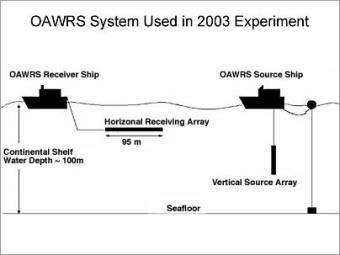
Setup for the remote sensor system used to measure fish populations off Long Island, N.Y., by researchers from MIT, Northeastern University and the Naval Research Laboratory. Image courtesy / Nicholas Makris

Researchers at MIT have found a new way of looking beneath the ocean surface that could help definitively determine whether fish populations are shrinking.

A remote sensor system developed by Associate Professor Nicholas Makris of mechanical engineering, along with others at MIT, Northeastern University and the Naval Research Laboratory, allows scientists to track enormous fish populations, or shoals, as well as small schools, over a 10,000-square-kilometer area - a vast improvement over conventional technology that can survey only about 100 square meters at a time.

"We're able to see for the first time what a large group of fish looks like," said Makris, who compared the dramatic improvement to the difference between seeing everything on a television screen and seeing only one pixel.

The new sensor system, described in the Feb. 3 issue of Science, could allow government agencies to figure out what's really happening to fish populations, which many environmentalists and scientists believe are in rapid decline.

"The world's fish stocks are being depleted at a horrible rate," said Makris, who attributed declining populations to overfishing, a problem that has been abetted by inaccurate fish counts. "One of the reasons (for the inaccurate counts) is the darkness in the ocean. You don't know what's going on."

Current surveying methods depend on highly localized observations taken from slow-moving research vessels, which provide only a small amount of data about a large shoal, Makris said. "It would be like watching 'Casablanca' and you're seeing one pixel moving across the screen, and that's all you get. You can't figure out what's going on, it's way too slow," he said.

Both the new and old methods rely on sonar, which locates objects by bouncing sound waves off of them. With the old technique, survey vessels send high-frequency sonar beams into the ocean, where they dissipate much like the light from a flashlight shining into a darkened room.

In contrast, the new system uses low-frequency sonar that can travel much greater distances and still return useful information with signals far less intense. This effectively "illuminates" vast areas of the ocean, about a million times larger than what could previously be studied. The images can be updated every minute, offering a chance to continuously monitor the shoals as they change in size and shape over time.

The new technology works best along the continental shelf, so the researchers focused their attention on the waters south of Long Island, New York. When they first started, they weren't looking for fish at all - they wanted to see if their device could locate ancient riverbeds under the ocean floor. But when their reconnaissance images did not match the riverbeds, the researchers went back with a new approach, and determined that they were seeing fish - tens of millions of fish.

This marks the first time scientists have been able to see the patterns formed by large fish populations. Makris found that fish often congregate in an hourglass pattern, also found among other animals, with a thin "bridge" connecting the two ends. The researchers also observed that the same shapes seen in a small scale appear on larger scales - tens of meters vs. tens of kilometers - displaying a fractal pattern.

Population density patterns could be a means of communication, Makris said. His team observed "waves" of population density that spread quickly through a shoal. "We have a situation where information can be very rapidly transmitted with these waves," he said.

Source: MIT

4.7 /5 (3 votes)  

Rank 4.7 /5 (3 votes)
Tags

Related Stories
Relevant PhysicsForums posts

More news stories

Anonymous knocks CIA website offline (Update)

The website of the Central Intelligence Agency was inaccessible on Friday after the hacker group Anonymous claimed to have knocked it offline.

Technology / Internet

created 10 hours ago | popularity 5 / 5 (9) | comments 16

New error-correcting codes guarantee the fastest possible rate of data transmission

Error-correcting codes are one of the triumphs of the digital age. They’re a way of encoding information so that it can be transmitted across a communication channel — such as an optical fiber o ...

Technology / Computer Sciences

created 19 hours ago | popularity 4.9 / 5 (8) | comments 6 | with audio podcast

Google users warned of threat to smartphone wallets

Users of Google smartphone wallets were being warned on Friday that there is a way to crack pass codes intended to thwart thieves from going on illicit shopping sprees.

Technology / Internet

created 9 hours ago | popularity 5 / 5 (2) | comments 0

New power source discovered

(PhysOrg.com) -- Researchers at the Massachusetts Institute of Technology (MIT) and RMIT University have made a breakthrough in energy storage and power generation.

Technology / Energy & Green Tech

created 18 hours ago | popularity 4.7 / 5 (30) | comments 8 | with audio podcast

Small modular reactor design could be a 'SUPERSTAR'

(PhysOrg.com) -- Though most of today's nuclear reactors are cooled by water, we've long known that there are alternatives; in fact, the world's first nuclear-powered electricity in 1951 came from a reactor ...

Technology / Energy & Green Tech

created 18 hours ago | popularity 4.4 / 5 (13) | comments 24 | with audio podcast


Humans may have helped the decline of African rainforests 3000 years ago

(PhysOrg.com) -- Large areas of rainforests in Central Africa mysteriously disappeared over three thousand years ago, to be replaced by savannas. The prevailing theory has been that the cause was a change ...

The power of estrogen -- male snakes attract other males

A new study has shown that boosting the estrogen levels of male garter snakes causes them to secrete the same pheromones that females use to attract suitors, and turned the males into just about the sexiest ...

Complex wiring of the nervous system may rely on a just a handful of genes and proteins

Researchers at the Salk Institute have discovered a startling feature of early brain development that helps to explain how complex neuron wiring patterns are programmed using just a handful of critical genes. ...

Could Venus be shifting gear?

(PhysOrg.com) -- ESA’s Venus Express spacecraft has discovered that our cloud-covered neighbour spins a little slower than previously measured. Peering through the dense atmosphere in the infrared, the ...

Advanced power-grid model finds low-cost, low-carbon future in West

(PhysOrg.com) -- The least expensive way for the Western U.S. to reduce greenhouse gas emissions enough to help prevent the worst consequences of global warming is to replace coal with renewable and other ...

Fool's gold may prove an unlikely alternative to overexploited catalytic materials

Catalytic materials, which lower the energy barriers for chemical reactions, are used in everything from the commercial production of chemicals to catalytic converters in car engines. However, with current catalytic materials ...