Birth of a colossus on wheels
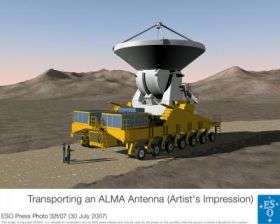
The first of two spectacular vehicles for the ALMA (Atacama Large Millimeter/submillimeter Array) Observatory rolled out of its hangar and passed successfully a series of tests. This vehicle, the ALMA antenna transporter, is a rather exceptional 'lorry' driving on 28 tyres. It is 10m wide, 20m long and 6m high, weighs 130 tons and has as much power as two Formula 1 engines. This colossus will be able to transport a 115-ton antenna and set it down on a concrete pad within millimetres of a prescribed position.
The ALMA Project is a giant, international observatory currently in construction on the high-altitude Chajnantor site in Chile, and composed initially of 66 high-precision telescopes, operating at wavelengths of 0.3 to 9.6 mm. The ALMA antennas will be electronically combined and provide astronomical observations which are equivalent to a single large telescope of tremendous size and resolution. ALMA will be able to probe the Universe at millimetre and submillimetre wavelengths with unprecedented sensitivity and resolution, with an accuracy up to ten times better than the Hubble Space Telescope, and complementing images made with ESO's Very Large Telescope Interferometer.
The telescopes can be moved across the high-altitude desert Chajnantor plateau, covering antenna configurations as compact as 150 metres to as wide as 15 kilometres. Changing the relative positions of the antennas and thus also the configuration of the array allows for different observing modes, comparable to using a zoom lens on a camera.
"The ALMA antennas will be assembled and their functionality will be verified at a base camp, located at an altitude of 2900 metres and the transporters will in a first step bring the telescopes up to the 5000-m high observatory," explains Hans Rykaczewski, the European ALMA Project Manager. "There, the transporters will move the antennas from the compact configuration to any extended configuration which could stretch up to 15 kilometres."
"The ability to move antennas to reconfigure the observatory's array is vital to fulfilling ALMA's scientific mission. The operations plan calls for moving antennas on a regular basis to provide the flexibility that will be such a big part of ALMA's scientific value. That's why the transporters are so important and why this is such a significant milestone," says Adrian Russell, the North American Project Manager for ALMA.
Given their important functions, both for the scientific work and in transporting high-tech antennas with the required care, the vehicles must live up to very demanding operational requirements. Each transporter has a mass of 130 tons and is able to lift and transport antennas of up to a weight of 115 tons. The transporters have to position the antennas on the docking pads with precision in the millimetre range. On the other hand, the transporters must be powerful enough to reliably and safely climb from an altitude of 2900 m to 5000 m with their heavy and valuable load, putting extraordinary demands on the two 500 kW diesel engines.
Not only moving telescopes to the high altitude site is a technical challenge, even driving to the base camp requires special attention. To drive this road downhill a special brake system had to be installed. Finally, as the transporters will be operated at an altitude with significantly reduced oxygen levels, a range of redundant safety devices had to be installed to protect both personnel and equipment from possible mishaps or accidents.
"In order to operate the transporter at the ALMA site, two engines with a total of about 1400 horse powers are installed and all the components have been checked to meet the requirements at this extreme conditions," says Andreas Kohler, Vice President for Research and Development at Scheuerle Fahrzeugfabrik, the company which signed in December 2005 the contract with ESO to build these two unique transporters. "The human factor was also considered. For example, the backrests of the driver seats are shaped to allow the driver to wear his oxygen tank while driving."
At the high altitude site of 5000 m, the two engines will loose about half of their power (compared to sea level) because of the reduced oxygen content on the air. The ALMA transporters will be able to move at the speed of 20 km/h when empty and 12 km/h when loaded with an antenna. The transporters can be driven from the cabin like a truck, or from a portable panel like a toy car.
The first ALMA transporter is planned to be delivered to the ALMA Observatory by the end of 2007. The second vehicle should arrive about three months later.
Source: European Southern Observatory


