Study: King Tut slain by sword in the knee
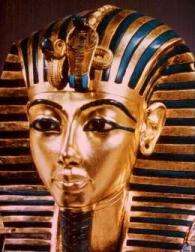
February 2, 2006 Pharaoh Tutankhamun

Researchers from Italy's Bolzano University say they believe Egyptian Pharaoh Tutankhamun died from an infection caused by a sword cut.

The scientists say they found traces of gold leaf bearing animal symbols in the late pharaoh's right kneecap, Italian news agency ANSA reported. That led the researchers to surmise it had fallen from Tutankhamun's raiments, lodging in a hole they believe was caused by a sword.

Experts during the centuries have been unable to definitively say what caused King Tut's death. But the new discovery has led to the hypothesis a sword blow produced a fatal infection.

ANSA said the findings have not yet officially been made public. An Italian newspaper said Egypt's archaeological chief Zahi Hawass was awaiting a final report before making an announcement.

Copyright 2006 by United Press International


print this article email this article download pdf blog this article bookmark this article     Stumble it Digg this share on Facebook retweet share on Reddit add to delicious
Rate this story - 3.3 /5 (121 votes)

Rank Filter

Move the slider to adjust rank threshold, so that you can hide some of the comments.


Display comments: newest first


February 2, 2006 all stories

Comments: 1

3.3 /5 (121 votes)
  • Stumble this up

  • Digg this

  • share this

  • hide
  • Related Stories

  • Study shows that some malignant tumors can be shut down after all
    created Nov 09, 2009 | popularity not rated yet | comments 0
  • Hormone mix could cut breast cancer risk and treat symptoms of menopause
    created Oct 19, 2009 | popularity not rated yet | comments 0
  • Nanotube risk assessment
    created Sep 18, 2009 | popularity not rated yet | comments 0
  • Craters on Vesta and Ceres Could Hold Key to Jupiter's Age
    created Sep 15, 2009 | popularity not rated yet | comments 0
  • 'Biotech violin' outdoes Stradivarius
    created Sep 14, 2009 | popularity not rated yet | comments 0


Other News

Museum: Galileo's fingers, tooth are found (AP)

Museum: Galileo's fingers, tooth are found

Other Sciences / Archaeology & Fossils

created 14 hours ago | popularity not rated yet | comments 5

(AP) -- Two fingers and a tooth removed from Galileo Galilei's corpse in a Florentine basilica in the 18th century and given up for lost have been found again and will soon be put on display, an Italian museum ...


Measure to change U. of Neb. stem-cell rule fails (AP)

Measure to change U. of Neb. stem-cell rule fails (Update 2)

Other Sciences / Other

created 14 hours ago | popularity 5 / 5 (1) | comments 0

(AP) -- The University of Nebraska's governing board on Friday voted not to place tighter restrictions on embryonic stem cell research than those outlined under federal guidelines, which were expanded after ...


Researcher: Faint writing seen on Shroud of Turin (AP)

Researcher: Faint writing seen on Shroud of Turin (Update)

Other Sciences / Archaeology & Fossils

created Nov 20, 2009 | popularity 1.7 / 5 (22) | comments 23

(AP) -- A Vatican researcher has rekindled the age-old debate over the Shroud of Turin, saying that faint writing on the linen proves it was the burial cloth of Jesus. Experts say the historian may be reading ...


Three of a kind

Three of a kind: Revealing language’s universal essence

Other Sciences / Social Sciences

created Nov 20, 2009 | popularity 3.7 / 5 (9) | comments 6

(PhysOrg.com) -- On the surface, English, Japanese, and Kinande, a member of the Bantu family of languages spoken in the Democratic Republic of Congo, have little in common. It is not just that the vocabularies ...


Maya

New insights into the life of the Maya

Other Sciences / Archaeology & Fossils

created Nov 16, 2009 | popularity 4.6 / 5 (15) | comments 7

(PhysOrg.com) -- Ancient artifacts are almost always concerned with rich and powerful religious and political leaders, but new excavations of an ancient Maya site have unearthed a pyramid decorated with murals ...