Circumstellar space: Where chemistry happens for the very first time
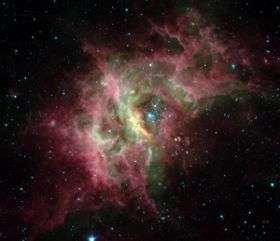
Picture a cool place, teeming with a multitude of hot bodies twirling about in rapidly changing formations of singles and couples, partners and groups, constantly dissolving and reforming. If you were thinking of the dance floor in a modern nightclub, think again.
It's a description of the shells around dying stars, the place where newly formed elements make compounds and life takes off, said Katharina Lodders, Ph.D., research associate professor of earth and planetary sciences in Arts & Sciences at Washington University in St. Louis.
Chemistry for the very first time
“The circumstellar environment is where chemistry happens for the very first time,” said Lodders. “It's the first place a newly synthesized element can do chemistry. It's a supermarket of things from dust to gas and dust grains to molecules and atoms. The circumstellar shells enable a chemistry that produced grains older than our sun itself. It's generated some popular interest, and this year marks the 20th anniversary of the presolar grain discoveries.”
After the discovery of presolar diamonds in a meteorite in 1987 - the first stardust found in a meteorite - researchers at Washington University in St. Louis have been prominent in finding and analyzing pre-solar grains made of silicon carbide, diamonds, corundum, spinel, and silicates. The latest discovery - a silicate grain that formed around a foreign star and became incorporated into a comet in our solar system - was captured and returned by the STARDUST space mission in 2006.
Lodders said that nucleosynthesis - the creation of atoms - takes place in a star's interior, made of a plasma far too hot for any molecular chemistry to take place. The event that enables chemistry is the death of a star, when elements are spewed out of the core, creating a shell around the star. As this circumstellar shell cools, the elements react to form gas molecules and solid compounds.
A star comes of age
Our sun and other dwarf stars of less than about ten solar masses burn hydrogen into helium in their cores. As they come of age, they become Red Giant stars and burn the helium to carbon and oxygen. But many heavy elements such as strontium and barium, even heavier than iron, are also produced, albeit in much smaller quantities than carbon. At the same time, the star begins to eject its outer layers into the interstellar medium by stellar winds, building up a circumstellar shell. So eventually, most of a star's mass, including the newly produced elements, is ejected into the interstellar medium through the circumstellar shell. Most interstellar grains come from such stars.
Heavyweight stars go out more spectacularly, in violent supernovae such as SN2006gy, first observed late last year, which has turned out to be the most massive supernova ever witnessed. But no matter what, all stars like the sun and heavier ones like SN2006gy empty their elements into their circumstellar environments, where gaseous compounds and grains can form. From there, the gas and grains enter the interstellar medium and provide the material for new stars and solar systems to be born.
Lodders presented a paper on circumstellar chemistry and presolar grains at the 233rd American Chemical Society National Meeting, held March 25-29 in Chicago, where a special symposium was held to track the evolution of the elements across space and time. A book of proceedings is being prepared for publication.
Lodders said that just one percent of all known presolar grains come from supernovas. She said that several million stars have been catalogued and several thousand individual presolar grains have now been analyzed. “Back in the 1960s, astronomers didn't know that presolar grains existed in meteorites,” Lodders said. “They were discovered when researchers were looking at meteorite samples and studying noble gases. They asked what is the mineral carrier of the noble gases.”
By separating minerals from samples of meteorites, they eventually found the carriers of the noble gases - presolar diamonds, graphite and silicon carbide -, and thus started the study of presolar grains 20 years ago. “So the genuine, micron-size star dust survived despite the potential chemical and physical processing in the interstellar medium, during solar system formation, and in the meteorite's parent asteroid,” she said. "Since the star dust preserved in meteorites must have been already present before the solar system and the meteorites formed, researchers call this star dust presolar grains".
“Laboratory astronomy of stardust has revealed much about stellar element and isotope production, and about gas and dust formation conditions in giant stars and supernovae.”
Source: Washington University in St. Louis


