Progress to Launch to Space Station
July 31, 2007 Progress vehicle

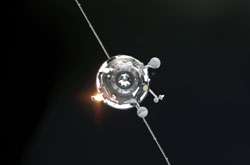
Backdropped by the blackness of space, an unpiloted Progress supply vehicle approaches the International Space Station in May 2007. Credit: NASA

A new Progress cargo carrier is scheduled to launch to the International Space Station at 1:34 p.m. EDT Thursday, Aug. 2, with more than 2.5 tons of fuel, air, water and other supplies and equipment aboard.

The station's 26th Progress unpiloted spacecraft will bring to the orbiting laboratory almost 1,600 pounds of propellant, more than 100 pounds of air and oxygen, more than 465 pounds of water and 2,954 pounds of dry cargo. Total cargo weight is 5,111 pounds.

Among the dry cargo are spares for Russian computers that had problems during the STS-117 mission of Atlantis to the station in June.

P26 will launch from the Baikonur Cosmodrome in Kazakhstan. It is scheduled to dock with the station Sunday, Aug. 5, at about 2:38 p.m.

The spacecraft will use the automated Kurs system to dock at the aft port of the Zvezda Service Module. Expedition 15 Commander Fyodor Yurchikhin will be at the manual TORU docking system controls, should his intervention become necessary.

Once Expedition 15 crew members, Yurchikhin and flight engineers Oleg Kotov and Clay Anderson, have unloaded the cargo, P26 will be filled with trash and station discards. It will be undocked from the station with its load of trash and deorbited, to burn in the Earth's atmosphere.

The Progress is similar in appearance and some design elements to the Soyuz spacecraft, which brings crew members to the station, serves as a lifeboat while they are there and returns them to Earth. The aft module, the instrumentation and propulsion module, is nearly identical.

But the second of the three Progress sections is a refueling module, and the third, uppermost as the Progress sits on the launch pad, is a cargo module. On the Soyuz, the descent module, where the crew is seated on launch and which returns them to Earth, is the middle module and the third is called the orbital module.

Source: NASA


print this article email this article download pdf blog this article bookmark this article     Stumble it Digg this share on Facebook retweet share on Reddit add to delicious
Rate this story - 5 /5 (2 votes)


July 31, 2007 all stories

Comments: 0

5 /5 (2 votes)
  • Stumble this up

  • Digg this

  • share this

  • hide
  • Related Stories

  • Rocket with new module for space station blasts off
    created 11 hours ago | popularity not rated yet | comments 0
  • Light-Duty Day for ISS Crew, Expedition 21 to Launch Wednesday Morning
    created Sep 29, 2009 | popularity not rated yet | comments 0
  • Wolfram Alpha 'Knowledge Engine' is Like a Modern Farmer's Almanac
    created May 08, 2009 | popularity not rated yet | comments 0
  • Ares I Five Segment Development Motor on the Move
    created Apr 20, 2009 | popularity not rated yet | comments 0
  • Crossing the icy unknown, hunting climate clues
    created Mar 21, 2009 | popularity not rated yet | comments 0


  • hide
  • Relevant PhysicsForums posts

  • Consistency of Meteor Shower Dates (i.e. the peak of Perseids always on Aug 13th)
    created 5 hours ago
  • Favourite Astronomy Book?
    created 20 hours ago
  • dark energy
    created 20 hours ago
  • The shape of our solar system's orbits.
    created Nov 07, 2009
  • More from Physics Forums - General Astronomy

Other News

Controversial new climate change results

Controversial new climate change results

Space & Earth / Environment

created 17 hours ago | popularity 4.5 / 5 (16) | comments 19

(PhysOrg.com) -- New data show that the balance between the airborne and the absorbed fraction of CO2 has stayed approximately constant since 1850, despite emissions of CO2 having risen from about 2 billion ...


Earth

Atomic Particles Help Solve Planetary Puzzle

Space & Earth / Earth Sciences

created 8 hours ago | popularity 4.6 / 5 (5) | comments 0

(PhysOrg.com) -- A University of Arkansas professor and his colleagues have shown that the Earth's mantle contains the same isotopic signatures from magnesium as meteorites do, suggesting that the planet formed ...


The Stars My Destination

The Stars My Destination

Space & Earth / Space Exploration

created 9 hours ago | popularity 5 / 5 (10) | comments 0

The Voyager spacecraft are now in the outermost layer of the heliosphere, traveling toward interstellar space - the first man-made spacecraft to travel such a vast distance from Earth.


Cave study links climate change to California droughts

Space & Earth / Earth Sciences

created 10 hours ago | popularity 3.7 / 5 (3) | comments 0

California experienced centuries-long droughts in the past 20,000 years that coincided with the thawing of ice caps in the Arctic, according to a new study by UC Davis doctoral student Jessica Oster and geology professor ...


Scientists prepare the Mini-Research Module 2 (MRM 2) "Poisk"

Rocket with new module for space station blasts off

Space & Earth / Space Exploration

created 11 hours ago | popularity 5 / 5 (1) | comments 0

A Soyuz rocket carrying a new Russian-made module for the International Space Station blasted off on Tuesday from the Baikonur space base in Kazakhstan, television pictures showed.