Carbon Nanotube Network Detects DNA Without Labels
February 3, 2006 Carbon Nanotube Network Detects DNA Without Labels

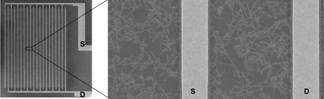
Figure 1: A random network of carbon nanotubes lies between parallel metal electrodes on a silicon chip. The distance between the electrodes is 10 micrometers.

Using a microchip device constructed with carbon nanotubes, researchers at the University of Pittsburgh and Nanomix, Inc., in Emeryville, CA, have developed a rapid method of detecting specific DNA sequences, including single-base mutations. The sensitivity of the new device is good enough to detect a single-base mutation in an amount of DNA present in one milliliter of blood.

This work was reported in the Proceedings of the National Academy of Science USA.

The key element of the new device is a network of carbon nanotube field-effect transistors. A team of investigators led by Alexander Star, Ph.D., from the University of Pittsburgh, and Christian Valcke, Ph.D., of Nanomix, Inc., created this sensing element by depositing single-wall carbon nanotubes between sets of parallel electrodes etched into a standard semiconductor chip (see Figure 1). Rather than attempt to align a few carbon nanotubes between a set of electrodes, a task that has proven difficult, the investigators used a large, random network of nanotubes.

The flow of electrical current between the two electrodes depends on the average electrical conductivity of the nanotube network lying between them. In turn, the electrical conductivity of the nanotube network changes markedly whenever DNA molecules stick to the surface of an individual nanotube.

To make the device specific for a particular piece of DNA, the investigators first coat the nanotubes with a piece of DNA whose sequence is complementary to the sequence of interest. If the goal is to detect a particular gene mutation, for example, the nanotubes would be coated with DNA whose base sequence (the order or A, T, C, and G) is complementary to that of a stretch of DNA that includes the known mutation. When a sample of DNA is then added to the device, any piece of DNA containing the target sequence, in this case a particular mutation, binds its complement on the nanotubes, producing a sharp drop in electrical conductivity.

The researchers note that their use of a random network of carbon nanotubes should make it easy to manufacture these devices at a low cost. The investigators are now working on methods for incorporating these sensors into microfluidics devices that could be used in doctors’ offices.

This work is detailed in a paper titled, “Label-free detection of DNA hybridization using carbon nanotube network field-effect transistors.” Investigators from the University of Pittsburgh and the University of California, Los Angeles, also participated in this study. An abstract is available through PubMed.

Source: National Cancer Institute


print this article email this article download pdf blog this article bookmark this article     Stumble it Digg this share on Facebook retweet share on Reddit add to delicious
Rate this story - 4.2 /5 (13 votes)


February 3, 2006 all stories

Comments: 0

4.2 /5 (13 votes)
  • Stumble this up

  • Digg this

  • share this

  • hide
  • Related Stories

  • Model microbial community for studying expanding dead zones characterized
    created Oct 22, 2009 | popularity not rated yet | comments 0
  • Sugarcane research aims to harvest green energy
    created Jul 10, 2009 | popularity not rated yet | comments 0
  • Progress Toward Artificial Tissue?
    created May 15, 2009 | popularity not rated yet | comments 0
  • Hungry microbes share out the carbon in the roots of plants
    created Oct 18, 2007 | popularity not rated yet | comments 0
  • Bacteria to run our cars, warm our homes
    created Oct 10, 2006 | popularity not rated yet | comments 0


Other News

Nanowire Formation

Nanowires key to future transistors, electronics

Nanotechnology / Nanophysics

created 20 hours ago | popularity 4.8 / 5 (8) | comments 1

(PhysOrg.com) -- A new generation of ultrasmall transistors and more powerful computer chips using tiny structures called semiconducting nanowires are closer to reality after a key discovery by researchers ...


Water droplets direct self-assembly process in thin-film materials

Nanotechnology / Nanomaterials

created Nov 23, 2009 | popularity 5 / 5 (4) | comments 2

You can think of it as origami - very high-tech origami. Researchers at the University of Illinois have developed a technique for fabricating three-dimensional, single-crystalline silicon structures from thin films by coupling ...


Using superconducting probes to get a picture of what it's like inside CNTs

Nanotechnology / Nanophysics

created Nov 20, 2009 | popularity 4.4 / 5 (9) | comments 0

(PhysOrg.com) -- "Carbon nanotubes are exciting for fundamental physics, and for potential technological applications," Nadya Mason tells PhysOrg.com. "However, we are generally limited in the way that we can study them. ...


Peptides control crystal growth with 'switches, throttles and brakes'

Peptides control crystal growth with 'switches, throttles and brakes'

Nanotechnology / Bio & Medicine

created Nov 23, 2009 | popularity 4.8 / 5 (5) | comments 0

(PhysOrg.com) -- By producing some of the highest resolution images of peptides attaching to mineral surfaces, scientists have a deeper understanding how biomolecules manipulate the growth crystals. This research ...


Fast, easy, and highly sensitive arsenic detection with gold nanoparticles

Nanotechnology / Nanomaterials

created Nov 25, 2009 | popularity 5 / 5 (1) | comments 0

(PhysOrg.com) -- Mention of arsenic poisoning usually brings to mind underhanded murder. However, the danger of arsenic poisoning from contaminated drinking water is far greater. Low concentrations of arsenic are found in ...