Coelacanth fossil sheds light on fin-to-limb evolution
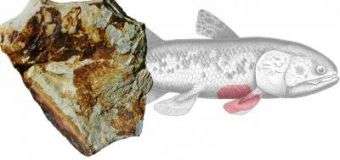
A 400 million-year-old fossil of a coelacanth fin, the first finding of its kind, fills a shrinking evolutionary gap between fins and limbs. University of Chicago scientists describe the finding in a paper highlighted on the cover of the July/August 2007 issue of Evolution & Development.
The fossil shows that the ancestral pattern of lobed fins closely resembles the pattern in the fins of primitive living ray-finned fishes, according to the scientists.
“This ends intense debate about the primitive pattern for lobed fins, which involves the ancestry of all limbs, including our own,” said author Michael Coates, Ph.D., associate professor of organismal biology and anatomy at Chicago.
According to the researchers, the fossil’s pattern is similar to the branching arrangement still embedded in the fins of paddlefishes, sturgeons and sharks.
“To understand the developmental evolution of the limbs of tetrapods [four-limbed vertebrates], we shouldn’t be looking at the fins of our nearest living fish relatives—lungfishes and coelacanths—because they’re far too specialized,” Coates said.
“Part of the reason why this is an interesting discovery is that people think of coelacanths animals as archetypal living fossils,” said Matt Friedman, evolutionary biology graduate student at Chicago and lead author of the paper. “But it’s a common misconception. If you look deep in the fossil record to the first members of that group, they are really different and very diverse.”
Until now, many biologists have looked at lungfish as a primitive model of the evolution of tetrapods. “Our fossil shows that what we’ve been using to define a primitive state is actually very specialized,” Friedman said, “which means it might give a deceptive view of what evolution was like for these fins skeletons.”
“If you’re going to figure out how limbs evolved, you need to have a good idea about pre-conditions,” Friedman said. “You need to know what the ancestral morphology was. With things like this [fossil], we’re beginning to hone in on the primitive conditions of fins that gave rise to limbs later on.”
Named Shoshonia arctopteryx after the Shoshoni people and the Shoshone National Forest, the fossil was excavated from Paleozoic sediments at Beartooth Butte in northern Wyoming.
Even though they both have been called living fossils, the discovery suggests that the two living groups of close fish relatives of tetrapods (lungfish and coelacanth) are both highly specialized, according to Friedman. Both groups acquired many of the same specializations, but independently of one another.
“They give this perception that maybe those are general characters, but we can show with fossils like this one that they’ve actually developed specializations in tandem,” Friedman said.
Shoshonia also supports recent work by the University of Chicago’s Neil Shubin, Marcus Davis and Randall Dahn that showed genetic expression of developmental patterns in fish fins and tetrapod limbs are conserved (Nature, May 24, 2007). “With this fossil, we have a conservative pattern in a close relative of tetrapods that is actually conserved in other fish groups outside of this immediate group,” Friedman said.
Not only does this fossil bridge the gap between primitive ray-finned fish and limbed animals like Tiktaalik roseae, the new data forces scientists to reassess the characteristics of the coelacanths, Friedman said.
“‘Living fossils’ are a problematic concept,” he said. “Often times the fossils look like living animals because the fossils are so poorly studied. Once you start to go in depth with the fossils, you start highlighting differences.”
Coelacanths were dubbed “Old Fourlegs,” because of their husky, limb-like fins. “When they first discovered them in the 1930s, people made all sorts of inferences about them,” Friedman said. “They assumed that it would use its fins to walk around on the bottom of the sea floor.”
Rather, these distinctive blue fish swim with their heads down, hovering just above the sea floor using an organ in their nose to detect living things in the mud.
“It was astonishing luck that we found it,” Friedman said, adding that the fossil had fallen off a cliff a couple of hundred feet high and landed in a different set of rocks. The four-inch long specimen details the fin of the animal, which the scientists approximate would have been about 18” to 24” long.
The scientists will return to the Wyoming site next summer to collect more samples.
Source: University of Chicago Medical Center


