The Mysterious Smell of Moondust
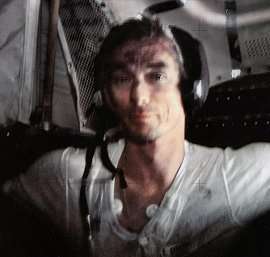
Moondust. "I wish I could send you some," says Apollo 17 astronaut Gene Cernan. Just a thimbleful scooped fresh off the lunar surface. "It's amazing stuff."
Feel it—it's soft like snow, yet strangely abrasive.
Taste it—"not half bad," according to Apollo 16 astronaut John Young.
Sniff it—"it smells like spent gunpowder," says Cernan.
How do you sniff moondust?
Every Apollo astronaut did it. They couldn't touch their noses to the lunar surface. But, after every moonwalk (or "EVA"), they would tramp the stuff back inside the lander. Moondust was incredibly clingy, sticking to boots, gloves and other exposed surfaces. No matter how hard they tried to brush their suits before re-entering the cabin, some dust (and sometimes a lot of dust) made its way inside.
Once their helmets and gloves were off, the astronauts could feel, smell and even taste the moon.
The experience gave Apollo 17 astronaut Jack Schmitt history's first recorded case of extraterrestrial hay fever. "It's come on pretty fast," he radioed Houston with a congested voice. Years later he recalls, "When I took my helmet off after the first EVA, I had a significant reaction to the dust. My turbinates (cartilage plates in the walls of the nasal chambers) became swollen."
Hours later, the sensation faded. "It was there again after the second and third EVAs, but at much lower levels. I think I was developing some immunity to it."
Other astronauts didn't get the hay fever. Or, at least, "they didn't admit it," laughs Schmitt. "Pilots think if they confess their symptoms, they'll be grounded." Unlike the other astronauts, Schmitt didn't have a test pilot background. He was a geologist and readily admitted to sniffles.
Schmitt says he has sensitive turbinates: "The petrochemicals in Houston used to drive me crazy, and I have to watch out for cigarette smoke." That's why, he believes, other astronauts reacted much less than he did.
But they did react: "It is really a strong smell," radioed Apollo 16 pilot Charlie Duke. "It has that taste -- to me, [of] gunpowder -- and the smell of gunpowder, too." On the next mission, Apollo 17, Gene Cernan remarked, "smells like someone just fired a carbine in here."
Schmitt says, "All of the Apollo astronauts were used to handling guns." So when they said 'moondust smells like burnt gunpowder,' they knew what they were talking about.
To be clear, moondust and gunpowder are not the same thing. Modern smokeless gunpowder is a mixture of nitrocellulose (C6H8(NO2)2O5) and nitroglycerin (C3H5N3O9). These are flammable organic molecules "not found in lunar soil," says Gary Lofgren of the Lunar Sample Laboratory at NASA's Johnson Space Center. Hold a match to moondust--nothing happens, at least, nothing explosive.
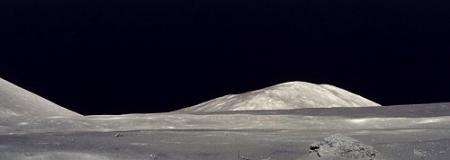
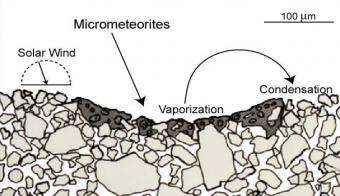
What is moondust made of? Almost half is silicon dioxide glass created by meteoroids hitting the moon. These impacts, which have been going on for billions of years, fuse topsoil into glass and shatter the same into tiny pieces. Moondust is also rich in iron, calcium and magnesium bound up in minerals such as olivine and pyroxene. It's nothing like gunpowder.
So why the smell? No one knows.
ISS astronaut Don Pettit, who has never been to the moon but has an interest in space smells, offers one possibility:
"Picture yourself in a desert on Earth," he says. "What do you smell? Nothing, until it rains. The air is suddenly filled with sweet, peaty odors." Water evaporating from the ground carries molecules to your nose that have been trapped in dry soil for months.
Maybe something similar happens on the moon.
"The moon is like a 4-billion-year-old desert," he says. "It's incredibly dry. When moondust comes in contact with moist air in a lunar module, you get the 'desert rain' effect--and some lovely odors." (For the record, he counts gunpowder as a lovely odor.)
Gary Lofgren has a related idea: "The gases 'evaporating' from the moondust might come from the solar wind." Unlike Earth, he explains, the moon is exposed to the hot wind of hydrogen, helium and other ions blowing away from the sun. These ions hit the moon's surface and get caught in the dust.
It's a fragile situation. "The ions are easily dislodged by footsteps or dustbrushes, and they would be evaporated by contact with warm air inside the lunar module. Solar wind ions mingling with the cabin's atmosphere would produce who-knows-what odors."
Want to smell the solar wind? Go to the moon.
Schmitt offers yet another idea: The smell, and his reaction to it, could be a sign that moondust is chemically active.
"Consider how moondust is formed," he says. "Meteoroids hit the moon, reducing rocks to jagged dust. It's a process of hammering and smashing." Broken molecules in the dust have "dangling bonds"--unsatisfied electrical connections that need atomic partners.
Inhale some moondust and what happens? The dangling bonds seek partners in the membranes of your nose. You get congested. You report strange odors. Later, when the all the bonds are partnered-up, these sensations fade.
Another possibility is that moondust "burns" in the lunar lander's oxygen atmosphere. "Oxygen is very reactive," notes Lofgren, "and would readily combine with the dangling chemical bonds of the moondust." The process, called oxidation, is akin to burning. Although it happens too slowly for smoke or flames, the oxidation of moondust might produce an aroma like burnt gunpowder. (Note: Burnt and unburnt gunpowder do not smell the same. Apollo astronauts were specific. Moondust smells like burnt gunpowder.)
Curiously, back on Earth, moondust has no smell. There are hundreds of pounds of moondust at the Lunar Sample Lab in Houston. There, Lofgren has held dusty moon rocks with his own hands. He's sniffed the rocks, sniffed the air, sniffed his hands. "It does not smell like gunpowder," he says.
Were the Apollo crews imagining things? No. Lofgren and others have a better explanation:
Moondust on Earth has been "pacified." All of the samples brought back by Apollo astronauts have been in contact with moist, oxygen-rich air. Any smelly chemical reactions (or evaporations) ended long ago.
This wasn't supposed to happen. Astronauts took special "thermos" containers to the moon to hold the samples in vacuum. But the jagged edges of the dust unexpectedly cut the seals of the containers, allowing oxygen and water vapor to sneak in during the 3-day trip back to Earth. No one can say how much the dust was altered by that exposure.
Schmitt believes "we need to study the dust in situ--on the moon." Only there can we fully discover its properties: Why does it smell? How does it react with landers, rovers and habitats? What surprises await?
NASA plans to send people back to the moon in 2018, and they'll stay much longer than Apollo astronauts did. The next generation will have more time and better tools to tackle the mystery.
We've only just begun to smell the moondust.
Source: Sceince@NASA (by Dr. Tony Phillips)


