Interplanetary networking: ESA's Mars Express will keep an eye on NASA's Phoenix
August 1, 2007 Martian lander Phoenix

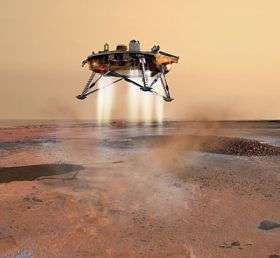
NASA’s Martian lander, Phoenix, is scheduled to be launched on 3 August this year and is expected to land on the Red Planet in the spring of 2008. The mission will investigate the Martian environment and will look beneath the frigid, arctic landscape in search of conditions favourable to past or present life. Credits: NASA/JPL (C.Waste)

ESA’s Mars Express will keep an eye on NASA’s Phoenix lander as it makes its way to the Martian surface, setting an example for international cooperation and interplanetary networking.

Phoenix’s launch is scheduled for 4 August this year and it is expected to land on the Red Planet in the spring of 2008. The mission will investigate the Martian environment and will look beneath the frigid, arctic landscape in search of conditions favourable to past or present life.

At NASA’s request, ESA’s Mars Express spacecraft will be following Phoenix’s Entry Descent and Landing (EDL) phase.

The critical part of the descent lasts about 13 minutes. During this time, the probe will transmit a continuous stream of information to two of NASA’s satellites already orbiting the Red Planet. To be on the safe side, NASA has requested Mars Express, which has been in orbit around Mars since December 2003, to also monitor the EDL phase.

Mars Express has been selected since, in principle, its elliptical orbit makes it possible for the spacecraft to have a continuous view of the lander and to communicate with it for longer periods of time.

Mars Express will optimise its orbit so that Phoenix is continuously in view during the EDL phase. The final orbit adjustment required for Mars Express will be determined a few weeks after the launch of Phoenix. Final adjustments will be made in April next year, just before the Phoenix EDL phase.

ESA’s Mars Express Mission Manager, Fred Jansen explains, “One of the instruments on board Mars Express is the Mars Express Lander Communications system (MELACOM), designed to communicate with probes on the planet’s surface. Originally meant for communicating with the Beagle 2 lander, which was unfortunately lost, we can now use it to communicate with Phoenix.”

It is possible that the spacecraft will communicate with the lander, not only during EDL, but also for the remainder of the anticipated 90-day lifetime of the mission.

“NASA still has two other active probes on the Martian surface. When Phoenix joins the fleet around mid-2008, lots of data will have to be relayed back to Earth from the surface of Mars. If we are asked to help out by channelling part of the communication through Mars Express, we will, of course, try to accomodate such a request" adds Jansen.

Apart from assistance during the EDL phase, NASA has also requested ESA to support the launch of Phoenix from its ground station in Kourou, French Guiana.

Source: European Space Agency


print this article email this article download pdf blog this article bookmark this article     Stumble it Digg this share on Facebook retweet share on Reddit add to delicious
Rate this story - 4.5 /5 (4 votes)


August 1, 2007 all stories

Comments: 0

4.5 /5 (4 votes)
  • Stumble this up

  • Digg this

  • share this

  • hide
  • Related Stories

  • Mountain on Mars may answer big question
    created Mar 04, 2009 | popularity not rated yet | comments 0
  • Planets Align for the 4th of July
    created Jul 02, 2008 | popularity not rated yet | comments 0
  • Mars Sample Return: The next step in exploring the Red Planet
    created Jul 02, 2008 | popularity not rated yet | comments 0
  • Listen to Phoenix descend
    created May 29, 2008 | popularity not rated yet | comments 0
  • First images from Phoenix Mars lander
    created May 26, 2008 | popularity not rated yet | comments 0


  • hide
  • Relevant PhysicsForums posts

  • Redshift as a distance indicator
    created 7 hours ago
  • Question about 2-body gravity
    created Nov 24, 2009
  • life on Mars
    created Nov 24, 2009
  • Semi-major axis from cartesian co-ordinates
    created Nov 23, 2009
  • More from Physics Forums - General Astronomy

Other News

Past regional cold and warm periods linked to natural climate drivers

Space & Earth / Earth Sciences

created 4 hours ago | popularity 5 / 5 (4) | comments 6

Intervals of regional warmth and cold in the past are linked to the El Niño phenomenon and the so-called "North Atlantic Oscillation" in the Northern hemisphere's jet stream, according to a team of climate scientists. These ...


Russia: no space for space tourists (AP)

Russia: no space for space tourists

Space & Earth / Space Exploration

created 12 hours ago | popularity 2.7 / 5 (3) | comments 2

(AP) -- A top Russian space official says there is no space for tourists wishing to fly to the International Space Station.


Astronauts surprised by holiday turkey dinners (AP)

Astronauts surprised by holiday turkey dinners

Space & Earth / Space Exploration

created 7 hours ago | popularity not rated yet | comments 0

(AP) -- Space shuttle Atlantis' astronauts thought they were going to give thanks with pantry leftovers Thursday as their mission drew to a close, but found turkey dinners awaiting them.


Gullies and Flow Features on Crater Wall

Gullies and Flow Features on Crater Wall

Space & Earth / Space Exploration

created 8 hours ago | popularity not rated yet | comments 0

(PhysOrg.com) -- This image from the High Resolution Imaging Science Experiment (HiRISE) camera on NASA's Mars Reconnaissance Orbiter shows a sample of the variety and complexity of processes that may occur ...


Burning coal worse for climate than clearing rain forests

Space & Earth / Environment

created 6 hours ago | popularity 3 / 5 (4) | comments 0

Deforestation has had a big influence on the increase of carbon dioxide (CO2) emissions in the past three centuries, but its impact is tapering off relatively. Nowadays, the burning of fossil fuels is a more crucial factor. ...