MIT team cooks up simple fuel recipe
MIT student Jules Walter has seen firsthand the impact of deforestation in his native Haiti: Nearly 98 percent of the island's forests are gone, and more trees are being cut down every year.
Deforestation is not only an environmental problem in that country, but it also makes life difficult for Haitians who rely on wood to cook their food.
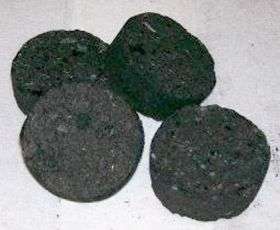
Now, a team of MIT students including Walter is working to bring affordable, environmentally friendly cooking fuel to developing countries like Haiti. The technique, which grew out of an MIT class, offers a simple way to produce charcoal briquettes from organic material such as sugarcane waste.
The students have formed a company to produce and distribute the charcoal to Haitian villagers. Their firm, which includes Walter, MIT graduate students Amy Banzaert and Kendra Leith, and Haitian community organizer Gerthy Lahens, recently won $30,000 in seed money from the MIT $100K Entrepreneurship Competition.
Walter, a computer science major who will be a senior at MIT this fall, is traveling to Haiti later this month to conduct a market study and meet with potential investors. He hopes his business will appeal to those who want to invest in something that is both profitable and socially responsible.
"Traditionally people think you can either make money or help people," said Walter. "But this is a project where we really think we can do both, and do both well."
Students in MIT lecturer Amy Smith's course, D-Lab: Introduction to Development, first started working to develop low-cost cooking fuels after a trip to Haiti in 2003. The D-Lab course gives students the chance to explore technological solutions to real-life problems.
"The charcoal project was one of the very first D-Lab projects, and over the years, dozens of students have worked to help create the solution," said Smith, who received a master's in engineering from MIT in 1995 and won a MacArthur Fellowship, often nicknamed the "genius grant," in 2004.
Walter and his teammates named their company Bagazo after the energy source for the charcoal: bagasse, or sugarcane waste. Sugarcane is widely available in Haiti, and corncobs and possibly other plant wastes, including banana leaves, can also be used to make the charcoal.
Several families in Haiti have tested the briquettes and liked them better than wood charcoal, Walter said. The briquettes are good for cooking because they burn longer than wood and are easier to light. They also create less smoke than wood and dung fires.
"Both of those emit a lot of smoke, especially when people cook inside their homes, and it gives them problems with their lungs," Walter said.
The production process has three steps. First, organic waste is carbonized in a drum in a low-oxygen environment, which prevents it from turning to ash. Second, the resulting powder is mixed with a binder to help hold it together. Then, it is pressed it into briquettes with a simple machine press and allowed to dry.
The entire process takes two and a half to three hours, but the Bagazo team wants to speed up and automate the process. Their plan is to develop a small- to medium-scale manufacturing business to distribute the fuel to people.
Although the team is focusing on Haiti, the briquettes could be beneficial in other places where trees are scarce, such as Africa and India. Students in Smith's class have visited Ghana and Pakistan to see if the briquettes could be successful there, and interested parties in Namibia have also contacted Walter.
Source: MIT


