Monkeys Learn in the Same Way as Humans, Psychologists Report
Monkeys seem to learn the same way humans do, a new research study indicates.
"Like humans, monkeys benefit enormously from being actively involved in learning instead of having information presented to them passively," said Nate Kornell, a UCLA postdoctoral scholar in psychology and lead author of the study, which appears in the August issue of the journal Psychological Science. "The advantage of active learning appears to be a fundamental property of memory in humans and nonhumans alike."
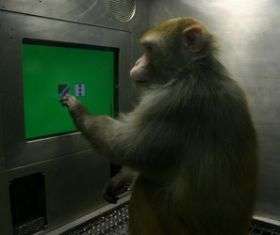
In Kornell's study, conducted when he was a psychology graduate student at Columbia University, two rhesus macaque monkeys learned to place five photographs in a particular order. The photographs were displayed on a touch-screen computer monitor similar to those found on ATMs. When the monkeys pressed a correct photograph, a border appeared around it. When either monkey pressed all five photographs in the correct order, he received a food reward. The chance of guessing all five accurately is less than one percent.
In all, each monkey learned to order at least 18 separate series of photographs, which included such items as a fish, a human face, a building, a football field and a flame from a match. They underwent three days of training before being tested.
In some of the training trials, the monkeys had to figure out the correct order themselves, while in others, they had the option of getting help by pushing an icon in the corner of the screen that caused the border of the correct photograph to flash. They were rewarded with an M&M candy each time they correctly completed the task without help and with a less desirable food pellet when they completed the task with hints from the help icon. After three days, the monkeys were tested without the benefit of the help icon.
"Both monkeys did much better if they had studied without a hint than if they had studied with a hint," Kornell said. "The monkeys did much better on the first three days when they had the help than when they didn't, but on the test day, it completely reversed. When they studied with the hint, there is no evidence they learned anything about the list. They learned the lists when they didn't get the help."
The findings are closely related to findings in humans that recalling answers from memory enhances long-term learning.
"The findings were somewhat unintuitive, because passively using the hint appeared to enhance performance during the study phase of the experiment but had a deleterious effect on long-term learning," Kornell said.
What are the implications for human learning?
"Many people incorrectly assume the better you do as you're studying, the more you're learning," said Kornell, who works in the laboratory of Robert A. Bjork, professor and chair of psychology at UCLA. "If students don't test themselves when they read a chapter, they can easily think they know the material when they don't. When you test yourself as you study, you may feel like you're making it harder on yourself, but on the test, you will do much better. Robert Bjork calls this 'desirable difficulty.' If you want to learn something well, when you're reading, stop and think about what you've read, and test yourself; you learn by testing yourself. If you make it more difficult for yourself while you study, you feel like you're doing worse, but you're learning more.
"Active learning is important in humans and — this study demonstrates — in monkeys as well," he added.
Less effective passive learning includes listening to a presentation and reading without testing yourself or summarizing what you have learned.
"When you summarize the material in your own words, that's much more active," Kornell said. "You can't do that if you don't understand it."
Cramming right before a test does not work as well as spacing studying out over a longer period of time, Kornell added, citing other research on learning and memory.
Kornell's research, supported by the National Institute of Mental Health, was conducted with Herbert Terrace, a professor of psychology at Columbia. The two monkeys, Macduff and Oberon, are housed at the New York State Psychiatric Institute, where Terrace has a joint appointment. Neither animal was harmed in the study, and they were fed daily regardless of how they performed in the trials.
"Many people," Kornell noted, "have had the experience of listening to a computer instructor open a menu and go through a series of steps. Then you try to do it, and you don't even know which menu or what the first step is. If you are passively following along, you won't remember it as well as if you're forced to do it yourself. Active learning is much harder, but if you can do it successfully, you will remember it much better in the long run.
"If you're learning to serve a tennis ball, you won't get much out of an instructor taking your arm and practicing the swing over and over," he said. "That's not going to help you nearly as much as if you serve the ball yourself."
The situation is the same for monkeys, according to Kornell.
"The way the monkeys learn to remember the correct answers is through active learning, like humans," he said. "They have to generate the answers themselves from memory. Generating the correct sequence from memory resulted in more long-term learning than the more passive training with hints."
Kornell noted that more than a century ago, author William James remarked on the importance of being actively involved in learning. Since then, science has proven him correct. Kornell also noted that his research confirms the teachings of another monkey: Curious George.
Source: UCLA


