Electricity from body heat
August 1, 2007 Electricity from body heat

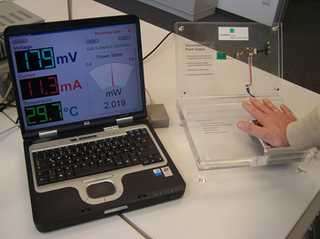
New circuits transform body heat – such as that of a hand – into electricity. © Fraunhofer IIS

Making calls from a cell phone with no battery, using just the warmth of your hand? Perhaps that’s no more than a pipe dream right now. But new circuits are already making it possible to harness body heat for generating electricity.

Numerous items of medical equipment are attached to the body of a patient in the intensive care ward. They monitor the heart rate, blood pressure, body temperature, pulse and breathing rate. This tends to produce quite a jumble of cables, for all these devices require their own electricity supply.

In future, medical sensors may be able to function without power from a wall socket. Instead, they will draw all the power they need from the warmth of the human body. The respective data will be sent by a radio signal to the central monitoring station.

In collaboration with colleagues from the Fraunhofer Institute for Physical Measurement Techniques IPM and the Fraunhofer Institute for Manufacturing Engineering and Applied Materials Research IFAM, research scientists at the Fraunhofer Institute for Integrated Circuits IIS in Erlangen have developed a way of harnessing natural body heat to generate electricity. It works on the principle of thermoelectric generators, TEG for short, made from semiconductor elements. The TEGs extract electrical energy simply from the temperature difference between a hot and a cold environment.

Normally, a difference of several tens of degrees would be required in order to generate enough power, but the differences between the body’s surface temperature and that of its environment are only a few degrees. “Only low voltages can be produced from differences like these,” explains Peter Spies, manager of this sub-project at the IIS. A conventional TEG delivers roughly 200 millivolts, but electronic devices require at least one or two volts.

The engineers have come up with a solution to this problem: “We combined a number of components in a completely new way to create circuits that can operate on 200 millivolts,” says Spies. “This has enabled us to build entire electronic systems that do not require an internal battery, but draw their energy from body heat alone.” The scientists are making further improvements to this system: Circuits that are “excited” at 50 millivolts already exist.

Peter Spies believes that in future, when further improvements have been made to the switching systems, a temperature difference of only 0.5 degrees will be sufficient to generate electricity.

The scientists have set their eyes on a wide range of possible applications: “Electricity can be generated from heat anyplace where a temperature difference occurs,” claims Spies. “That could be on the body, on radiators to meter the heating costs, when monitoring the cooling chain during the transport of refrigerated goods, or in air conditioning systems.”

Source: Fraunhofer-Gesellschaft


print this article email this article download pdf blog this article bookmark this article     Stumble it Digg this share on Facebook retweet share on Reddit add to delicious
Rate this story - 4.6 /5 (36 votes)


August 1, 2007 all stories

Comments: 0

4.6 /5 (36 votes)
  • Stumble this up

  • Digg this

  • share this

  • hide
  • Related Stories

  • A RANK insider resolving the enigma of the fever chart
    created Nov 25, 2009 | popularity not rated yet | comments 0
  • Study finds bees can learn differences in food's temperature
    created Nov 17, 2009 | popularity not rated yet | comments 0
  • Smart drug delivery system -- Gold nanocage covered with polymer (w/ Video)
    created Nov 01, 2009 | popularity not rated yet | comments 0
  • Energy-autonomous sensors for aircraft
    created Oct 01, 2009 | popularity not rated yet | comments 0
  • How alcohol blunts the ability of hamsters to 'rise and shine'
    created Sep 01, 2009 | popularity not rated yet | comments 0


  • hide
  • Relevant PhysicsForums posts

  • Achromat lens - magnifying LCD
    created 20 hours ago
  • Control System
    created Nov 24, 2009
  • Base Isolation Systems in Skyscrapers?
    created Nov 23, 2009
  • Need to interview a Computer Hardware Engineer for school project
    created Nov 23, 2009
  • More from Physics Forums - General Engineering

Other News

A worman works on a computer

Half of Euro online travel purchases legally unsafe: EU

Technology / Internet

created 10 minutes ago | popularity not rated yet | comments 0

More than half of all people who buy flights, hotel rooms and hire cars online risk being left without compensation if companies fail under outdated law, the EU said Thursday.


Building real security with virtual worlds

Technology / Computer Sciences

created 2 hours ago | popularity 3 / 5 (2) | comments 0

(PhysOrg.com) -- Advances in computerized modeling and prediction of group behavior, together with improvements in video game graphics, are making possible virtual worlds in which defense analysts can explore and predict ...


Sony optimistic on 3-D TVs, in-house display (AP)

Sony optimistic on 3-D TVs, in-house display

Technology / Hi Tech

created 9 hours ago | popularity not rated yet | comments 0

(AP) -- A third to a half of the Sony Corp. TV sets sold annually will be packed with 3-D features by the year ending March 2013, a senior executive said Thursday.


Should I buy a PC or Mac?

Technology / Software

created 20 hours ago | popularity 3.7 / 5 (6) | comments 12

Q. Our 6-year-old PC computer is dying a slow death and we are considering moving to a new iMac but have a few concerns. First, of all, we have several Word documents on our disk drive now that we want to keep and add to ...


Holiday Web shopping looks brighter than last year

Technology / Internet

created 5 hours ago | popularity not rated yet | comments 0

(AP) -- Online retailers hope the convenience of the Web, plus discounts and deals, spur still-nervous shoppers to spend more online this holiday season - even as traditional retailers brace for mediocre sales.