Typhoon Usagi Gathers Strength, Heads for Japan
August 1, 2007 Typhoon Usagi Gathers Strength, Heads for Japan

Typhoon Usagi continues to gather strength in the West Pacific as it continues on a course for southern Japan.

On August 1 at 1200 Zulu Time (9:00 p.m. Japan Local Time), Usagi was located near 27.5 north and 134.8 east or approximately 385 miles east-northeast of Naha, Okinawa, Japan.

Usagi was moving northwest at 14 knots (16 mph). Maximum sustained winds were 115 knots (132 mph) with gusts to 140 knots (161 mph). It is expected to continue tracking northwest and make landfall over Kyushu mid-day on August 2.

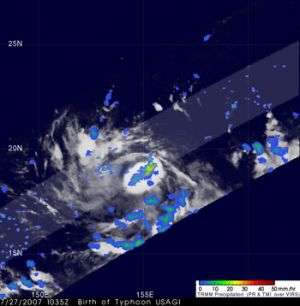
This image from TRMM was taken at 10:35 Universal Time on July 27, about 24 hours before the system became a tropical depression. The image shows the horizontal distribution of rain intensity looking down on the storm. Rain rates in the center of the swath are from the TRMM Precipitation Radar (PR), while those in the outer portion are from the TRMM Microwave Imager (TMI).

The rain rates are overlaid on infrared (IR) data from the TRMM Visible Infrared Scanner (VIRS). At this stage, the system appears as a relatively small cluster of storms. The circulation is very weak with no evidence of banding (curvature) in the rain field.

Source: NASA


print this article email this article download pdf blog this article bookmark this article     Stumble it Digg this share on Facebook retweet share on Reddit add to delicious
Rate this story - 4 /5 (2 votes)


August 1, 2007 all stories

Comments: 0

4 /5 (2 votes)
  • Stumble this up

  • Digg this

  • share this

  • hide
  • Related Stories


  • hide
  • Relevant PhysicsForums posts

  • Climate Science Update
    created 2 hours ago
  • The IPCC and the term "most"
    created Nov 23, 2009
  • Is global warming a fact?
    created Nov 23, 2009
  • Random variability of wind patterns
    created Nov 23, 2009
  • More from Physics Forums - Earth

Other News

Past regional cold and warm periods linked to natural climate drivers

Space & Earth / Earth Sciences

created 20 hours ago | popularity 3.7 / 5 (13) | comments 22

Intervals of regional warmth and cold in the past are linked to the El Niņo phenomenon and the so-called "North Atlantic Oscillation" in the Northern hemisphere's jet stream, according to a team of climate scientists. These ...


China is set to launch its second moon orbiter next October, state media have reported

China to launch second lunar probe: state media

Space & Earth / Space Exploration

created 4 hours ago | popularity 5 / 5 (3) | comments 0

China will launch its second moon orbiter next October, state media reported Friday, as it powers ahead with a space programme that has sparked concerns abroad.


In Greenland, warming fuels dream of hidden wealth (AP)

In Greenland, warming fuels dream of hidden wealth

Space & Earth / Environment

created 2 hours ago | popularity 3 / 5 (2) | comments 0

(AP) -- Gert Ignatiussen returns to this fjord-front Inuit town with the spoils of his hunting trip. Six seals, all killed with a single shot to the head.


Space shuttle Atlantis, 7 astronauts back on Earth

Space & Earth / Space Exploration

created 6 minutes ago | popularity not rated yet | comments 0

(AP) -- Space shuttle Atlantis and its seven astronauts returned to Earth with a smooth touchdown Friday to end an 11-day flight that resupplied the International Space Station.


New climate targets may not change daily life much (AP)

New climate targets may not change daily life much

Space & Earth / Environment

created 3 hours ago | popularity 1 / 5 (1) | comments 0

(AP) -- Americans' day-to-day lives won't change noticeably if President Barack Obama achieves his newly announced goal of slashing carbon dioxide pollution by one-sixth in the next decade, experts say.