Purdue 'milestone' a step toward advanced sensors, communications
August 1st, 2007 Purdue 'milestone' a step toward advanced sensors, communications

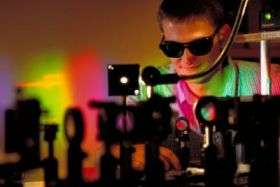
Jason McKinney, a former visiting assistant professor in Purdue's School of Electrical and Computer Engineering, works with equipment that produces pulsing laser light in the university's Ultrafast Optics and Optical Fiber Communications Laboratory. Researchers in the lab recently have shown how to finely control the spectral properties of ultrafast light pulses, a step toward creating advanced sensors, more powerful communications technologies and more precise laboratory instruments. McKinney is now an engineer at the Naval Research Laboratory. Credit: Purdue Engineering Communications Office photo/Vincent Walter

Engineers at Purdue University have shown how to finely control the spectral properties of ultrafast light pulses, a step toward creating advanced sensors, more powerful communications technologies and more precise laboratory instruments.

The laser pulses could be likened to strobes used in high-speed photography to freeze fast-moving objects such as bullets or flying insects. These laser pulses, however, are millions of times faster than such strobes, with flashes lasting a trillionth or quadrillionth of a second - a picosecond or femtosecond, respectively.

The properties of the pulses, when represented on a graph, take on specific shapes that characterize the changing light intensity from the beginning to end of each pulse. Precisely controlling this intensity, which is called "pulse shaping," will enable researchers to tune the laser pulses to suit specific applications, said Andrew Weiner, Distinguished Professor of Electrical and Computer Engineering at Purdue.

Researchers at other institutions have developed ultrafast lasers producing trains of pulses that are split into hundreds of thousands of segments, with each segment representing a different portion of the spectrum making up a pulse. The segments are called "comb lines" because they resemble teeth on a comb when represented on a graph, and the entire pulse train is called a "femtosecond frequency comb." The 2005 Nobel Prize in physics was awarded to researchers who precisely controlled the frequencies of these comb lines and demonstrated applications related to advanced optical clocks, which could improve communications, enhance navigation systems and enable new experiments to test physics theory, among other possible uses.

In the new research, the Purdue engineers precisely "shaped" 100 comb lines from such a frequency comb in a single pulse.

"There are still huge technological challenges ahead, but we really see 100 comb lines as a milestone, a significant step," Weiner said. The research is based at Purdue's Ultrafast Optics and Optical Fiber Communications Laboratory.

Findings are detailed in a research paper appearing online this week in the journal Nature Photonics. The paper was written by postdoctoral research associate Zhi Jiang, doctoral student Chen-Bin Huang, senior research scientist Daniel E. Leaird and Weiner, all in Purdue's School of Electrical and Computer Engineering.

The pulse-shaping technique, called optical arbitrary waveform generation, is not new. However, the Purdue team is the first to accomplish shaping of light pulses from a femtosecond frequency comb and to demonstrate the technique on such a fine scale by controlling the properties of 100 spectral comb lines within each pulse.

By precisely controlling this "fine frequency structure" of laser pulses, researchers hope to create advanced optical sensors that detect and measure hazardous materials or pollutants, ultra-sensitive spectroscopy for laboratory research, and optics-based communications systems that transmit greater volumes of information with better quality while increasing the bandwidth. However, fully realizing these goals will require controlling 100,000 to 1 million comb lines in each pulse, Weiner said.

The advancement by the Purdue engineers enables the researchers to control the amplitude and "phase" of individual comb lines, or the high and low points of each spectral line, representing a step toward applying the technique for advanced technologies.

Source: Purdue University


print this article email this article download pdf blog this article bookmark this article     Digg this Stumble it share on Facebook share on Reddit add to delicious save to Yahoo! bookmarks
4.6/5 after 16 votes


August 1st, 2007 all stories
Physics / General Physics

Comments: 0
Rank: 4.6/5 after 16 votes

  • Stumble this up

  • Digg this

  • Share it:
  • share on Facebook
  • share on MySpace
  • share on Slashdot
  • rss-newsfeed
  • share on Google
  • share on Reddit
  • add to delicious
  • save to Yahoo! bookmarks
  • share on Windows Live
  • Add to Mixx!
Rating: 4.6/5 after 16 votes

  • Related Stories

  • LIDAR system offers peerless precision in remote measurements
    created May 24, 2009 | popularity not rated yet | comments 0
  • Goal: developing the best atomic clock in the world
    created May 29, 2009 | popularity not rated yet | comments 0
  • Creating the astro-comb to locate Earth-like planets
    created May 07, 2009 | popularity not rated yet | comments 0
  • Atomic fountain clocks are becoming still more stable
    created Mar 18, 2009 | popularity not rated yet | comments 0
  • Physicist proposes to use femtosecond, chirped laser pulse trains to reduce decoherence
    created Nov 10, 2008 | popularity not rated yet | comments 0

Tags


  • Physicists Demonstrate Quantum Memory with Matter Qubits
    Physicists Demonstrate Quantum Memory with Matter Qubits
    Physics / General Physics
    created Jul 03, 2009 | popularity 4.4 / 5 (17) | comments 1
  • 'Holey' Nanosheets for Wastewater Dye Removal
    Nanotechnology / Nanomaterials
    created Jul 01, 2009 | popularity 5 / 5 (5) | comments 1
  • Jellyfish Robot Swims Like its Biological Counterpart
    Jellyfish Robot Swims Like its Biological Counterpart
    Electronics / Robotics
    created Jun 26, 2009 | popularity 4.4 / 5 (8) | comments 1
  • Could Maxwell's Demon Exist in Nanoscale Systems?
    Could Maxwell's Demon Exist in Nanoscale Systems?
    Physics / General Physics
    created Jun 24, 2009 | popularity 4.4 / 5 (18) | comments 29
  • Living Safely with Robots, Beyond Asimov's Laws
    Living Safely with Robots, Beyond Asimov's Laws
    Electronics / Robotics
    created Jun 22, 2009 | popularity 4.6 / 5 (52) | comments 40
  • Other News

    Scientists create first electronic quantum processor

    Scientists create first electronic quantum processor

    Physics / General Physics

    created Jun 28, 2009 | popularity 4.8 / 5 (53) | comments 39

    A team led by Yale University researchers has created the first rudimentary solid-state quantum processor, taking another step toward the ultimate dream of building a quantum computer.


    Science journals

    How to Spot an Influential Paper Based on its Citations

    Physics / General Physics

    created Jul 04, 2009 | popularity 4 / 5 (9) | comments 5

    (PhysOrg.com) -- At first it may seem that the number of citations received by a published scientific paper is directly related to that paper's quality of content. The higher the quality, the more people read ...


    Fermilab's CDF observes Omega-sub-b baryon

    Fermilab's CDF observes Omega-sub-b baryon

    Physics / General Physics

    created Jun 29, 2009 | popularity 4.7 / 5 (17) | comments 7

    (PhysOrg.com) -- At a recent physics seminar at the Department of Energy’s Fermi National Accelerator Laboratory, Fermilab physicist Pat Lukens of the CDF experiment announced the observation of a new particle, ...


    New insights, and a new angle, on high-temperature superconductivity

    New insights, and a new angle, on high-temperature superconductivity

    Physics / Superconductivity

    created Jun 29, 2009 | popularity 4.8 / 5 (13) | comments 6

    (PhysOrg.com) -- A Princeton-led research team has revealed surprising information about how electron behavior influences the conduction of electricity in a class of high-temperature superconductors. An increased ...


    The art of invisibility and the perfect cat's eye

    The art of invisibility and the perfect cat's eye

    Physics / Optics & Photonics

    created Jun 30, 2009 | popularity 4 / 5 (8) | comments 6

    (PhysOrg.com) -- In recent years scientists have explored the impossible by developing invisibility or 'cloaking' devices, but can the same technology also help make things more visible?