NGC 5746: Detection of hot halo gets theory out of hot water
February 3, 2006
NGC 5746: Detection of hot halo gets theory out of hot water

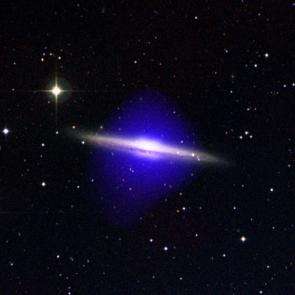
Credit: X-ray: NASA/CXC/U. Copenhagen/K.Pedersen et al; Optical: Palomar DSS

Scientists using NASA's Chandra X-ray Observatory have detected an extensive halo of hot gas around a quiescent spiral galaxy. This discovery is evidence that galaxies like our Milky Way are still accumulating matter from the gradual inflow of intergalactic gas.

"What we are likely witnessing here is the ongoing galaxy formation process," said Kristian Pedersen of the University of Copenhagen, Denmark, and lead author of a report on the discovery.

Chandra observations show that the hot halo extends more than 60,000 light years on either side of the disk of the galaxy known as NGC 5746. The detection of such a large halo alleviates a long-standing problem for the theory of galaxy formation. Spiral galaxies are thought to form from enormous clouds of intergalactic gas that collapse to form giant, spinning disks of stars and gas.

One prediction of this theory is that large spiral galaxies should be immersed in halos of hot gas left over from the galaxy formation process. Hot gas has been detected around spiral galaxies in which vigorous star formation is ejecting matter from the galaxy, but until now hot halos due to infall of intergalactic matter have not been detected.

"Our observations solve the mystery of the missing hot halos around spiral galaxies," said Pedersen. "The halos exist, but are so faint that an extremely sensitive telescope such as Chandra is needed to detect them."

NGC 5746 is a massive spiral galaxy about a 100 million light years from Earth. Its disk of stars and gas is viewed almost edge-on. The galaxy shows no signs of unusual star formation, or energetic activity from its nuclear region, making it unlikely that the hot halo is produced by gas flowing out of the galaxy.

"We targeted NGC 5746 because we thought its distance and orientation would give us the best chance to detect a hot halo caused by the infall of intergalactic gas," said Jesper Rasmussen of the University of Birmingham, United Kingdom and a coauthor of the report. "What we found is in good agreement with computer simulations in which galaxies are built up gradually from the merger of smaller clouds of hot gas and dark matter."

The computer simulations were done by Jesper Sommer-Larsen (also a coauthor of the report) and collaborators at the University of Copenhagen. The paper describing these results will be published in the April issue of the journal New Astronomy. Other researchers on this project were Sune Toff, Yale University; Andrew Benson, University of Oxford, United Kingdom; and Richard Bower, University of Durham, United Kingdom.

Source: Chandra X-ray Center

4.2 /5 (10 votes)  

Rank 4.2 /5 (10 votes)
Tags

Relevant PhysicsForums posts

More news stories

Europe stakes billion-dollar bet on new rocket

A pencil-slim rocket is scheduled to lift into space from South America on Monday, carrying a billion-dollar bet that Europe can grab a juicy slice of the market to place satellites in low orbit.

Space & Earth / Space Exploration

created 7 hours ago | popularity 3.5 / 5 (2) | comments 0

NASA sees wide-eyed cyclone Jasmine

Cyclone Jasmine's eye has opened wider on NASA satellite imagery, as it moves through the Southern Pacific Ocean.

Space & Earth / Earth Sciences

created 23 hours ago | popularity 3.5 / 5 (2) | comments 2

NASA sees Giovanna reach cyclone strength, threaten Madagascar

Tropical Storm 12S built up steam and became a cyclone on February 10, 2012 as NASA's Terra satellite passed overhead. Residents of east-central Madagascar should prepare for this cyclone to make landfall ...

Space & Earth / Earth Sciences

created 23 hours ago | popularity not rated yet | comments 0

Political leaders play key role in how worried Americans are by climate change: study

More than extreme weather events and the work of scientists, it is national political leaders who influence how much Americans worry about the threat of climate change, new research finds.

Space & Earth / Environment

created Feb 06, 2012 | popularity 5 / 5 (6) | comments 68

Humans may have helped the decline of African rainforests 3000 years ago

(PhysOrg.com) -- Large areas of rainforests in Central Africa mysteriously disappeared over three thousand years ago, to be replaced by savannas. The prevailing theory has been that the cause was a change ...

Space & Earth / Environment

created Feb 10, 2012 | popularity 4.3 / 5 (13) | comments 16 | with audio podcast report


Walney offshore wind farm is world's biggest (for now)

(PhysOrg.com) -- The Walney wind farm on the Irish Sea--characterized by high tides, waves and windy weather--officially opened this week. The farm is treated in the press as a very big deal as the Walney ...

GPS court ruling leaves US phone tracking unclear

A US Supreme Court decision requiring a warrant to place a GPS device on the car of a criminal suspect leaves unresolved the bigger issue of police tracking using mobile phones, legal experts say.

Study finds that anti-diabetic medication can prevent the long-term effects of maternal obesity

In a study to be presented today at the Society for Maternal-Fetal Medicine's annual meeting, The Pregnancy Meeting, in Dallas, Texas, researchers will report findings that show that short therapy with the anti-diabetic medication ...

Netflix settlement trims 14 pct off 4Q earnings

(AP) -- Netflix pressed the rewind button on its fourth-quarter earnings after settling allegations that the video subscription service violated a consumer-privacy law.

Europeans protest controversial Internet pact

Tens of thousands of people marched in protests in more than a dozen European cities Saturday against a controversial anti-online piracy pact that critics say could curtail Internet freedom.

Google users warned of threat to smartphone wallets

Users of Google smartphone wallets were being warned on Friday that there is a way to crack pass codes intended to thwart thieves from going on illicit shopping sprees.