New software enables easy access to huge Mars database
August 2, 2007 New software enables easy access to huge Mars database

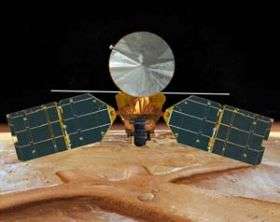
The Mars Reconnaissance Orbiter (MRO) taking pictures of Mars. Software developed by WUSTL researchers now allows viewers everywhere access to early images from the most powerful spectral camera ever sent to Mars. Image courtesy of NASA

A software program developed by researchers at Washington University in St. Louis is allowing viewers everywhere access to early images from the most powerful spectral camera ever sent to Mars. The images are now available on NASA's online planetary data archive.

The images come from Compact Reconnaissance Imaging Spectrometer for Mars (CRISM), flying aboard NASA's MRO. The Orbital Data Explorer also provides data sets from the High Resolution Imaging Science Experiment (HiRISE), the Mars Express High Resolution Stereo Camera (HRSC), the Mars Express Observatoire pour la Mineralogie l'Eau, les Glaces et l'Activite (OMEGA) spectrometer, plus gravity data.

CRISM has been searching for mineralogical evidence of past water on the Martian surface since November 2006, when MRO settled into a science-gathering orbit around the planet. CRISM, combined with other cameras and sensors on MRO, is providing the most detailed look yet at Martian geology, climate and surface makeup. Through its telescopic scanners CRISM has taken more than 1,900 images of specific targets, including more than 500 at the instrument's highest resolution that pinpoints areas down to 15 meters — or 48 feet — in 544 "colors" of reflected sunlight.

The camera has also mapped about half of the planet at lower resolution — showing areas as small as 200 meters (660 feet) in 72 colors — and monitored abundances of atmospheric gases and particulates in the atmosphere, returning more than 950 separate measurements that track seasonal variations.

"The Mars Reconnaissance Orbiter is collecting more data, and carrying out more complex observation plans, than any other mission to Mars," said Arvidson. "Orbital Data Explorer augments existing tools on the PDS site by providing advanced search, retrieval and order capabilities, as well as integrated analysis and visualization tools that will make it easier to examine and compare data from MRO and other missions."

Led by scientists at the Johns Hopkins University Applied Physics Laboratory (APL) in Laurel, Md., the CRISM team already has delivered the first month of these observations to the NASA Planetary Data System. They're available at http://pds-geosciences.wustl.edu/missions/mro/crism.htm , along with several tools that make the data accessible to Web users.

Over its two-year primary mission the orbiter will send back more data than all previous Mars missions combined. This first CRISM package, posted in the Planetary Data System's Geosciences section, contains about 410 gigabytes of data — enough to fit on nearly 600 compact discs.

"CRISM is opening new areas of discovery on Mars, and uncovering evidence of how water altered the planet over billions of years," said CRISM Principal Investigator at the APL, Scott Murchie. The APL, which has built more than 150 spacecraft instruments over the past four decades, led the effort to develop, integrate, and test CRISM. The CRISM team includes experts from universities, government agencies and small businesses in the United States and abroad; visit http://crism.jhuapl.edu for more information.

Source: Washington University in St. Louis


print this article email this article download pdf blog this article bookmark this article     Stumble it Digg this share on Facebook retweet share on Reddit add to delicious
Rate this story - 3.5 /5 (4 votes)


August 2, 2007 all stories

Comments: 0

3.5 /5 (4 votes)
  • Stumble this up

  • Digg this

  • share this

  • hide
  • Related Stories

  • Scientists see water ice in fresh meteorite craters on Mars
    created Sep 24, 2009 | popularity not rated yet | comments 0
  • Researchers reveal widespread, hardworking water on ancient Mars
    created Jul 16, 2008 | popularity not rated yet | comments 0
  • APL mineral-mapper has key role in selecting next Mars rover landing site
    created Oct 20, 2007 | popularity not rated yet | comments 0
  • Layered Crater on Mars
    created Jul 18, 2007 | popularity not rated yet | comments 0
  • Mineral Mapper Uncovering Clues of Martian Surface Composition
    created Feb 16, 2007 | popularity not rated yet | comments 0


  • hide
  • Relevant PhysicsForums posts

  • Telescope Recommendations Anyone?
    created 2 hours ago
  • Kind of a dumb question...
    created 6 hours ago
  • Uranus' satellite Miranda question
    created Dec 07, 2009
  • black dwarf sun
    created Dec 06, 2009
  • More from Physics Forums - General Astronomy

Other News

Mars

Life on Mars theory boosted by new methane study

Space & Earth / Space Exploration

created 9 hours ago | popularity 4.8 / 5 (12) | comments 4

Scientists have ruled out the possibility that methane is delivered to Mars by meteorites, raising fresh hopes that the gas might be generated by life on the red planet, in research published tomorrow in Earth an ...


Hubble's deepest view of universe unveils never-before-seen galaxies

Hubble's Deepest View of Universe Unveils Never-Before-Seen Galaxies (w/ Video)

Space & Earth / Astronomy

created 12 hours ago | popularity 4.7 / 5 (26) | comments 14

(PhysOrg.com) -- In 2004, Hubble created the Hubble Ultra Deep Field (HUDF), the deepest visible-light image of the Universe, and now, with its brand-new camera, Hubble is seeing even farther. This image was ...


Absence of evidence for a meteorite impact event 13,000 years ago

Absence of evidence for a meteorite impact event 13,000 years ago

Space & Earth / Earth Sciences

created 12 hours ago | popularity 4.4 / 5 (8) | comments 10

An international team of scientists led by researchers at the University of Hawaii at Manoa have found no evidence supporting an extraterrestrial impact event at the onset of the Younger Dryas ~13000 years ...


Aussie galaxy survey to lead to 'new physics'

Aussie galaxy survey to lead to 'new physics'

Space & Earth / Astronomy

created 7 hours ago | popularity 4.4 / 5 (8) | comments 1

(PhysOrg.com) -- Australian astronomers have released the first set of data from the first project to look at the effects of "dark energy" halfway back in the Universe's lifetime.


Gravestones Talking through Time

Gravestones Talking through Time

Space & Earth / Earth Sciences

created 4 hours ago | popularity 5 / 5 (1) | comments 0

(PhysOrg.com) -- A visit to your local graveyard can provide not only a history lesson, but a science lesson as well. Historians know that gravestones can reflect the lives of people whose memories are lost ...