Cassini Finds Possible Origin of One of Saturn's Rings
August 2, 2007
Cassini Finds Possible Origin of One of Saturn's Rings

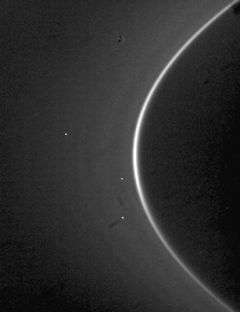
This image shows the arc orbits at a distance of 167,496 kilometres. It is about 250 kilometres wide in radius and subtends less than 60 degrees of orbital longitude. The classical position of the G ring is about 172,600 kilometres from Saturn, and the arc blends smoothly into this region. Scientists suspect that bodies trapped in this remarkably bright feature may be the source of the G ring material, driven outward from the arc by electromagnetic forces in the Saturn system. The arc itself is likely held in place by gravitational resonances with Mimas of the type that anchor the famed arcs in Neptune's rings. There is an obvious narrow dark gap in the G ring beyond the arc. This feature is close to yet another resonance with Mimas, but no arcs are present at this locale. Credits: NASA - JPL - Space Science Institute

Cassini scientists may have identified the source of one of Saturn's more mysterious rings. Saturn's G ring likely is produced by relatively large, icy particles that reside within a bright arc on the ring's inner edge.

The particles are confined within the arc by gravitational effects from Saturn's moon Mimas. Micrometeoroids collide with the particles, releasing smaller, dust-sized particles that brighten the arc. The plasma in the giant planet's magnetic field sweeps through this arc continually, dragging out the fine particles, which create the G ring.

The finding is evidence of the complex interaction between Saturn's moons, rings and magnetosphere. Studying this interaction is one of Cassini's objectives. The study is in the Aug. 2 issue of the journal Science and was based on observations made by multiple Cassini instruments in 2004 and 2005.

"Distant pictures from the cameras tell us where the arc is and how it moves, while plasma and dust measurements taken near the G ring tell us how much material is there," said Matthew Hedman, a Cassini imaging team associate at Cornell University in Ithaca, N.Y., and lead author on the Science paper.

Saturn's rings are an enormous, complex structure, and their origin is a mystery. The rings are labeled in the order they were discovered. From the planet outward, they are D, C, B, A, F, G and E. The main rings -- A, B and C-from edge-to-edge, would fit neatly in the distance between Earth and the moon. The most transparent rings are D -- interior to C -- and F, E and G, outside the main rings.

Unlike Saturn's other dusty rings, such as the E and F rings, the G ring is not associated closely with moons that either could supply material directly to it -- as Enceladus does for the E ring -- or sculpt and perturb its ring particles -- as Prometheus and Pandora do for the F ring. The location of the G ring continued to defy explanation, until now.

Cassini images show that the bright arc within the G ring extends one-sixth of the way around Saturn and is about 155 miles wide, much narrower than the full 3,700-mile width of the G ring. The arc has been observed several times since Cassini's 2004 arrival at the ringed planet and thus appears to be a long-lived feature. A gravitational disturbance caused by the moon Mimas exists near the arc.

As part of their study, Hedman and colleagues conducted computer simulations that showed the gravitational disturbance of Mimas could indeed produce such a structure in Saturn's G ring. The only other places in the solar system where such disturbances are known to exist are in the ring arcs of Neptune.

Cassini's magnetospheric imaging instrument detected depletions in charged particles near the arc in 2005. According to the scientists, unseen mass in the arc must be absorbing the particles. "The small dust grains that the Cassini camera sees are not enough to absorb energetic electrons," said Elias Roussos of the Max-Planck-Institute for Solar System Research, Germany, and member of the magnetospheric imaging team. "This tells us that a lot more mass is distributed within the arc."

The researchers concluded that there is a population of larger, as-yet-unseen bodies hiding in the arc, ranging in size from that of peas to small boulders. The total mass of all these bodies is equivalent to that of a 328-foot-wide, ice-rich small moon.

Joe Burns, a co-author of the paper from Cornell University and a member of the imaging team, said, "We'll have a super opportunity to spot the G ring's source bodies when Cassini flies about 600 miles from the arc 18 months from now."

Source: NASA

4.5 /5 (8 votes)  

Rank 4.5 /5 (8 votes)
Tags

Related Stories
Relevant PhysicsForums posts
  • Never ending outer space.....
    created14 hours ago
  • Neutron Star fragments?
    created16 hours ago
  • stationary or not?
    created20 hours ago
  • Scale of the Universe
    createdFeb 10, 2012
  • Titan's lack of impact craters
    createdFeb 09, 2012
  • Real pictures of black hole eating a star?
    createdFeb 08, 2012
  • More from Physics Forums - General Astronomy

More news stories

Latin America mining boom clashes with conservation

Latin America is experiencing a mining boom as prices rise fuelled by a hike in global demand, but the region is also being hit by a wave of violent protests, strikes and rallies by environmentalists.

Space & Earth / Environment

created 7 hours ago | popularity not rated yet | comments 0

Political leaders play key role in how worried Americans are by climate change: study

More than extreme weather events and the work of scientists, it is national political leaders who influence how much Americans worry about the threat of climate change, new research finds.

Space & Earth / Environment

created Feb 06, 2012 | popularity 5 / 5 (6) | comments 73

NASA budget will axe Mars deal with Europe: scientists

US President Barack Obama's budget proposal to be submitted next week for 2013 will cut NASA's budget by 20 percent and eliminate a major partnership with Europe on Mars exploration, scientists said Thursday.

Space & Earth / Space Exploration

created Feb 10, 2012 | popularity 5 / 5 (3) | comments 55

Humans may have helped the decline of African rainforests 3000 years ago

(PhysOrg.com) -- Large areas of rainforests in Central Africa mysteriously disappeared over three thousand years ago, to be replaced by savannas. The prevailing theory has been that the cause was a change ...

Space & Earth / Environment

created Feb 10, 2012 | popularity 4.1 / 5 (14) | comments 20 | with audio podcast report

Study shows global glaciers, ice caps, shedding billions of tons of mass annually

Earth's glaciers and ice caps outside of the regions of Greenland and Antarctica are shedding roughly 150 billion tons of ice annually, according to a new study led by the University of Colorado Boulder.

Space & Earth / Earth Sciences

created Feb 08, 2012 | popularity 4.4 / 5 (9) | comments 14 | with audio podcast


Injured boomers beware: Know when to see doctor

(AP) -- It happened to nurse Jane Byron years after an in-line skating fall, business owner Haralee Weintraub while doing "men's" push-ups, and avid cyclist Gene Wilberg while lifting a heavy box.

Google might launch Drive for cloud storage soon

(PhysOrg.com) -- Google's next big move, according to the Wall Street Journal, is a cloud storage service called Drive. Hardly first to the plate, Google is simply catching up to introducing its cloud reposi ...

Love a click away in Indonesia's Twitter Republic

He was a geeky kid from Yogyakarta, she a glamorous city girl in Jakarta. In a country with one of the world's most vibrant social networking scenes they fell in love on Twitter.

Europeans protest controversial Internet pact

Tens of thousands of people marched in protests in more than a dozen European cities Saturday against a controversial anti-online piracy pact that critics say could curtail Internet freedom.

Walney offshore wind farm is world's biggest (for now)

(PhysOrg.com) -- The Walney wind farm on the Irish Sea--characterized by high tides, waves and windy weather--officially opened this week. The farm is treated in the press as a very big deal as the Walney ...

Navy to begin tests on electromagnetic railgun prototype launcher

The Office of Naval Research (ONR)'s Electromagnetic (EM) Railgun program will take an important step forward in the coming weeks when the first industry railgun prototype launcher is tested at a facility ...