Ceramic tubes could cut greenhouse gas emissions from power stations
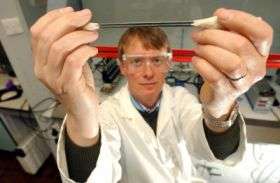
Greenhouse gas emissions from power stations could be cut to almost zero by controlling the combustion process with tiny tubes made from an advanced ceramic material, claim engineers today.
The material, known as LSCF, has the remarkable property of being able to filter oxygen out of the air. By burning fuel in pure oxygen, it is possible to produce a stream of almost pure carbon dioxide, which has commercial potential for reprocessing into useful chemicals.
LSCF is not a brand new material - it was originally developed for fuel cell technology - but engineers at Newcastle University in northern England, in collaboration with Imperial College London, have developed it for potential use in reducing emissions for gas-fired power stations and possibly coal and oil-fired electricity generation as well. Conventional gas-fired power stations burn methane in a stream of air, producing a mixture of nitrogen and greenhouse gases including carbon dioxide and nitrogen oxides, which are emitted into the atmosphere. Separating the gases is not practical because of the high cost and large amount of energy needed to do so.
However, the LSCF tubes would allow only the oxygen component of air to reach the methane gas, resulting in the production of almost pure carbon dioxide and steam, which can easily be separated by condensing out the steam as water.
The resulting stream of carbon dioxide could be piped to a processing plant for conversion into chemicals such as methanol, a useful industrial fuel and solvent.
The new combustion process has been developed and tested in the laboratory by Professor Ian Metcalfe, Dr Alan Thursfield and colleagues in the School of Chemical Engineering and Advanced Materials at Newcastle University, in collaboration with Dr Kang Li in the Chemical Engineering Department at Imperial College London. The research has been funded by the Engineering and Physical Sciences Research Council (EPSRC).
Details of the research and development project are published on 3 August 2007 simultaneously in two technical publications - Materials World and The Chemical Engineer. A series of research papers have also been published in academic journals as the project has developed.
The LSCF tubes look like small, stiff, drinking straws and are permeable to oxygen ions — individual atoms carrying an electrical charge. Crucially, LSCF is also resistant to corrosion or decomposition at typical power station operating temperatures of around 800C.
When air is blown around the outside of the tubes, oxygen is able to pass through the wall of the tube to the inside, where it combusts with methane gas that is being pumped through the centre of the tubes.
The oxygen-depleted air, which consists mainly of nitrogen, can be returned to the atmosphere with no harmful effects on the environment, while the carbon dioxide can be collected separately from the inside of the tubes after combustion.
An alternative would be to control the flow of air and methane so that only partial combustion took place. This would result in a flow of 'synthesis gas', a mixture of carbon monoxide and hydrogen, which can easily be converted into a variety of useful hydrocarbon chemicals.
The tubes of LSCF, which stands for Lanthanum-Strontium-Cobalt-Ferric Oxide, have been tested successfully in the laboratory and the design is attracting interest from the energy industry. The Newcastle team is now carrying out further tests on the durability of the tubes to confirm their initial findings that they could withstand the conditions inside a power station combustion chamber for a reasonable length of time.
Although it has not yet been attempted, it should be possible to assemble a power station combustion chamber from a large number of the tubes, with space between them for air to circulate.
In theory the technology could also be applied to coal and oil-fired power stations, provided that the solid and liquid fuels were first converted into gas. This operation is simple in theory but would add to the cost and complexity of running a power station.
Government statistics suggest that the UK energy industry produces over 200 million tonnes of carbon dioxide per year, which is more than one-third of the country's total carbon dioxide emissions.
Professor Metcalfe said: 'The cheapest way to dispose of waste carbon dioxide from combustion is to release it into the atmosphere. We have been doing this since humans first discovered how to make fire.'
'The technology we have developed may provide a viable alternative, although whether it is economical to introduce it will depend largely upon the carbon credit system that Governments operate in the future.'
LSCF is a relatively new material and over the past ten years or so been the subject of research in many countries, mainly into its potential use as a cathode in fuel cells.
Source: University of Newcastle upon Tyne


