Unknotting DNA clue to cancer syndrome
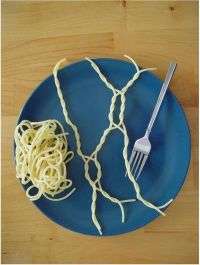
A new UC Davis study that explains the actions of a gene mutation that causes early onset cancer provides a fundamental insight into the mechanism of DNA-break repair.
People with Bloom's syndrome, a rare genetic disease, typically develop cancer in their twenties. The underlying cause is a mutation in a gene called Blm, which encodes a member of the RecQ family of DNA-unwinding enzymes, or helicases, that are involved in repairing DNA.
Neil Hunter, assistant professor of microbiology at UC Davis, and his colleagues studied the equivalent protein in yeast, SGS1. They found that when SGS1 was defective, yeast chromosomes became more promiscuous in combining with each other as they attempt to repair breaks in the DNA.
Normally, to repair broken DNA, matching chromosomes associate so that an intact chromosome can act as a template for the damaged one. The DNA strands are then exchanged to form four-way structures called Holliday junctions. To complete repair, these junctions are resolved in one of two ways: either leaving the original chromosomes intact, or exchanging the chromosome arms to form a crossover.
Both yeast and human cells contain two copies of each chromosome, one from each parent. During the cell division cycle, each chromosome gets copied, so for a while there are four of each.
Textbook models show only one end of a DNA break exchanging strands with the template chromosome, while the other end waits passively, Hunter said. But the new study clearly shows that both break ends can autonomously fish around to capture repair templates. Furthermore, when SGS1 is defective, all four matching chromosomes present can get entangled in a multichromosome Holliday junction.
"It's a lot less tidy than we thought, but with both break ends being capable of exchange the repair process will also be more efficient. The drawback is that it's also more risky," Hunter said.
Resolution of multichromosome Holliday junctions increases the risk of rearranging chromosomes, with chunks of DNA ending up in the wrong place. Such rearrangements can lead to cancer. In their normal forms, the SGS1 and Bloom's proteins keep the situation under control by separating the entangled chromosomes and preventing undesirable crossovers.
While these experiments were done in yeast, Hunter predicted that the results could be extended to human cells.
"This is a fundamental insight into the mechanism of DNA-break repair," he said.
Citation: The paper is published in the July 27 issue of the journal Cell. The other authors are Steve D. Oh, Jessica P. Lao, Patty Yi-Hwa Hwang, all graduate students at UC Davis, and Andrew F. Taylor and Gerald R. Smith at the Fred Hutchinson Cancer Research Center in Seattle.
Source: University of California - Davis


