'Trust me, I'm a physicist' – the weird world of quantum entanglement
February 3, 2006 Professor Sir Peter Knight

Declaring that it is always useful to start a lecture with a literary quote, Professor Sir Peter Knight began his on quantum entanglement with the statement: "Let's just say we want to avoid any Imperial entanglements."

After identifying his inspiration as Star Wars Episode IV - A New Hope, Sir Peter, Head of the Faculty of Natural Sciences at Imperial College London, went on to explain how quantum entanglement has divided scientists and transformed our understanding of the natural world.

Its discoverer, the physicist Erwin Schrodinger, defined entanglement as the process of two systems entering into temporary physical interaction and separating after a period of mutual influence. Following this process, he said, they can no longer be described in the same way as before.

This discovery sent waves through the scientific world and in 1927 a group of physicists, including Schrodinger and Marie Curie, gathering to debate the implications. Showing recently discovered film footage of that meeting, dubbed the Solvay Conference, Sir Peter drew his audience's attention to the appearance of the attendees, and asked: "Why were they looking so grim when they left, compared to when they started?"

The cause, he explained, was the real worry caused by this new theory's introduction of randomness to quantum physics. The idea that an electron might have the free-will to choose how and when to move even drove Albert Einstein to write in a letter to fellow physicist Max Born: "In that case I would rather be a cobbler, or even an employee in a gaming-house, than a physicist."

Schrodinger's response was that it is no more possible to experiment with single particles than it is to raise ichthyosauri in the zoo. Sir Peter adds, however: "In my game, we are in the business of raising ichthyosauri - it's what we do all the time."

Quantum entanglement, he explained, is now the basis for emerging technologies such as quantum computing and encryption, already used in the City of London to securely move financial information.

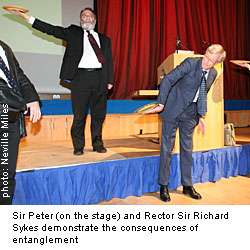
Further illustrations of the intriguing consequences of entanglement involved members of the audience including Rector Sir Richard Sykes taking part in the 'Balinese plate dance', about which Sir Peter commented: "I used to do this with 200 quantum mechanics students."

Sir Peter's lecture 'Quantum entanglement weird but useful' was delivered as Imperial's 18th annual Schrodinger lecture.

The full lecture can be viewed here (RealMedia)

Source: Imperial College London


print this article email this article download pdf blog this article bookmark this article     Stumble it Digg this share on Facebook retweet share on Reddit add to delicious
Rate this story - 4 /5 (29 votes)


February 3, 2006 all stories

Comments: 0

4 /5 (29 votes)
  • Stumble this up

  • Digg this

  • share this

  • hide
  • Related Stories

  • A 'quantum of sol' -- how nanotechnology could hold the key to a solar-powered future
    created Jun 30, 2009 | popularity not rated yet | comments 0
  • Spy researcher says once improbable Bond villains now close to real thing
    created Oct 30, 2008 | popularity not rated yet | comments 0
  • Light throws a curve ball
    created Sep 29, 2008 | popularity not rated yet | comments 0
  • Scientists reveal effects of quantum 'traffic jam' in high-temperature superconductors
    created Aug 27, 2008 | popularity not rated yet | comments 0
  • Quantum Chaos Unveiled?
    created Aug 06, 2008 | popularity not rated yet | comments 0


Other News

The LHC tunnel

Peckish bird briefly downs big atom smasher

Physics / General Physics

created 11 hours ago | popularity 3.8 / 5 (9) | comments 11

A peckish bird briefly knocked out part of the world's biggest atom smasher by causing a chain reaction with a piece of bread, the European Organisation for Nuclear Research (CERN) said Monday.


First Bose-Einstein condensation of strontium

First Bose-Einstein condensation of strontium

Physics / Quantum Physics

created 5 hours ago | popularity 5 / 5 (4) | comments 1

In an international first, scientists from the Institute of Quantum Optics and Quantum Information (IQOQI, Austria) produced a Bose-Einstein condensate of the alkaline-earth element strontium, thus narrowly ...


Ginzburg helped develop the Soviet Union's hydrogen bomb in the late 1940s and early 1950s

Russian bomb physicist Ginzburg dead at 93

Physics / General Physics

created 13 hours ago | popularity 5 / 5 (4) | comments 0

Nobel Physics prize winner Vitaly Ginzburg, who helped develop the Soviet hydrogen bomb, has died at age 93, the Russian Academy of Sciences said Monday.


Plasma-in-a-bag for sterilizing devices

Physics / General Physics

created 2 hours ago | popularity not rated yet | comments 0

The practice of sterilizing medical tools and devices helped revolutionize health care in the 19th century because it dramatically reduced infections associated with surgery. Through the years, numerous ways of sterilization ...


Stars Fueled by Dark Matter Could Hold Secrets to the Universe

Stars Fueled by Dark Matter Could Hold Secrets to the Universe

Physics / General Physics

created Nov 03, 2009 | popularity 4.5 / 5 (52) | comments 43

(PhysOrg.com) -- The first stars in the universe may have been very different from the stars we see today, yet they may hold clues to understanding some of the mysterious features of the universe. These "dark ...