Dreamy Lunar Eclipse
August 3, 2007 Dreamy Lunar Eclipse

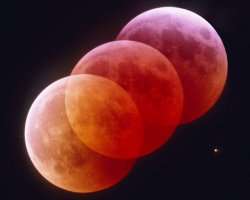
Photos of the March 3, 2007, lunar eclipse. Credit: Antonio Finazzi and Michele Festa of Lago di Garda, Italy.

Close your eyes, breath deeply, let your mind wander to a distant seashore: It's late in the day, and the western sun is sinking into the glittering waves. At your feet, damp sand reflects the twilight, while overhead, the deep blue sky fades into a cloudy mélange of sunset copper and gold, so vivid it almost takes your breath away.

A breeze touches the back of your neck, and you turn to see a pale full Moon rising into the night. Hmmm. The Moon could use a dash more color. You reach out, grab a handful of sunset, and drape the Moon with phantasmic light. Much better.

Too bad it's only a dream...

Early Tuesday morning, August 28th, the dream will come true. There's going to be a colorful lunar eclipse visible from five continents including most of North America: map.
Dreamy Lunar Eclipse
Enlarge


The event begins 54 minutes past midnight PDT (0754 UT) on August 28th when the Moon enters Earth's shadow. At first, there's little change. The outskirts of Earth's shadow are as pale as the Moon itself; an onlooker might not even realize anything is happening. But as the Moon penetrates deeper, a startling metamorphosis occurs. Around 2:52 am PDT (0952 UT), the color of the Moon changes from moondust-gray to sunset-red. This is totality, and it lasts for 90 minutes.

To understand why the change occurs, close your eyes and dream yourself all the way to the Moon. Once again, you're standing on a seashore—the Sea of Tranquillity. There's no water. You're surrounded by hundreds of miles of dusty, hardened lava. Overhead hangs Earth, nightside down, completely hiding the Sun behind it. The eclipse is underway.

With the Sun blocked, you might expect utter darkness, but no, the ground at your feet is aglow. Why? Look back up at Earth. The rim of the planet seems to be on fire. Around Earth's circumference you see every sunrise and sunset in the world—all at once. This incredible light beams into the heart of Earth's shadow, transforming the Moon into a landscape of copper moondust and golden hills.

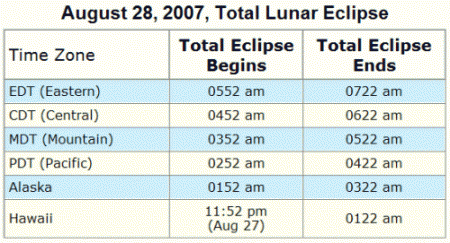
Wake up! This is really going to happen, and some planning is necessary. Start times of totality are listed in the table below. Set your alarm an hour or so in advance to gather snacks and dress warmly. (Even in August, four o'clock in the morning can be chilly.) Waking up early also allows you to catch some of the partial eclipse before totality.

The eclipse will be visible from Australia, Japan, parts of Asia and most of the Americas, but not from Africa or Europe. Pacific observers are favored. On the west coast of the United States, the entire eclipse will unfold high in the post-midnight sky. On the east coast, totality will be truncated by sunrise. That's okay; even a little eclipse can be a dream.

Source: Science@NASA, by Dr. Tony Phillips


print this article email this article download pdf blog this article bookmark this article     Stumble it Digg this share on Facebook retweet share on Reddit add to delicious
Rate this story - 3.8 /5 (5 votes)


August 3, 2007 all stories

Comments: 0

3.8 /5 (5 votes)
  • Stumble this up

  • Digg this

  • share this

  • hide
  • Related Stories

  • Detecting Life-Friendly Moons
    created Oct 26, 2009 | popularity not rated yet | comments 0
  • Groups See Sun Darken
    created Jul 30, 2009 | popularity not rated yet | comments 0
  • Images of Solar Eclipse as seen by Hinode Satellite
    created Jul 24, 2009 | popularity not rated yet | comments 0
  • Scientists capitalize on extended solar eclipse
    created Jul 22, 2009 | popularity not rated yet | comments 0
  • Full solar eclipse turns day to night in Asia
    created Jul 22, 2009 | popularity not rated yet | comments 0


  • hide
  • Relevant PhysicsForums posts

  • Some help with a X-Ray astronomy question please!
    created 18 hours ago
  • Help with Images and Optical Instrument Question..
    created Nov 26, 2009
  • Redshift as a distance indicator
    created Nov 26, 2009
  • Question about 2-body gravity
    created Nov 24, 2009
  • More from Physics Forums - General Astronomy

Other News

Fermi Telescope Peers Deep into Microquasar

Fermi Telescope Peers Deep into Microquasar (w/ Video)

Space & Earth / Astronomy

created 12 hours ago | popularity 4.5 / 5 (6) | comments 0

(PhysOrg.com) -- NASA's Fermi Gamma-ray Space Telescope has made the first unambiguous detection of high-energy gamma-rays from an enigmatic binary system known as Cygnus X-3. The system pairs a hot, massive ...


The Energy Sources of Ultraluminous Galaxies

The Energy Sources of Ultraluminous Galaxies

Space & Earth / Astronomy

created 12 hours ago | popularity 4.4 / 5 (10) | comments 1

(PhysOrg.com) -- Ultraluminous infrared galaxies ((ULIRGs) are galaxies whose luminosity exceeds that of a trillion suns; for comparison, the Milky Way galaxy has a typical (and much more modest) luminosity ...


Space shuttle Atlantis, 7 astronauts back on Earth (AP)

Space shuttle Atlantis, 7 astronauts back on Earth

Space & Earth / Space Exploration

created 13 hours ago | popularity not rated yet | comments 0

(AP) -- Space shuttle Atlantis and its seven astronauts returned to Earth with a smooth touchdown Friday to end an 11-day flight that resupplied the International Space Station.


New climate targets may not change daily life much (AP)

New climate targets may not change daily life much

Space & Earth / Environment

created 16 hours ago | popularity 3.8 / 5 (10) | comments 3

(AP) -- Americans' day-to-day lives won't change noticeably if President Barack Obama achieves his newly announced goal of slashing carbon dioxide pollution by one-sixth in the next decade, experts say.


China is set to launch its second moon orbiter next October, state media have reported

China to launch second lunar probe: state media

Space & Earth / Space Exploration

created 17 hours ago | popularity 5 / 5 (4) | comments 0

China will launch its second moon orbiter next October, state media reported Friday, as it powers ahead with a space programme that has sparked concerns abroad.