Initial trigger is not enough to determine a stem cell’s fate
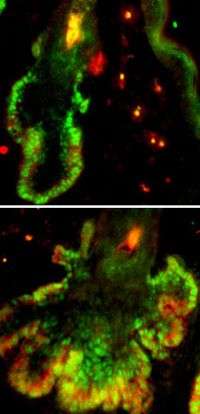
Disturbing a stem cell from its initial quiescent state was once thought to taint its gold-standard properties. However, research uncovering how a signaling pathway regulates stem cell behavior reveals that stem cells, once activated, enter a window of time during which they respond to their environment and retain their ability to alter their developmental path.
Scientists led by Elaine Fuchs at The Rockefeller University have found that the BMP, or bone morphogenetic protein, pathway needs to be turned on and off at the right time and at the right place for adult skin stem cells to become hair follicles.
“These stem cells preferentially become hair follicles, but are capable of redirecting their developmental course and becoming skin cells when needed; if epidermal skin stem cells are not around to repair a wound on the surface of the skin, these hair follicle stem cells become reprogrammed to make epidermis,” says lead author Kris Kobielak, a former postdoc in Fuchs’s lab.
At the time of this finding, Kobielak had been trying to understand the role of BMP in the development of hair cells. Since its discovery in 1965, the BMP pathway has been found to regulate cell proliferation and differentiation in many tissues, including hair follicle. But until now, researchers didn’t know how it controls stem cell behavior during the hair cycle.
In adult skin, each hair follicle contains a reservoir of stem cells called the bulge. When the bulge receives the proper signals, the stem cells begin to proliferate into progenitor cells and then differentiate into hair follicles.
The researchers found that while BMP signaling must be on to keep these cells in an undifferentiated state, it must be off for these cells to become activated and begin proliferating. BMP signaling then needs to be turned back on for these activated stem cells to differentiate into hair follicles.
When the researchers inactivated the BMP pathway using conditional inducible gene targeting in a mouse, the bulge expanded as the stem cells proliferated, but these cells couldn’t differentiate into hair follicles because the key signal they needed to progress to the next step of the cycle was lost. “This resulted in large tumor-like masses of cells that retained many markers of follicle stem cells,” says Fuchs, who is Rebecca C. Lancefield Professor and head of the Laboratory of Mammalian Cell Biology and Development at Rockefeller and an investigator at the Howard Hughes Medical Institute.
Kobielak, now an assistant professor of pathology at the Center for Stem Cell and Regenerative Medicine at the University of Southern California, and his colleagues thought that these activated stem cells would lose their ability to differentiate into other cell types and repair wounds.
But what the group found was just the opposite. When they created a skin wound deep enough to wipe out the epidermal stem cells underneath it, some of the activated stem cells migrated up through the skin, differentiated into skin cells and repaired the wound.
“This was a surprise for us because many people thought that quiescence was a fundamental feature of follicle stem cells, and that once activated, the proliferating progeny enter a lineage and become irreversibly committed,” says Fuchs. “But since the tumors persist over months, and the activated follicle stem cells can repair wounds, it suggests that follicle stem cells can retain their multipotency and become reprogrammed even after becoming activated to progress to a step where they would normally produce hair.”
The research not only has implications for understanding how stem cells can be harnessed for regenerative medicine, but may also help explain how some forms of cancer develop.
The tumors seen in Kobielak’s mice overexpress the sonic hedgehog signaling pathway, which is implicated in basal cell carcinomas. This finding suggests that this form of cancer may originate from hair follicle stem cells. “Nobody has ever looked at whether decreased BMP signaling is a feature of basal cell carcinomas,” says Fuchs. “This finding,” she says, “at least merits future exploration of this.”
Citation: Proceedings of the National Academy of Sciences 104(24): 10063-10068 (July 12, 2007)
Source: Rockefeller University


