A New Wrinkle in Thin Film Science
August 3rd, 2007 A New Wrinkle in Thin Film Science

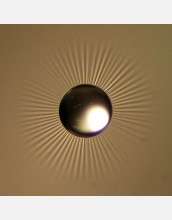
A starburst of wrinkles form in a thin film material when a drop of water is placed on the film as it floats in water. These remarklably simple experiments, done with a pool of water in a Petri dish and a low-magnification microscope, give researchers insight into whether the material properties of ultrathin films differ from their properties in bulk quantities. Credit: Jiangshui Huan, University of Massachusetts, Amerherst

Wrinkles are often considered a nuisance, but it turns out that they can reveal fundamental properties of materials, according to University of Massachusetts Amherst scientists.

The researchers have discovered that the thickness and elasticity of a thin film can be calculated by counting and measuring the wrinkles that form when a force is applied to the film. The findings, published in the Aug. 3 issue of the journal Science, shed light on how thin films behave and have implications for understanding the behavior of many materials, from membranes in water purification systems to the artificial skins used in treatment of severe burns.

Jiangshui Huang, Megan Juszkiewicz, Narayanan Menon, Wim de Jeu, Todd Emrick and Thomas Russell of UMass Amherst collaborated on the work with scientists from the Institute for Atomic and Molecular Physics in the Netherlands and the Universidad de Santiago in Chile.

When scientists consider a material’s inherent properties, basic qualities such as molecular weight, color or elemental composition come to mind. But the physics and chemistry students of tomorrow now have more to consider. With a simple and elegant experiment, the UMass Amherst team has demonstrated that the size and number of wrinkles that form when a force is applied to a thin film is directly related to the thickness and elasticity of the film, and these qualities can be readily calculated using wrinkle data.

To investigate, the researchers led by polymer scientist Thomas Russell and physicist Narayanan Menon floated ultrathin sheets, or films of polystyrene—a polymer typically used in hard plastics— in a Petri dish of water. With each polystyrene film the scientists induced wrinkles, either by adding a drop of water or a solid disc to the center of the film, or poking it with a sharp point. The scientists then counted the number and length of the wrinkles radiating out from the center, and recorded the wrinkling with a digital camera.

As the scientists prodded and poked the floating films, which ranged in thickness from 31 to 233 nanometers, they noted several consistencies. When they added water to the droplet at the film’s center, increasing the weight on the film, the wrinkles were longer and there were more of them. When they added the same amount of water to a thicker piece of film, the wrinkles were again longer, but there were fewer than with the thin film.

By scaling the relationships they observed between the number of wrinkles, the length of the wrinkles and the thickness and elasticity of the film, the researchers came up with some simple equations for determining a film’s elasticity and thickness by counting and measuring its wrinkles. Because they floated their films on water, their data were free of confounding forces made by the tacks or pins often used in wrinkling experiments to hold the films firmly in place.

“As we venture into the age of nanotechnology, it becomes increasingly important to know if the material properties of ultrathin films differ from their properties in bulk,” says Russell.

To further test their proposed relationship between wrinkles and elasticity, the team experimented with polystyrene sheets that were modified to various degrees with a plasticizer. The relationship held up and the team was able to calculate each film’s elasticity. With only a low-magnification microscope and a dish of water, the scientists were able to calculate the elasticity of the films with as much precision as the more expensive, equipment-heavy and time-consuming methods that are currently in use.

“These experiments give us a simple, inexpensive way to access the properties of such nanoscopically thin films that can be several tens of nanometers thick,” says Menon.

The work is “very simple and very fundamental,” says Todd Emrick, a member of the research team. “Yet it has implications the materials community will find very interesting. Polymer films are used worldwide under conditions where they withstand force and respond to it—understanding this response is key to improving materials that span a broad range of applications from biomedical to cosmetic, and many others.”

Source: NSF


print this article email this article download pdf blog this article bookmark this article     Digg this Stumble it share on Facebook share on Reddit add to delicious save to Yahoo! bookmarks
4.2/5 after 13 votes


August 3rd, 2007 all stories
Nanotechnology / Nanophysics

Comments: 0
Rank: 4.2/5 after 13 votes

  • Stumble this up

  • Digg this

  • Share it:
  • share on Facebook
  • share on MySpace
  • share on Slashdot
  • rss-newsfeed
  • share on Google
  • share on Reddit
  • add to delicious
  • save to Yahoo! bookmarks
  • share on Windows Live
  • Add to Mixx!
Rating: 4.2/5 after 13 votes


Tags


  • Physicists Demonstrate Quantum Memory with Matter Qubits
    Physicists Demonstrate Quantum Memory with Matter Qubits
    Physics / General Physics
    created Jul 03, 2009 | popularity 4.4 / 5 (17) | comments 1
  • 'Holey' Nanosheets for Wastewater Dye Removal
    Nanotechnology / Nanomaterials
    created Jul 01, 2009 | popularity 5 / 5 (5) | comments 1
  • Jellyfish Robot Swims Like its Biological Counterpart
    Jellyfish Robot Swims Like its Biological Counterpart
    Electronics / Robotics
    created Jun 26, 2009 | popularity 4.4 / 5 (8) | comments 1
  • Could Maxwell's Demon Exist in Nanoscale Systems?
    Could Maxwell's Demon Exist in Nanoscale Systems?
    Physics / General Physics
    created Jun 24, 2009 | popularity 4.4 / 5 (18) | comments 29
  • Living Safely with Robots, Beyond Asimov's Laws
    Living Safely with Robots, Beyond Asimov's Laws
    Electronics / Robotics
    created Jun 22, 2009 | popularity 4.6 / 5 (52) | comments 40
  • Other News

    A 'quantum of sol' -- how nanotechnology could hold the key to a solar-powered future

    A 'quantum of sol' -- how nanotechnology could hold the key to a solar-powered future

    Nanotechnology / Nanomaterials

    created Jun 30, 2009 | popularity 3.9 / 5 (15) | comments 17

    (PhysOrg.com) -- A new generation of 'nano-structured' millimetre-sized solar cells that could convert the sun's energy to electricity more than twice as efficiently as current technology, is the subject of ...


    Australian researchers are set to begin human trials of a tiny nano-cell that acts as a "Trojan horse" against cancer

    Hi-tech 'Trojan horse' can kill cancer cells: researchers

    Nanotechnology / Bio & Medicine

    created Jun 29, 2009 | popularity 4.7 / 5 (12) | comments 7

    Australian researchers are set to begin human trials of a tiny nano-cell that acts as a "Trojan horse" against cancer cells, a breakthrough they say may curb the need for debilitating chemotherapy.


    'Holey' Nanosheets for Wastewater Dye Removal

    Nanotechnology / Nanomaterials

    created Jul 01, 2009 | popularity 5 / 5 (5) | comments 1

    (PhysOrg.com) -- Researchers have discovered that extremely thin sheets of nickel oxide with hexagonally shaped holes can absorb hazardous dyes from wastewater nearly as well as the best traditional methods, but are recyclable. ...


    Harnessing Nanoparticles To Track Cancer Cell Changes

    Nanotechnology / Bio & Medicine

    created Jul 03, 2009 | popularity not rated yet | comments 1

    The more dots there are, the more accurate a picture you get when you connect them. Cancer researchers adopting that philosophy have developed a new imaging technology that could give scientists the ability to simultaneously ...


    Computer-Guided Nanoparticle Therapy Destroys Tumors

    Nanotechnology / Bio & Medicine

    created Jun 29, 2009 | popularity 4.9 / 5 (12) | comments 0

    Gold nanoshells are among the most promising new nanoscale therapeutics being developed to kill tumors, acting as antennas that turn light energy into heat that cooks cancer to death. Now, a multi-institutional research team ...